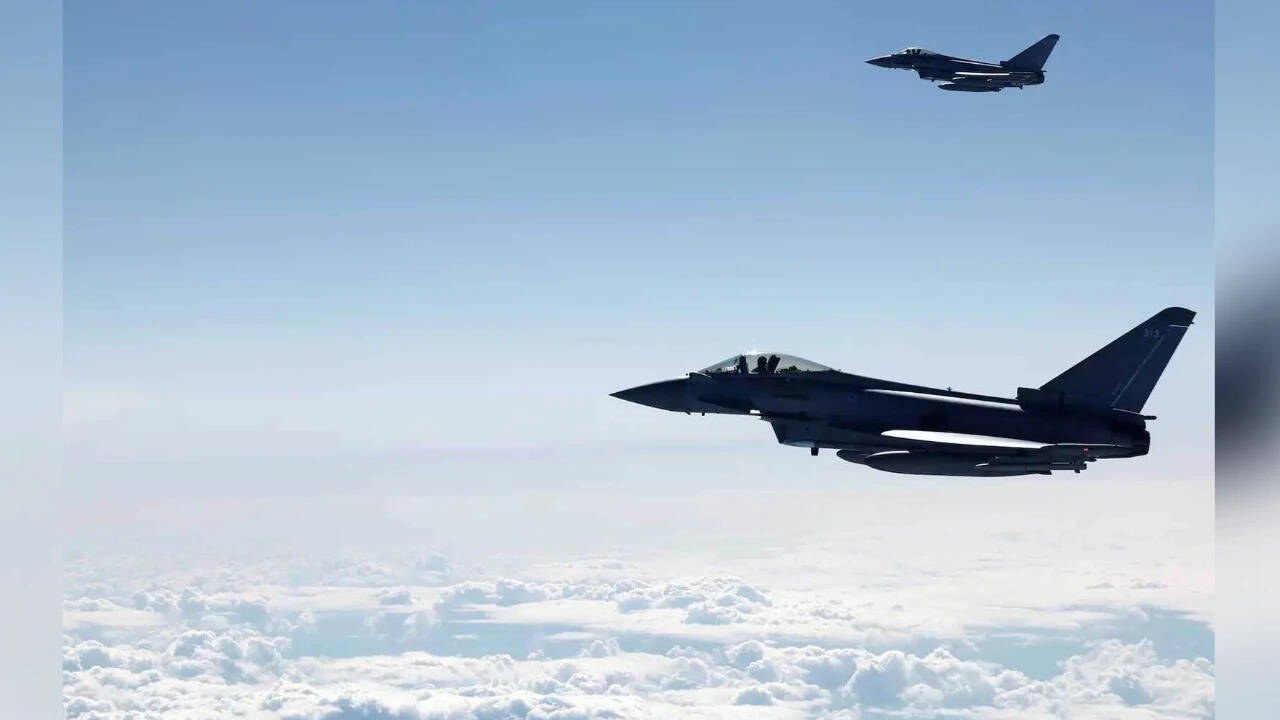
The desert sky over the Persian Gulf is rarely just empty blue. In the brittle glare of early March, when the regional war ignited with sudden, blinding fury, that sky became a chessboard of fire and panic. Two Iranian Sukhoi Su-24 bombers roared south, cutting low over the water toward the sprawling concrete expanse of Al Udeid Air Base, the massive American military installation anchoring the Qatari desert.
Seconds counted. Decisions were measured in heartbeats.
When those aircraft crossed into restricted Qatari airspace, radar screens flashed amber, then sharp, unforgiving red. Qatari authorities attempted to establish radio contact, broadcasting warnings into the static. There was no answer. Bound by strict rules of engagement and the sovereign necessity to defend its borders, a Qatari F-15 scrambled, intercepted, and delivered the definitive response. The jets plunged from the sky, breaking apart over land and water.
That much is historical record. But war leaves behind a shadow heavier than metal debris, and six months later, that shadow has materialized as a diplomatic storm.
Imagine sitting in a quiet room in Tehran, staring at a calendar that has ticked off six agonizing months. To the families of Javad Salehi, Abdol-Majid Dashtian, and Emran Behrushian, the war did not end with a ceasefire or a diplomatic communiqué. It froze in a state of agonizing ambiguity.
Public statements from Iranian military officials, led by General Mohammad Bagherzadeh of the General Staff of the Armed Forces, pierced the fragile quiet with a startling assertion. Tehran claimed that these three pilots did not perish in the fiery descent. Instead, they ejected, survived, and were captured alive by Qatari forces, languishing in secret detention ever since. The narrative presented to the International Committee of the Red Cross was one of hidden men, cut off from communication, denied contact with loved ones or consular officials.
It was a claim designed to evoke immediate outrage. It was also, according to Doha, entirely fiction.
The response from the Qatari Foreign Ministry was swift and unyielding. Majed Mohammed Al-Ansari, the official spokesperson, took to public platforms to issue a categorical denial. The accusation was labeled not just incorrect, but deliberately misleading, deployed at a perilously sensitive juncture when fragile regional efforts to de-escalate tensions were struggling to take root.
Doha’s version of events paints a starkly different picture of the immediate aftermath. According to Qatari authorities, search and rescue teams deployed into the zone with elite efficiency once the smoke cleared. They were looking for survivors. What they found instead was the grim reality of high-altitude interception.
Qatar maintains that it recovered the remains of only one pilot from that fateful mission, an airman whose body was subsequently handled through diplomatic coordination channels for repatriation. Furthermore, Qatari officials emphasize that back in April, as the dust of the initial conflict began to settle, an open invitation was extended to an Iranian technical team. They were invited to visit Doha, inspect the operational logs, and examine the exact details of the search and rescue missions to clear any lingering doubts.
That invitation, Doha states, met only silence from Tehran. Months passed, and instead of a technical dialogue, the world received a public political salvo.
Why revive the ghost of a March skirmish now?
The timing is rarely accidental in the geopolitics of the Gulf. As regional capitals attempt to stitch together a durable framework after months of devastating strikes and counter-strikes, pressure points are constantly tested. Allegations of secret detentions serve a purpose, acting as diplomatic leverage or domestic theater when broader peace talks stall.
Yet, beneath the strategic posturing lie human tragedies. Somewhere between the official denials and the impassioned appeals, the families of missing aviators remain suspended in a permanent state of not knowing.
The radar tracks have faded. The wreckage has been cleared from the sand. But the war of words over who fell and who was captured demonstrates that in modern conflicts, the hardest thing to recover isn't a downed aircraft, but the simple, unvarnished truth.


