The sea at midnight off the coast of Bandar Mahshahr smells of sulfur, saltwater, and the sweet, heavy rot of unrefined crude. Captain Reza knows every centimeter of this water, not because he studies maritime charts with a scholar's precision, but because he has navigated these black waves for twenty years with his transponder switched off.
To the rest of the world, Reza does not exist. His ship, a rust-streaked tanker built during a different century, does not exist either. On modern satellite tracking maps, his vessel is a ghost, a phantom blip erased by a manual flick of a switch in the cramped, salt-stained bridge. Above him, high in the stratosphere, American surveillance satellites stare down at the Persian Gulf, hunting for signatures of illicit trade. Thousands of miles away in Washington, economic strategists adjust their digital dashboards, convinced that a wall of maximum pressure has successfully sealed the valves of the Iranian state.
They are wrong.
History teaches us a stubborn lesson about walls: the taller you build them, the more valuable the ladder becomes. When the architecture of global finance is weaponized into an economic blockade, it does not destroy commerce; it simply drives it into the dark.
Consider what happens when you tell a nation holding the world's fourth-largest oil reserves that it is no longer allowed to sell its lifeblood. Does the oil stop bubbling up from the ancient earth beneath Khuzestan? Does the machinery in the refineries quietly grind to a halt out of respect for international sanctions?
No. The pressure simply shifts.
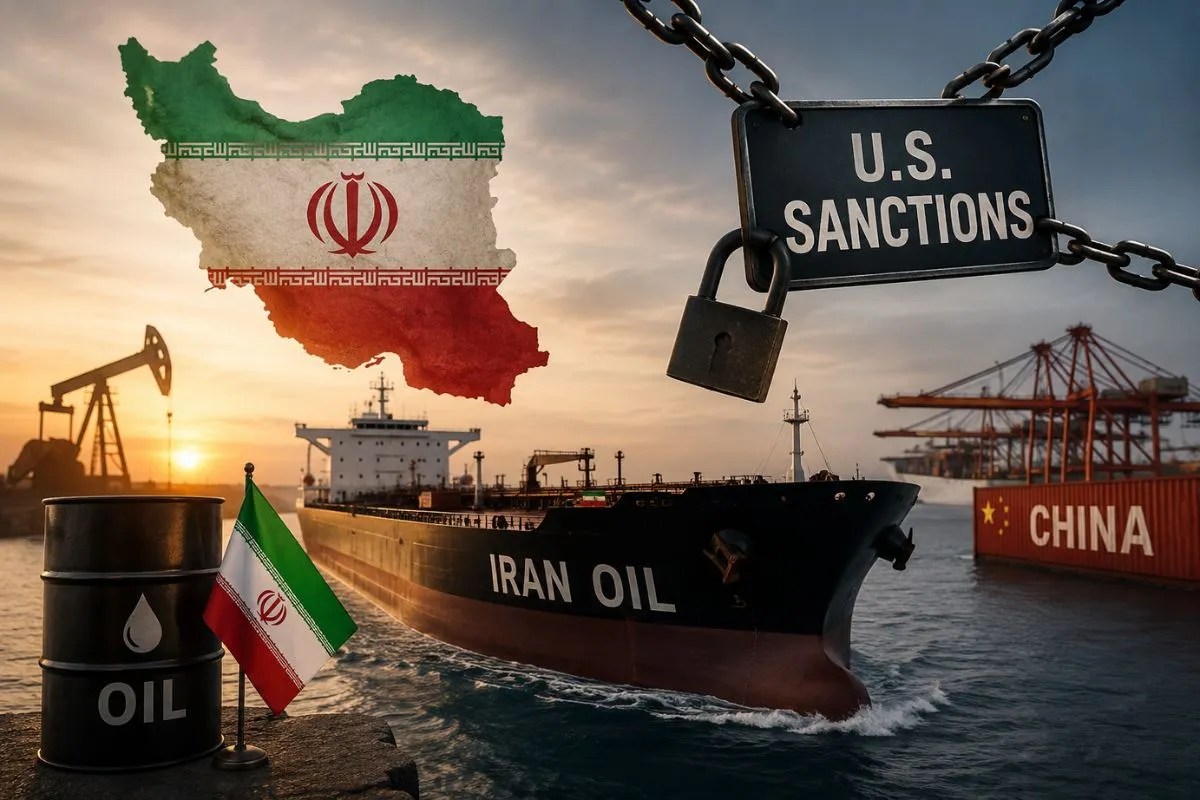
For years, the United States has enforced a relentless campaign of economic strangulation against Iran, aiming to reduce its crude exports to absolute zero. The strategy is straightforward on paper. Threaten secondary sanctions against any port, any bank, and any refinery bold enough to touch Iranian hydrocarbons. Freeze out financial institutions from the SWIFT messaging system. Choke the supply lines until the regime buckles.
Yet, step down onto the piers of Southeast Asia or the hidden blending yards of the Malacca Strait, and you will see a very different reality. The oil moves. It flows through a labyrinth of shadows, defying the most sophisticated naval patrols on earth.
How does it happen? Follow the crude.
It begins in the dead of night, where tankers load up at Iranian terminals while riding low in the water. Once away from the coast, the first layer of deception occurs. This is ship-to-ship transfer, an operation carried out in choppy international waters far from the gaze of coast guards. Imagine two massive steel leviathans, each longer than three football fields, locked together in a violent embrace on the open sea. Heavy hoses snake across the foaming gap between them. Millions of barrels of Iranian crude are pumped from the sanctioned ghost ship into a vessel flying a flag of convenience—perhaps from a small landlocked nation with no coastline to speak of, or a registry known for asking very few questions.
As a hypothetical scenario, picture a tanker named the Pacific Horizon. When it left the Persian Gulf, its papers read like a work of fiction. By the time it drifts near the waters of Southeast Asia, it has undergone a metamorphosis. Its name has been painted over with new letters. Its registration documents, bought through a chain of shell companies stretching from the Marshall Islands to Dubai, declare its cargo as heavy fuel oil originating from Iraq or Oman.
Paperwork is easily altered. Oil, once mixed, loses its passport entirely.
When Iranian crude is blended with oil from other nations in vast storage tanks across Asia, its molecular origin dissolves into a statistical blur. Refineries hungry for discounted feedstock care very little about geopolitical friction when profit margins are wide enough to absorb the risk. To a hungry industrial machine, a barrel of cheap oil is simply fuel.
The financial plumbing follows the same underground currents. Traditional banks are terrified of the US Treasury Department's Office of Foreign Assets Control, and for good reason. A single violation can lock a multi-national bank out of the US dollar clearing system overnight. So, the transactions bypass Western currency altogether. Deals are struck in alternative currencies, through small regional banks willing to absorb the friction, or settled via sophisticated barter systems and cryptocurrency networks that leave no trace on Wall Street ledgers.
It is a multi-billion-dollar game of cat and mouse, played out on a global scale.
The human cost of this subterranean trade is rarely captured in quarterly economic reports. It is felt in the strained eyes of sailors who spend months at sea without touching port, terrified of port authorities who might impound their vessels. It is felt in the quiet desperation of ordinary families in Tehran, who watch the value of their savings evaporate while macro-economists debate the elasticity of energy markets.
Sanctions were designed to target governments, but their ripples touch everyone. They create an ecosystem where middlemen thrive, where corruption becomes an institutional survival skill, and where the black market evolves from a fringe economy into the main engine of survival.
When you squeeze a balloon in one place, the air simply bulges out somewhere else. By cutting official channels, the architects of maximum pressure inadvertently birthed the most resilient shadow fleet the maritime world has ever seen. Hundreds of aging tankers now cruise the oceans under false flags, their insurance policies underwritten by obscure local syndicates, their captains navigating by instinct and encrypted radio signals.
They are the physical embodiment of a profound geopolitical truth. Commerce abhors a vacuum just as nature does. Where there is a desperate seller and a willing buyer, human ingenuity will carve a channel through any blockade, no matter how formidable the steel or how sharp the laws.
Captain Reza looks out over the dark expanse of the sea, watching the faint lights of a distant horizon. He adjusts his course, cutting through the swells toward a rendezvous point that exists on no official map. Behind him, deep in the dark belly of his ship, millions of gallons of black gold surge silently against the steel, refusing to be stopped.