Dust cakes the back of your throat long before you see them. It is the kind of fine, red earth that clings to sweat and turns your skin into leather by noon. Out here, on the edges of the Kenyan savanna, silence is rarely quiet. It hums with the dry rattle of acacia pods and the distant, low thrum of cicadas. But beneath those sounds, something heavier vibrates through the soles of your boots.
Footsteps. Massive ones. You might also find this related coverage insightful: Who Gets To Claim The American Promise.
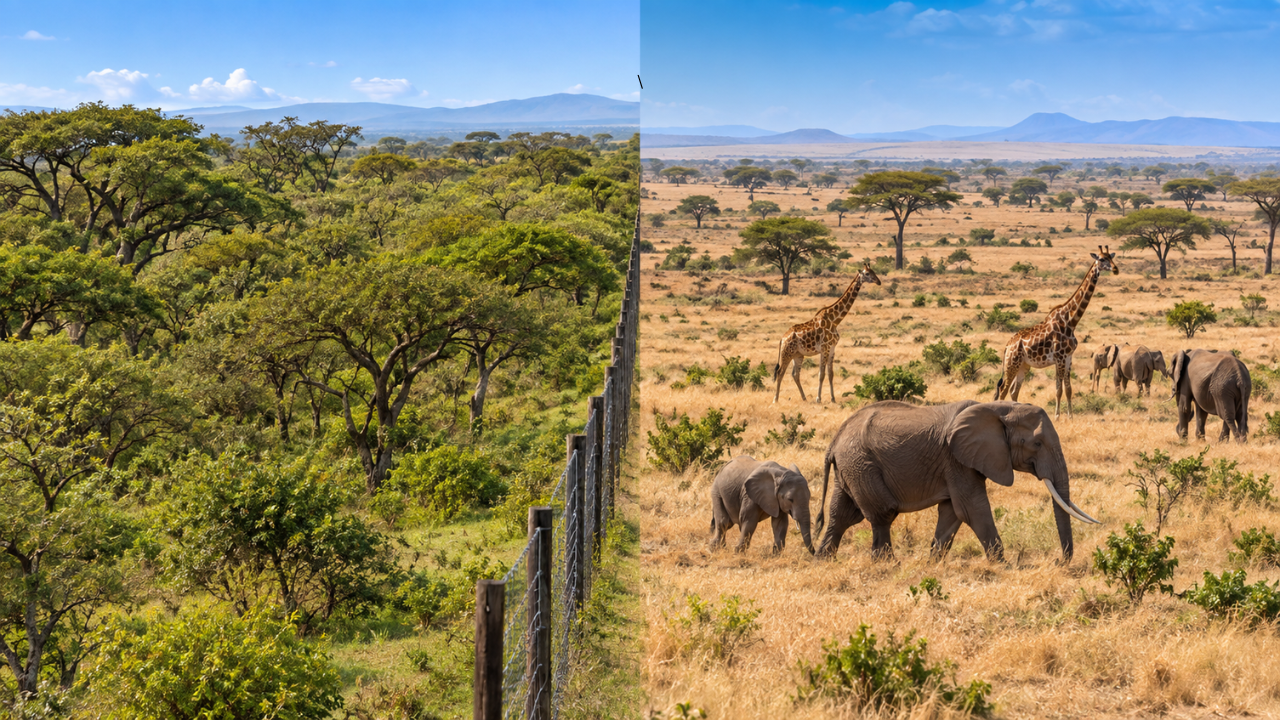
For nearly two decades, this particular stretch of land was locked away behind fences and administrative caution. An eighteen-year exclusion. No elephants. No giraffes. Just a fenced-in laboratory where scientists could watch what happens when you take the architects of the wild and pull them out of the room. Without the giants, the land exhaled and stretched upward. Bushes thickened. Saplings rushed toward the equatorial sun without fear. Within a few years, a landscape that had historically been open grassland began to choke on its own unchecked ambition, turning into dense, woody thickets.
People assumed it was healing. More trees, after all, must mean a healthier world. We are conditioned to equate green with goodness, as if nature is a savings account where hoarding canopy cover is the only way to build wealth. As discussed in latest coverage by Al Jazeera, the implications are worth noting.
Then the gates opened.
Consider what happens when you invite the bulldozers of flesh and bone back into a room they built.
An African elephant does not merely walk through a landscape; it edits it. Picture a creature standing three meters tall at the shoulder, weighing as much as a loaded delivery truck, driven by an ancient, insatiable hunger for bark, roots, and tender upper branches. When they returned to this fenced sanctuary, they did not arrive as polite guests. They arrived as a force of ecological punctuation.
Within months, the dense woody vegetation began to fracture. Trees were stripped, pushed over, snapped clean at the waist like matchsticks. Giraffes, stretching their dark, blue-black tongues high into the canopy, methodically pruned the upper foliage, keeping the taller acacias shaped like giant, flat-topped umbrellas. The tall, crowding trees that had dominated the skyline during the eighteen-year hiatus suddenly found themselves under siege. Tree cover plummeted. The green walls began to crumble.
To an untrained eye passing by in a Land Cruiser, it looked like devastation. It looked like destruction.
It was actually restoration.
We make the mistake of viewing nature as a fragile painting that needs to be hung on a wall and left untouched. We think protection means putting a glass case over the ecosystem. But the savanna is not a museum piece. It is an argument—a violent, beautiful, dynamic negotiation between animals and plants that has been argued for millions of years.
For generations, pastoralists and conservationists have watched this dance with a mixture of anxiety and awe. The data gathered after the giants returned confirmed what intuition whispered: tree cover didn't just fall; it fell because it had to. When elephants and giraffes suppress woody plants, they keep the savanna open. They prevent the encroachment of thickets that would otherwise choke out the grasses. And grass is the lifeblood of everything else. Zebras, wildebeests, gazelles, and the predators that hunt them cannot run, hide, or graze effectively in a dense forest. By breaking the trees, the elephants ensure the survival of the plains.
Strip away the academic papers and the satellite imagery, and you are left with a simple, humbling truth. Sometimes, to save a habitat, you have to watch things get broken.
I remember standing near a salt lick in Tsavo years ago, watching a bull elephant systematically dismantle a mature acacia that had blocked his line of sight. It was deliberate work. He wedged his tusks beneath the roots, leaned his massive, wrinkled forehead forward, and pushed. The wood groaned—a sharp, wet sound that echoed across the dry pan. The tree toppled. Dust billowed. And instantly, a dozen hornbills darted out of the falling branches to inspect the freshly exposed soil, while a family of warthogs trotted over to investigate the overturned roots.
Death for the tree was dinner for the soil, a pathway for the sun, a line of sight for a lioness hiding in the grass two hundred yards away.
That is the paradox of the wild. Every act of creation is tied to a small, calculated act of demolition. When we locked the gates eighteen years ago, we tried to freeze time. We tried to create a version of nature that was tidy, predictable, and devoid of conflict. We wanted the majesty of the animals without the mess of their appetites. But nature refuses to be curated.
The falling tree cover in Kenya is not a failure of conservation. It is the sound of the ecosystem remembering who it is. As the red dust settles behind the departing herds, leaving broken branches and scarred trunks in their wake, the grass underneath begins to catch the unfiltered light of the African sun, green and sharp and waiting for the rain.