Cold.
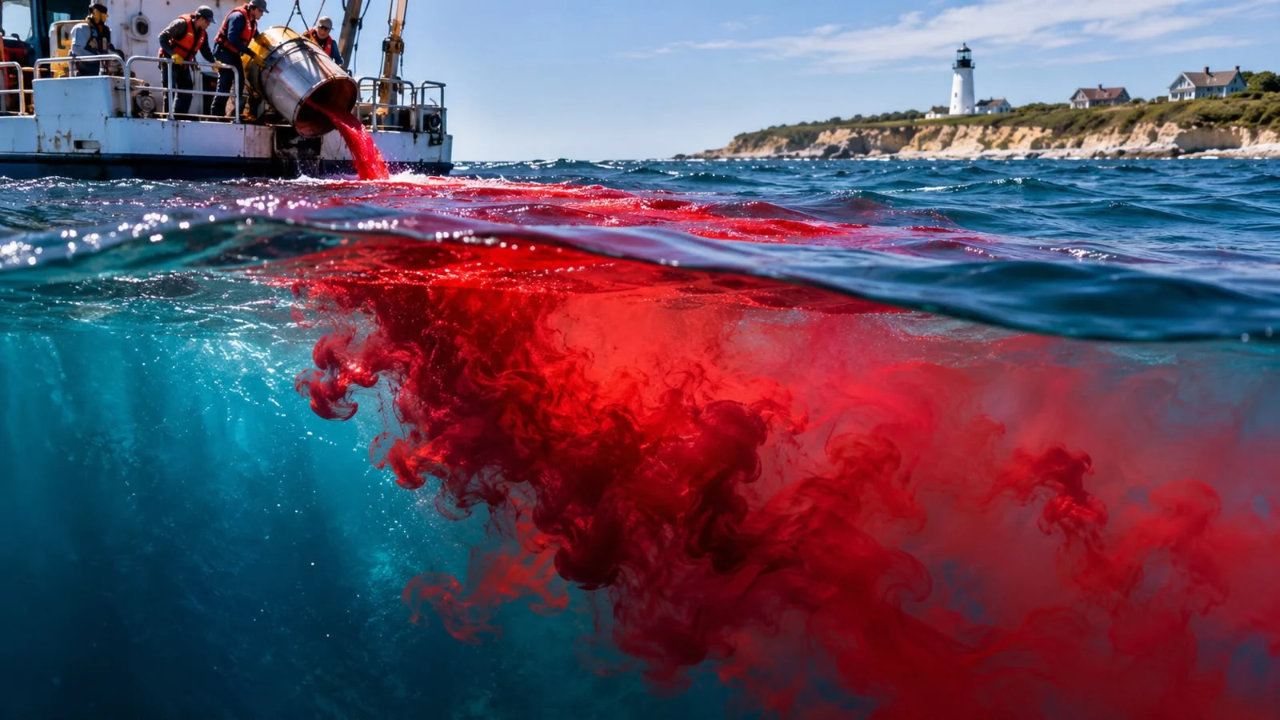
That is the first thing you notice when you lean over the steel railing of a research vessel at three in the morning in the middle of the North Atlantic, watching a hose pump fluorescent pink dye into the black water. The air bites at your knuckles. The diesel engines thrum through the soles of your boots, a low mechanical heartbeat keeping twenty-five exhausted scientists upright against a rolling swell. Building on this idea, you can find more in: Inside the Unverified Claims of a Melania Trump Truce in Oleshky.
You are staring at a patch of sea that looks entirely unified. One endless, churning expanse of dark indigo. To the human eye, water is just water. You drop a stone, it sinks. You pour cream into coffee, and with a single flick of a spoon, the two fluids swirl together into a uniform tan. We carry that kitchen-table intuition out onto the open ocean, assuming that wind, waves, and gravity constantly stir the sea like a giant pot on a stove.
We got the ocean completely backward. Observers at The New York Times have also weighed in on this matter.
Beneath that restless surface, the sea is not a single mixing bowl. It is a towering stack of invisible, glass-like shelves. And a landmark dye-release experiment—tracking fluorescent tracers injected directly into the ocean interior—has just mapped how stubbornly those shelves refuse to let anything pass through them.
The Invisible Architecture of the Deep
To understand what the oceanographers found, picture a hypothetical coastal town—let us call it Harborview—where every summer, the fishermen notice the surface water turning bathwater warm while the lobsters in their traps sixty feet down remain in near-freezing brine. If you were to dive straight down off Harborview's pier, you wouldn't feel a gradual cooling. You would hit a wall.
Scientists call this layered structure stratification, and the sharpest boundary between warm, light surface water and cold, dense deep water is the pycnocline. Think of it as an invisible ceiling made not of concrete, but of density differences—tiny variations in temperature and salt content that make water layers slide past one another like oiled panes of glass rather than blending together.
For decades, climate models relied on a comfortable assumption: that internal waves breaking beneath the surface generate enough turbulence to punch through these density barriers, steadily carrying heat, oxygen, and carbon downward into the abyss. Without that downward transport, the deep ocean cannot act as the planet's long-term storage vault.
So a team of physical oceanographers decided to stop guessing and actually watch the water move. They released a harmless, traceable dye—fluorescein or rhodamine, glowing bright green or magenta under specialized sensors—at a precise depth inside a stratified layer, then towed ultra-sensitive fluorometers back and forth through the dark for days, mapping every millimeter of the plume's journey.
What they saw defied the textbooks.
Instead of billowing downward in chaotic clouds, the dye flattened. It stretched out horizontally for kilometers into a razor-thin pancake, barely a few meters thick, trapped between two density layers as if pressed between sheets of acrylic.
Why a Pancake of Dye Should Keep You Awake at Night
I spent three seasons working alongside marine field crews off the continental shelf, and I still remember the first time I watched a conductivity-temperature-depth profiler plot real-time data on a dimly lit cabin screen. The line dropped straight down, steady and predictable, until at eighty meters it suddenly snapped sideways like a broken bone. Above the line sat water teeming with sunlit plankton; below it lay a dark, silent world starved of fresh air.
Standing in that cramped lab, smelling stale coffee and wet neoprene, you realize how fragile the planet's breathing apparatus actually is.
The ocean absorbs roughly ninety percent of the excess heat trapped by greenhouse gases and about a quarter of the carbon dioxide we pump into the atmosphere. That sounds reassuring until you ask a simple question: Where does it go?
If the ocean mixes freely from top to bottom, that heat and carbon get diluted across thousands of meters of cold abyssal water, buying coastal cities and marine ecosystems decades of breathing room. But the dye experiment reveals a stark physical bottleneck. Because the layered structure limits vertical exchange, downward transport happens at a crawl—orders of magnitude slower than horizontal spreading.
Consider what happens next when the surface ocean warms faster than the deep:
- The lid tightens. Warmer surface water becomes even lighter and more buoyant. The density gap between the top layer and the cold water beneath widens, turning that invisible glass ceiling into reinforced steel.
- Oxygen gets locked out. Deep-sea creatures rely on surface water sinking to bring down dissolved oxygen. When stratification blocks that elevator, vast "oxygen minimum zones" expand upward, suffocating fisheries from the bottom up.
- Nutrients stay trapped below. Microscopic phytoplankton at the surface need nitrates and phosphates from the deep to grow. Cut off the vertical supply line, and the base of the marine food web begins to starve.
It is a feedback loop written in basic fluid mechanics. You cannot argue with buoyancy.
Inside the Hunt for a Ghost Plume
Tracking a dye patch in the open ocean is less like a sterile laboratory test and more like trying to follow a single drop of ink spilled into a darkened Olympic swimming pool while riding a bucking bronco.
Let us imagine a lead researcher—call her Dr. Elena Vance—standing at the ship's stern console during hour thirty-six of a tracking run. She hasn't slept more than ninety minutes at a stretch. The ship is towing a winged sensor sled on an armored cable two hundred meters below the hull, flying it up and down in a sawtooth pattern through the water column.
On her monitor, the dye appears as a ghostly spike on a graph. If the captain turns two degrees too wide, they lose the patch in the vastness of the sea. If they tow too fast, the cable vibrates and ruins the turbulence measurements.
"There," Elena whispers, tapping the screen as the fluorometer registers a faint concentration—parts per trillion, the equivalent of dissolving a single sugar cube into a hundred Olympic pools.
The data streaming up that cable tells a story of extreme anisotropy, a technical word for a simple reality: the ocean moves sideways effortlessly, and vertically almost not at all. Currents shear the dye into long, ribbon-like filaments stretching across miles of ocean, while internal waves ripple through the layers like wind moving across a wheat field. Yet when those waves pass, the water particles simply bob up and down and settle right back onto their original density shelf. No mixing occurs. The dye stays imprisoned in its thin horizontal sheet, drifting sideways into oblivion rather than descending into the deep.
I used to think turbulence was violent and obvious—whitecaps crashing over a bow, swirling eddies behind a bridge piling. Watching those vertical mixing profiles taught me how wrong that instinct is. Down in the interior ocean, turbulence happens in brief, intermittent spasms, like tiny sparks flickering in a damp room before dying out. Most of the time, the layered structure wins.
The Question Everyone Asks When the Data Comes Back
Whenever these findings surface outside oceanography conferences, the first reaction is usually disbelief. If the ocean barely mixes vertically, how does deep water ever form at all?
The answer lies at the edges of the map.
While the vast interior of the oceans behaves like a tightly stacked layer cake, vertical exchange happens violently in a few specific places: near the poles, where freezing winds chill salty surface water until it becomes heavy enough to plunge straight to the seafloor, and over jagged underwater mountain ranges, where deep tidal currents slam into rock faces and churn the layers together like an eggbeater.
Away from those localized mixing hotspots, however, the open ocean is remarkably stratified. The dye experiment proved that we cannot rely on gentle, widespread background mixing to quietly absorb our excess heat at the surface and whisk it away into the deep. Instead, heat piles up in the top few hundred meters—precisely where hurricanes draw their fuel, where coral reefs bleach, and where commercial fish stocks live and spawn.
To be honest, there is still plenty that keeps physical oceanographers awake at night. Measuring vertical diffusivity at millimeter scales across an ocean basin covering seventy percent of the Earth is extraordinarily hard. A single storm, a passing warm-core eddy, or a subtle shift in wind stress can temporarily punch a hole through a density barrier that held firm for months. Nobody claims the ocean's layers are completely sealed forever.
Yet the trend line is unmistakable. Across every major ocean basin, the upper layer is growing warmer, lighter, and more stubbornly separated from the cold abyss beneath it.
Standing on the Deck at Dawn
By six in the morning, the North Atlantic sky begins to bruise into violet and pale gray. The wind drops just enough for the spray to stop stinging your face. Behind the ship's wake, the fluorescent dye is long gone from sight, swallowed by the dark water thirty meters down—invisible to satellites, invisible to passing cargo ships, invisible to the coastal towns whose weather and livelihoods depend on what happens inside that hidden boundary.
Somewhere beneath the hull, that razor-thin sheet of magenta tracer is still sliding sideways through the pitch black, pressed flat against an invisible ceiling of cold, heavy water that refuses to let it pass.


