The morning in Quibdó didn’t start with a bang. It started with the smell of scorched coffee and the humid, heavy air that clings to the Chocó region like a wet wool blanket. Life here moves to a specific rhythm—the rhythmic scraping of brooms against pavement, the distant call of fruit vendors, and the low hum of a town trying to exist in the crosshairs of a conflict that the rest of the world often chooses to forget.
Then the world ripped open. Meanwhile, you can explore other developments here: The Myth of Perpetual Conflict and Why Iran’s Rhetoric is a Calculated Distraction.
When a bomb detonates in a crowded urban center, the sound isn't the first thing that hits you. It’s the pressure. It is a physical wall of displaced air that slams into the lungs, stealing the breath before the ears even register the roar. In an instant, the mundane reality of a Tuesday morning was replaced by a jagged, terrifying new architecture of smoke and screaming.
The count is no longer just a statistic. It is a ledger of shattered lives. Nineteen people who woke up, tied their shoes, and kissed their families goodbye are not coming home. Thirty-eight others are currently lying in hospital beds, some wondering if they will ever walk again, others staring at the ceiling in a silence so profound it feels like drowning. To see the full picture, check out the detailed analysis by BBC News.
The Anatomy of a Number
We see the headline: 19 dead, 38 wounded. We process it for three seconds and then we scroll. But a number is a poor vessel for the truth.
Nineteen deaths means nineteen empty chairs at dinner tables tonight. It means nineteen sets of keys that will never turn in a lock again. It means a network of hundreds of grieving relatives, friends, and coworkers whose mental maps of the world have just been irrevocably altered. When we talk about the "toll" of an attack in Colombia, we aren't just talking about bodies. We are talking about the systematic erosion of hope in a community that has already given more than its fair share to the altar of violence.
Consider a hypothetical woman named Elena. She wasn't a politician. She wasn't a soldier. She was standing near a storefront, perhaps checking the price of rice, when the device—hidden in a package that looked like any other—transformed from an object into an executioner. In the dry reports, Elena is a "casualty." In reality, she was the person who knew exactly how her grandson liked his eggs, the person who kept the local community garden from being overrun by weeds, and the person whose laughter was the loudest thing on her block.
When Elena dies, the garden dies. The grandson loses his North Star. The block gets a little quieter, a little colder. Multiply that by nineteen, and you begin to understand the actual scale of the disaster.
The Invisible Stakes of the Chocó
The Chocó department is one of the most beautiful places on Earth, a lush corridor of biodiversity tucked between the Andes and the Pacific. It is also one of the poorest. This isn't a coincidence. Violence thrives where the state is thin.
In the aftermath of the explosion, the air smells of cordite and irony. For years, the narrative surrounding Colombia has been one of "post-conflict" healing and peace accords. But for the people of Quibdó, "peace" is often just a word used by people in Bogota who don't have to worry about whether a motorcycle idling too long outside their shop is a customer or a threat.
The real tragedy of this bombing isn't just the immediate carnage. It’s the "after-shutter." It’s the way the local economy freezes because people are too afraid to go to the market. It’s the way parents keep their children home from school, fearing the next shadow. The invisible stakes are the death of public life. Every bomb dropped in a street like this is an attempt to turn a community into a collection of isolated, terrified individuals.
The Logistics of Terror
This wasn't a random act of God. It was a calculated delivery of misery.
Preliminary investigations point toward the shifting tectonic plates of illegal armed groups—dissidents of the FARC, the ELN, or the Clan del Golfo—fighting over the gold mines and drug routes that crisscross this jungle-choked province. To these groups, 19 dead civilians are not people; they are "messages." They are tokens used in a high-stakes game of territorial dominance.
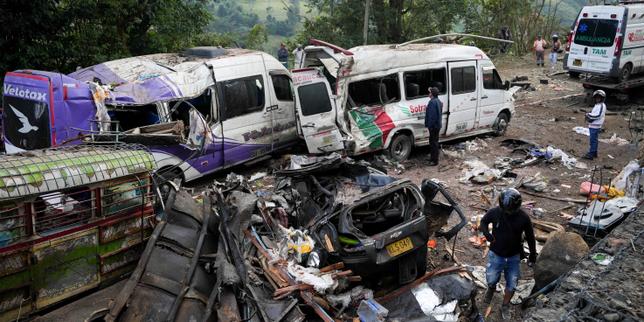
The debris on the ground tells a story of cheap materials used for expensive pain. Shrapnel, nails, and industrial-grade explosives are packed into containers designed to maximize the "radius of hurt." The 38 wounded are dealing with more than just physical trauma. They are dealing with the psychological residue of being targeted in a war they never signed up to fight.
Medical teams in Quibdó are working under the flicker of fluorescent lights, their floors slick with the reality of what happens when politics turns into ballistics. The hospitals here were already struggling. Now, they are battlegrounds.
The Weight of Being Seen
There is a specific kind of exhaustion that settles into the bones of a survivor. It’s the exhaustion of being a headline for a day and a ghost for a decade.
The people of Colombia are resilient—a word that is often used to praise victims so we don't have to feel as guilty about their suffering. But resilience has a breaking point. You can only rebuild a storefront so many times before you decide it’s safer to leave the windows boarded up. You can only bury so many neighbors before you stop learning the names of the new ones.
The international community watches from a distance, perhaps offering a "robust" condemnation or a "pivotal" statement of support. But those words don't clear the glass from the streets. They don't muffle the sound of a mother wailing in a morgue.
What is needed is not just an accounting of the dead, but a commitment to the living. The 38 wounded will need surgeries, yes, but they will also need a reason to believe that their city isn't a lost cause. They need to know that the world sees the Chocó not as a casualty zone, but as a home.
The Silence After the Siren
Eventually, the sirens stop. The yellow police tape is taken down and rolls across the street in the wind like urban tumbleweed. The smoke clears, revealing the scorched skeletons of buildings that used to be businesses.
But the silence that follows is the heaviest part.
It is a silence filled with questions that have no easy answers. Why here? Why them? How much longer? In the heart of Quibdó, a young man stands by the crater left by the blast. He isn't crying. He is just staring. He is looking at a piece of a colorful fabric—maybe a sleeve, maybe a tablecloth—caught in the jagged edge of a ruined wall.
He reaches out, touches the fabric, and then pulls his hand back as if burned.
The sun begins to set over the Atrato River, turning the water a deep, bruised purple. In a few hours, the news cycle will move on. A new scandal, a new game, or a new catastrophe will take the top spot on the feed. But in nineteen homes tonight, the lights will stay on, because sleep is impossible when the world has just been rewritten in blood and glass.
The count is 19. The count is 38. But the real number is much higher, and it is still growing with every heartbeat of the survivors left behind in the dust.