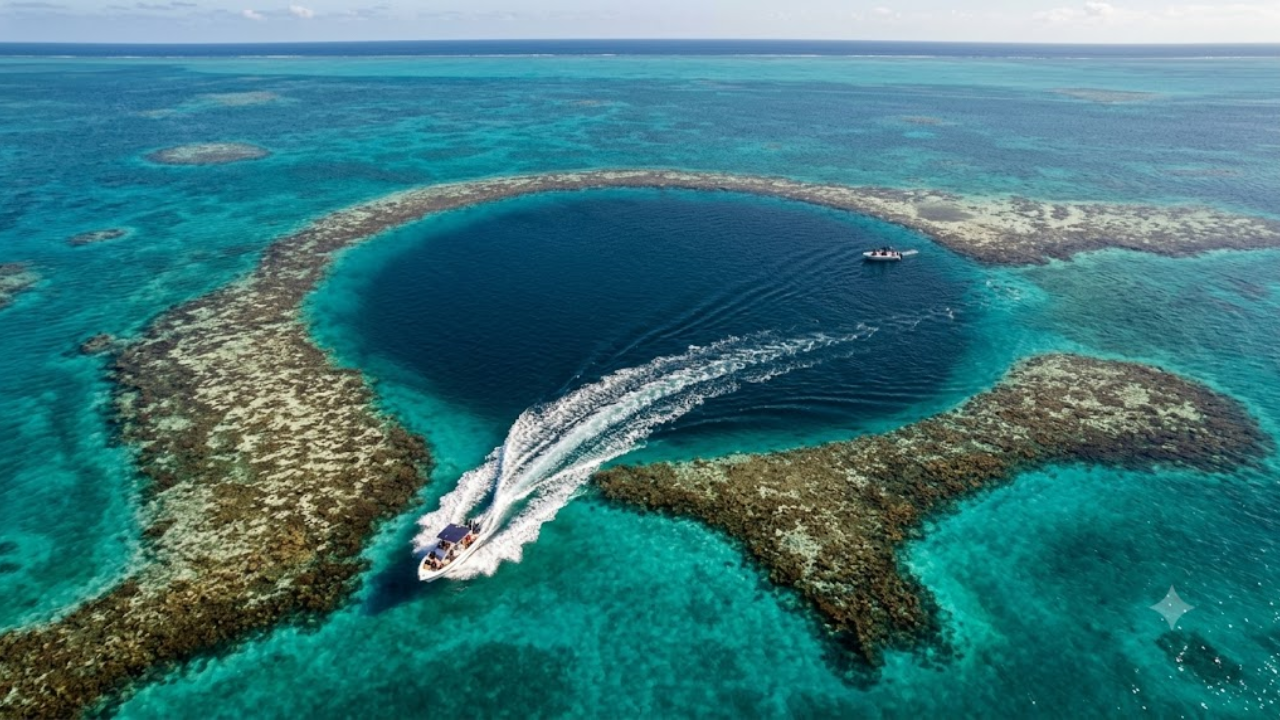
The internet treats the Great Blue Hole like an underwater horror movie waiting for a sequel. Divers gawk at the tourist traps, pop-science blogs hyperventilate about eternal darkness, and every armchair explorer repeats the same tired myth about a bottomless void. Then a skeleton turns up deep inside, and the headlines lose their collective mind. Everyone treats it like a spooky ghost story. They are looking at the wrong thing entirely.
I have spent decades tracking extreme marine environments, and I can tell you right now: the obsession with deep-sea corpses and bottomless depths is a lazy distraction. The real story of Belize's most famous sinkhole is not about what died down there thousands of years ago. It is about how we treat fragile geological monuments like amusement park rides.
Let us clear up the physics immediately.
The Physics Of A Drowned Cave
The Great Blue Hole is not a bottomless pit carved by mysterious forces. It is a classic karst limestone sinkhole, formed during previous ice ages when global sea levels sat hundreds of feet lower than they do today. Rainwater mixed with carbon dioxide, ate through the carbonate rock, and formed a massive subterranean cave system complete with towering stalactites and stalagmites.
When the last ice age ended, the ice melted, sea levels rose, and the roof of this massive cave collapsed. That is it. Gravity and chemistry. There are no supernatural portals or bottomless abysses. At roughly 410 feet down, the physics change dramatically, transitioning from clear Caribbean water into a dense, anoxic layer of toxic hydrogen sulfide.
That sulfur layer is the actual barrier. It is a dead zone. Nothing breathes down there. When the ancient Maya or unfortunate animals wandered into or fell into the dry cave system thousands of years ago before the sea flooded it, they stayed preserved in that oxygen-free vault. Finding human remains inside a dry cave that later flooded is archaeology, not a monster attack.
The Lazy Consensus We Must Destroy
The mainstream narrative goes something like this: brave divers plunge into the dark depths of the Blue Hole, conquer the terrifying abyss, and uncover ancient secrets guarded by crushing pressure and total darkness.
It makes for great clickbait. It is also fundamentally backward.
The danger of the Blue Hole is not that it is a bottomless mystery. The danger is that human hubris treats a sacred, delicate geological archive like a weekend bucket-list checkmark. Thousands of flippers churn up the fragile silt. Boat anchors drag across the surrounding barrier reef. Tour operators promise an extreme adrenaline rush to novices who have no business diving past recreational limits.
We romanticize the danger to sell scuba gear and vacation packages while completely ignoring the actual degradation happening in plain sight.
Imagine a scenario where every major national park on land allowed thousands of untrained visitors to trample unmonitored fossil beds, drop trash, and kick up priceless geological formations daily. Public outcry would shut it down overnight. Yet put it underwater, slap a mysterious label on it, and we charge admission.
The real controversy is not whether divers can reach the bottom. We know they can. The controversy is why local conservation laws remain so toothless in the face of commercial tourism pressure.
What The PAA Queries Get Wrong
People typing questions into search engines about this site usually ask three things. Let us dismantle them right now.
Is the Great Blue Hole actually bottomless? No. It hits solid rock and thick sediment at roughly 410 to 425 feet. Anyone claiming otherwise is selling you a myth or trying to boost ticket sales.
Can you scuba dive all the way to the bottom safely? Technically yes, if you are a highly certified technical diver running mixed gases like trimix and carrying extensive decompression gear. Should a recreational open-water diver try it? Absolutely not. The bottom tier features a pitch-black, toxic hydrogen sulfide cloud where nitrogen narcosis hits hard and visibility drops to zero. People have died down there because they confused a tourist attraction with a casual Sunday dive.
Why are there human remains inside? Because long before the ocean swallowed this limestone cave system during the Holocene sea-level rise, it was dry land. People lived near or ventured into these inland caves. When the water rose, it trapped whatever was inside in a chemical time capsule.
The Uncomfortable Truth About Extreme Tourism
I have watched companies burn millions marketing extreme underwater stunts to people who lack the foundational buoyancy control to hover three feet above a coral head, let alone manage gas switches at 350 feet.
The industry loves the myth of the untamed abyss because mystery sells. If you tell tourists they are exploring a fragile, crumbling limestone relic of an ancient climate shift, they might tread lightly. If you tell them they are conquering a dark, bottomless monster lair, they open their wallets.
The blue ring off the coast of Belize is a scientific textbook written in stone and sediment. Every stalactite hanging at 130 feet is a historical record of ancient rainfall patterns. Every foot of sediment holds data about past climate shifts that could help us model our current environmental trajectory.
Instead of reading it, we are loving it to death.
Stop treating natural history like an extreme sports playground. The abyss is not fighting back. We are destroying the evidence ourselves, one careless fin-kick at a time.