The weight was wrong. That is usually how the realization begins—a subtle, nagging sensory mismatch that tells the human brain something has been violated. You are standing in the middle of a brightly lit Target aisle, or perhaps you’ve already made it to the car, and your hands tell you a story that the glossy cardboard packaging is trying to hide. A box that should contain three pounds of precision-engineered Danish plastic feels suspiciously light. Or perhaps, it feels just a little too shifty.
This is the moment of the "brick swap," a retail crime that sits at the strange intersection of desperate ingenuity and high-carb absurdity. You might also find this related story useful: The Nine Degree Lie Why Hong Kongs Weather Panic Is A Productivity Scam.
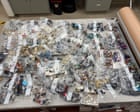
In Anaheim, California, a man named Thomas Langenbach lived a life that, on paper, suggested he had moved far beyond the need for petty shoplifting. He was a successful executive. He had a home. He had a career. Yet, he became the face of a bizarrely specific crime spree that involved the systematic replacement of high-end Lego sets with bags of dry pasta.
The Chemistry of the Swap
The mechanics are deceptively simple. A "buyer" walks into a big-box retailer, selects a premium set—perhaps a $500 Star Wars Millennium Falcon or a complex Technic crane—and takes it home. With the precision of a surgeon, they open the box, remove the numbered bags of bricks, and replace them with something of equal weight. As reported in detailed reports by Glamour, the implications are significant.
Dry pasta is the gold standard for this particular brand of fraud.
Penne, rotini, or farfalle—it doesn't matter much to the thief, but it matters immensely to the scale. Most modern retailers have sophisticated loss-prevention systems that weigh items at the point of return to ensure the contents match the original product. If you fill a Lego box with rocks, it’s too heavy. If you leave it empty, the clerk knows instantly. But a couple of boxes of generic store-brand pasta? That hits the sweet spot. It provides that familiar, rhythmic "shush-shush" sound of sliding plastic when the box is tilted, a sound we have been conditioned since childhood to associate with the promise of a new build.
The thief reseals the box with professional-grade adhesive or heat guns, returns it for a full refund, and then heads to the secondary market. On eBay or specialized collector sites, those stolen bricks are pure liquid assets.
The Victim in the Living Room
We often think of retail fraud as a victimless crime, a rounding error on a corporate balance sheet. We picture the giant corporation absorbing the hit, a tiny fraction of a percent lost to "shrinkage." But the true stakes of the pasta-for-plastic trade aren't found in a ledger. They are found on a Saturday morning.
Imagine a grandfather who has saved for months to buy his grandson the one thing the boy has talked about all year. He navigates the crowded aisles, pays the equivalent of a car payment, and presents the gift with that specific pride that comes from being the hero of the day. The boy tears at the tape. His eyes are wide. He tips the box over, expecting the clatter of a thousand tiny possibilities.
Instead, out tumbles a heap of dry bow-tie pasta.
The confusion comes first. Then the crushing disappointment. The grandfather looks like a fool; the child feels like the world has played a cruel joke on him. This is the invisible cost of the swap. The thief didn't just steal plastic; they stole a core memory and replaced it with a grocery staple.
Why Lego is the Ultimate Currency
To understand why a grown man would risk a felony record for a bag of bricks, you have to understand the economy of the "AFOL" (Adult Fan of Lego). Unlike almost any other toy, Lego sets appreciate in value at a rate that frequently outpaces the S&P 500. Once a set is retired, its price on the secondary market can double or triple overnight.
The bricks are serialized, but they aren't tracked. They are small, durable, and universally recognized. In the underworld of retail arbitrage, they are more stable than most fiat currencies.
Law enforcement officials have noted that Lego sets are "gateway" items for organized retail crime rings. They are easy to grab, easy to move, and—until recently—relatively easy to return. The Anaheim case wasn't an isolated incident of a man wanting to build a castle for free; it was a high-volume operation. When police eventually searched the suspect's home, they found hundreds of sets. It wasn't a hobby. It was a warehouse.
The High-Stakes Game of Cat and Mouse
Retailers are finally catching on, but the battle is increasingly technical. Some stores have begun using ultra-high-definition cameras at the return desks to look for the tell-tale signs of "re-taping." Others are training staff to recognize the specific "rattle" of authentic Lego bags versus the sharper, more brittle sound of dry noodles.
But as the security gets tighter, the methods get weirder. We have seen reports of boxes filled with sand, wet towels, or even old telephone books. The pasta method remains the most poetic, however, because of the sheer domesticity of it. There is something profoundly jarring about finding a pantry staple inside a premium toy. It is a collision of the mundane and the malicious.
The people who commit these crimes often don't see themselves as "criminals" in the traditional sense. They see themselves as "gamers" of a system. They find the loopholes, the soft spots in the corporate armor, and they exploit them. They tell themselves that the store can afford it.
The Weight of the Lie
In the end, the man in Anaheim was caught not because the pasta was discovered at the return desk, but because he became too bold. He was spotted by a loss-prevention officer who noticed him swapping price tags—another layer to the grift. Once the thread was pulled, the entire sweater unraveled.
The fallout of these arrests ripples through the community. Return policies become stricter for everyone. The "no questions asked" grace period that honest customers rely on begins to vanish. Prices rise to cover the losses. We all pay a small "pasta tax" every time we check out.
But beyond the economics, there is a lingering sense of distrust. Now, when we buy a high-value item, we find ourselves shaking the box. We listen closely. We look for a smudge of glue that doesn't belong. We have been taught that the contents may not match the cover.
The next time you walk past the toy aisle and see those colorful boxes stacked high, remember that for some, those aren't spaceships or medieval towers. They are just vessels for a very expensive dinner, hidden behind a thin layer of cardboard and a lie that weighs exactly three pounds.
It is a strange world where a man will trade his reputation, his career, and his freedom for the sake of a few plastic bricks and a bag of rotini. But then again, the hunger for something for nothing has always been the most difficult thing to satisfy.