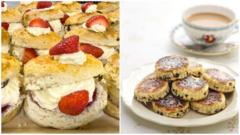
The grass at the All England Lawn Tennis and Croquet Club is clipped precisely to eight millimeters. It is a measurement that does not change. It has not changed for decades. For two weeks every summer, this patch of southwest London becomes the most heavily policed surface on earth, a theater of strict geometry where the balls must be yellow, the clothing must be white, and the afternoon tea must feature a scone.
Until now.
Step into the kitchens behind Center Court two hours before the gates open. The air is thick with the scent of scalded milk, warm sugar, and the sharp, metallic tang of industrial refrigerators working overtime. In the center of this culinary engine room stands the head chef, surrounded by a mountain of currants and a row of heavy, cast-iron griddles that look entirely out of place in a facility designed for haute cuisine. The chef is not baking scones. There are no pastry cutters slicing through towering blocks of aerated dough. No trays of golden, high-rising crowns waiting for clotted cream.
Instead, the griddles are covered in small, flat, speckled rounds of dough. Welsh cakes.
To understand the sheer audacity of this decision, one must understand that food at Wimbledon is not merely sustenance. It is liturgy. The consumption of strawberries and cream is a ritual performed with religious devotion by hundreds of thousands of spectators. The scone is the undisputed cornerstone of the tournament's afternoon tea service. Tampering with it is not viewed as a mere menu update. It is treated as an act of cultural vandalism.
When the tournament announced that Welsh cakes would be taking the place of the traditional scone at several of its premier dining locations, the reaction was immediate and fierce. Traditionalists took to the airwaves and letters pages, horrified by what they saw as an unforced error. How could a tournament deeply rooted in English heritage outsource its most sacred baked good to the valleys of Wales?
But the chef remained unbothered by the storm.
Consider the anatomy of a scone consumed in a crowded stadium. It is a structural nightmare. A good scone requires a knife. It requires a stable surface to split it in half. It demands a delicate balancing act of clotted cream and strawberry jam, a mathematical equation of toppings that inevitably fails the moment you try to take a bite while sitting in a cramped plastic seat on Court 3. The crumb structure is designed for a quiet parlor, not a bustling sports venue. One bite, and a shower of dry flakes descends onto your navy blazer or linen dress. The cream slides off the side. The jam drips onto your lap.
The chef looked at this daily disaster and saw a problem that needed solving.
The solution was hidden in a century-old Welsh tradition. A Welsh cake is a peculiar creature. It is the lovechild of a sweet pastry, a fruit scone, and a pancake, yet it behaves like none of them. It is cut thin, packed with currants, and cooked not in an oven, but directly on a hot bakestone or griddle. The dry heat of the iron sears the outside instantly, locking in a moist, tender interior while creating a slightly crisp exterior that holds its shape under pressure.
It is, by all accounts, the ultimate portable pastry.
The chef's defense of the switch rests on a combination of sensory superiority and sheer logistical genius. A Welsh cake does not require a knife. It does not require a plate. It does not demand that you choose between putting the cream on first or the jam on first, a debate that has caused minor civil wars across the British Isles for generations. The sweetness is baked directly into the dough, enhanced by a dusting of caster sugar the moment it leaves the heat. It is a self-contained unit of afternoon tea, ready to be eaten with one hand while the other holds a glass of Pimm's or notes down a tiebreak score.
But the real magic lies in how it handles the unpredictable British summer.
On a sweltering July afternoon, a pre-assembled cream scone becomes a ticking time bomb. The clotted cream melts into a greasy slick; the jam thins out and turns the pastry soggy. If the weather turns cold and damp, a standard scone loses its charm quickly, becoming dense and chalky. The Welsh cake, however, is resilient. It is best eaten warm, straight from the iron, when the currants are plump and the interior is soft. Yet, even when it cools to room temperature, the high butter content ensures it remains rich and meltingly tender.
The shift on the menu is more than just a triumph of culinary engineering. It is a quiet subversion of class dynamics within the sport.
For generations, the scone has been an emblem of high society, associated with manicured lawns and silver teapots. The Welsh cake has humbler origins. It was originally created as a quick, cheap treat for coal miners, baked by their wives on cast-iron plates over open fires. It was designed to fit into a tin lunchbox, to survive a shift deep underground, and to provide a burst of energy to men doing backbreaking work.
To bring this working-class staple into the inner sanctum of the All England Club is a beautiful, poetic irony. It challenges the unspoken rule that luxury must always look complicated.
Watch a spectator encounter one for the first time. Let us call her Margaret. She has attended the tournament every year since 1994. She wears a wide-brimmed straw hat and carries a vintage program. She approaches the tea counter expecting the familiar, comforting sight of a cream tea. Instead, she is handed a small, warm, sugar-dusted disc. She looks at it with open skepticism. It is too flat. It has no cream.
She takes a bite.
The initial crunch of the sugared crust gives way to a crumb that is shockingly tender, almost shortbread-like in its richness. The warmth releases the aroma of warm butter and the subtle, deep spice baked into the dough. The currants offer a sharp, fruity contrast to the sugar. There is no mess. There are no crumbs on her lap. She does not need a napkin to wipe jam from her fingers.
The skepticism vanishes, replaced by a quiet, begrudging satisfaction.
The chef understood that the essence of tradition is not about copying the past exactly. It is about preserving the feeling that the past gave us. People do not love scones because of their shape; they love them because they represent a pause in the day, a moment of sweet indulgence shared with friends against the backdrop of a great British summer ritual. The Welsh cake delivers that exact feeling, only better, cleaner, and with a nod to a heritage that is just as rich but far less pretentious.
As the afternoon sun begins to cast long shadows across the grass courts, the lines at the food kiosks do not dwindle. The griddles in the back continue to hiss as fresh batches of dough hit the hot iron. The purists may still grumble in the commentary boxes, clinging to the idea that some things should never change. But out on the concourses, thousands of people are walking around with sugar on their fingertips and smiles on their faces.
Tradition did not break. It simply evolved into something you can eat with one hand.