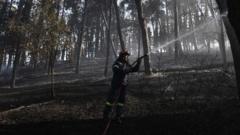
Every summer, the international news cycle follows a script so rigid you could automate it with a basic macro. The headlines scream about raging infernos, desperate containment efforts, and "unprecedented" climate anomalies paralyzing the Mediterranean. The standard narrative is comfortable: it frames wildfires as sudden, external monsters invading human territory, leaving brave firefighters to engage in a heroic, brute-force struggle against nature.
It is a gripping story. It is also entirely wrong.
The obsession with suppression is killing the very ecosystems we claim to protect. By treating every ember as a crisis, we have engineered an ecological time bomb. The real tragedy in Greece—and across the global shrubland corridors—isn't a lack of water bombers or firefighting personnel. It is the systemic refusal to accept that fire is a management tool, not an enemy combatant.
The Suppression Paradox: Why More Firefighters Equal Worse Fires
The media looks at a massive blaze in the Attica region and asks why the government didn't deploy more planes. They look at the symptoms. They ignore the foundational ecology.
In fire ecology, there is a well-documented phenomenon known as the suppression paradox. When you put out every single fire immediately, you prevent the natural clearance of understory biomass. In ecosystems like the Greek phrygana and maquis—dense, resinous shrublands—plants are biologically adapted to burn. They require periodic, low-intensity burns to clear out dead matter and regenerate.
When humans intervene to suppress every minor ignition for decades, dead wood, pine needles, and volatile shrubs accumulate. The fuel load reaches unnatural, explosive levels. When a spark inevitably catches during a dry heatwave, the resulting fire is no longer a manageable surface burn. It becomes a catastrophic crown fire that burns so hot it sterilizes the soil and vaporizes everything in its path.
I have spent years analyzing land-use data and watching policy failures across Southern Europe. The math is brutal and unyielding. You can double the firefighting budget every year, but you cannot out-pump a hundred thousand hectares of continuous, overgrown fuel. By focusing entirely on containment, we are simply compounding interest on a debt that nature will eventually collect.
The Myth of "Unprecedented" Mediterranean Ecosystems
Mainstream coverage loves the word "unprecedented." It removes accountability. If a disaster is unprecedented, no policy could have prevented it, right?
Let's look at the actual data. The Mediterranean basin has been burning for millennia. The vegetation there has evolved specific traits to survive, and even thrive, in fire regimes. Pinus halepensis (Aleppo pine), which dominates the Greek landscape, possesses serotinous cones. These cones remain sealed with resin for years, only opening to release seeds when exposed to the intense heat of a fire. The seeds then germinate rapidly in the nutrient-rich ash bed left behind.
When media outlets frame these blazes as the complete annihilation of nature, they expose a profound ignorance of basic biology. The forest isn't dying; it is trying to reset.
The real shift isn't the presence of fire. It is the radical change in human geography over the last six decades.
The Rural Exodus and the Wildland-Urban Interface (WUI)
Historically, rural Greek populations managed the landscape implicitly. Villagers grazed goats, collected firewood, and practiced small-scale, localized agriculture. This created a highly fragmented landscape—a mosaic of bare soil, green crops, grazed patches, and forest blocks. Fire could not easily travel across these broken patterns.
- The Shift: Post-WWII urbanization drew millions away from the countryside and into Athens and Thessaloniki.
- The Result: Abandoned agricultural terraces reverted to continuous, unmanaged scrubland.
- The Aggravation: Suburban sprawl pushed residential homes directly into these dense, flammable forests without adequate clearing zones.
This zone is known as the Wildland-Urban Interface (WUI). The crisis in Greece is not a forestry crisis; it is a zoning crisis. People are building living rooms inside the fuel load, and then expressing shock when the fuel burns.
Dismantling the Fatal Flaws of Public Perception
If you look at online forums and public commentary during a wildfire crisis, the same flawed assumptions appear repeatedly. Let's dismantle the two most prominent ideas.
"We just need more water-dropping planes."
This is the ultimate political theater. Watching a Canadair scoop water and drop it onto a wall of smoke looks spectacular on the evening news. It makes politicians look proactive. In reality, aerial suppression is highly inefficient against extreme fires. Strong winds deflect the drops, high temperatures evaporate the water before it hits the ground, and planes cannot fly at night when the fire actually slows down. Aviation assets are a support mechanism, not a solution.
"Climate change means we can no longer prevent these disasters."
This is a dangerous form of climate fatalism. Climate change undoubtedly extends the fire season and dries out fuel faster. But temperature is only one variable in the fire behavior triangle (fuel, weather, topography). We cannot immediately alter the weather, but we have total control over the fuel. Blaming climate change entirely is a convenient shield for governments that have failed to implement aggressive land management policies.
The Unpopular, Actionable Blueprint for Survival
Fixing this requires a complete shift in strategy. It requires moving from a reactive, military-style defense model to a proactive, ecological management model. This transition will be politically painful, which is precisely why it is rarely attempted.
1. Legalize and Scale Prescribed Burning
The most effective way to eliminate dangerous fuel loads is to burn them deliberately under mild, highly controlled winter conditions. This clears the understory without harming mature trees. Currently, bureaucratic red tape and public fear make large-scale prescribed burning nearly impossible to execute legally in many Mediterranean countries. We must train specialized burn crews and give them the legal mandate to set fires intentionally.
2. Enforce Draconian Defensible Space Mandates
If you choose to live in a highly flammable forest, you lose the right to let your property become a hazard to the community. Property owners must be legally required to maintain a 30-meter buffer zone around their structures, completely cleared of volatile shrubs and low-hanging tree branches. Non-compliance shouldn't result in a minor fine; it should result in the immediate cancellation of property insurance and a denial of public firefighting protection during a crisis. Firefighters should not be ordered to risk their lives defending a home surrounded by literal kindling.
3. Incentivize Landscape Fragmentation
We need to artificially recreate the agricultural mosaic of the past. Governments should subsidize goat and sheep herding in strategic buffer zones around urban centers. Livestock are nature's weed-whackers; they consume the fine fuels that allow fires to climb into the tree canopy. Furthermore, clear-cutting wide, strategic breaks through continuous pine forests and replacing them with less flammable olive groves or vineyards creates natural firebreaks that actually work.
The Cost of the Contrarian Approach
Let's be completely transparent about the downsides of this strategy. If we adopt an ecological fire model, it means accepting smoke. It means that during the winter and spring, skies will occasionally be hazy from prescribed burns. It means accepting that some areas will look charred and unappealing in the short term as they undergo necessary natural cycles.
It also means making hard choices about where people are allowed to build. It means halting suburban expansion into pristine forest zones and telling developers no.
But the alternative is what we see right now: an endless, losing battle where we spend billions of dollars to watch communities burn, only to repeat the exact same mistakes twelve months later.
Stop looking at the sky for more airplanes. Look at the ground. The fuel is the problem, and we are the ones letting it pile up.