One hundred dollars a barrel sounds like a number written in ink on a wall street ticker, tidy and far away.
Then you stand under the fluorescent canopy of a corner gas station at six in the morning, watching the digital wheels spin faster than the fuel flows, and you realize that number has teeth. It bites into the cost of hauling lettuce across three states. It tugs at the price of a plane ticket home for the holidays. It whispers through the quiet rooms where families decide whether to fix the brakes this month or wait until payday. For an alternative perspective, consider: this related article.
Right now, U.S. crude has pushed past that psychological threshold of $100 a barrel, while Brent—the international benchmark that prices everything from North Sea barrels to West African shipments—has climbed to a five-month high. The spark behind the rally is a drumbeat out of Tehran: officials in Iran declaring the country is prepared for warfare.
Markets do not wait for missiles to fly before they price in fear. Traders buy insurance the moment smoke appears on the horizon, and oil is the oldest, loudest insurance policy on earth. Further reporting on this trend has been shared by Business Insider.
The Number That Changes Every Receipt
To understand why a barrel of crude crossing $100 rattles economies far outside the Persian Gulf, it helps to strip away the jargon of futures contracts and West Texas Intermediate. Think of oil not as a black liquid sitting in a tank, but as the calorie count of modern life. Every tomato in a grocery aisle, every parcel dropped on a porch, every shift driven across town burns calories—mostly diesel, jet fuel, and gasoline refined from crude.
When U.S. oil climbs above $100 a barrel and Brent reaches a five-month peak on the back of Iranian war readiness, two things happen almost at once. First, producers and refiners face higher input costs and wider risk premiums. Second, shipping routes and supply chains begin pricing in friction. Even if not a single tanker is halted today, marine insurers raise war-risk rates, buyers lock in cargoes early, and jittery money floods into energy contracts.
I have lived through oil spikes before—not from a glass tower overlooking a trading floor, but from the front seat of a beat-up sedan with a check-engine light that stayed on for eight months. Back then, watching a twenty-dollar bill barely reach half a tank taught me a lesson no textbook ever prints: energy inflation is personal. It hits people who have no spare margin before it hits people who trade spreads for a living.
And honestly, I will admit something that trips up even seasoned observers: oil markets are maddeningly opaque in moments like this. Rhetoric from Tehran can harden overnight or soften through backchannels just as fast. Trying to predict exact barrel prices week by week is a fool's errand. What matters far more is understanding the mechanics of fear—how a threat of warfare translates into higher prices at the pump, why Brent and U.S. crude move the way they do, and where the real breaking points sit.
A Morning in Two Lives
Note: The following two characters are hypothetical composites created to illustrate how a $100-plus oil market affects real people on opposite ends of the supply chain.
Marta on Route 9
Marta has driven regional freight for fourteen years. Her cab smells faintly of cold coffee, peppermint discs, and diesel exhaust—the perfume of a life measured in highway mile markers rather than calendar dates. At 4:40 a.m., before the sky turns slate blue, she checks her fuel card balance on her phone. Diesel isn't a background expense for an independent owner-operator; it is the oxygen of the job. When crude jumps above $100 and Brent hits a five-month high on warnings of war with Iran, fuel surcharges on freight contracts rarely catch up on the same day. Marta eats the gap first. A few extra cents per gallon over a two-thousand-mile week doesn't sound dramatic on a spreadsheet. On her bank statement, it means putting off new tires or skipping a day off she badly needed.
Tariq at the Trading Desk
Three thousand miles away, Tariq stares at three monitors in a dimly lit room where the air smells like stale espresso and ozone. His job isn't to haul goods; it's to price risk before it arrives. When news breaks that Iran says it is prepared for warfare, Tariq doesn't wait for confirmation from a port authority. He watches Brent futures tick upward to a five-month high, watches U.S. crude clear $100, and calculates how quickly physical buyers will scramble if maritime tension escalates. To Tariq, a geopolitical threat is a probability curve. To Marta, two time zones away, that same curve is whether her profit margin survives the month.
Consider what happens next: neither Marta nor Tariq controls what happens in the Gulf, yet both are bound by the same physical chain.
Why Brent and U.S. Oil React to Drums of War
People often ask why headlines mention both "U.S. oil" and "Brent" in the same breath, as if the world runs on two separate planets. They don't, though they have distinct personalities.
U.S. oil—typically benchmarked by West Texas Intermediate, or WTI—reflects domestic supply, shale output, pipeline bottlenecks, and American refinery demand. Brent crude is priced off North Sea oil fields, yet it serves as the global reference point for roughly two-thirds of the world's traded crude because it is waterborne and easily linked to international shipping lanes.
When Iran signals that it is prepared for warfare, Brent often feels the geopolitical pulse immediately because global seaborne trade is what faces chokepoint anxiety—especially around the Strait of Hormuz, through which a massive share of global petroleum passes. Meanwhile, U.S. crude crossing $100 shows that domestic prices aren't insulated in a bubble. Even when America pumps huge volumes of oil, global markets set the floor and ceiling through arbitrage, exports, and shared macro pressures.
| Benchmark / Factor | What It Tracks | Why a $100+ / Five-Month High Matters Now |
|---|---|---|
| U.S. Crude (WTI) | Domestic U.S. production, storage, and refinery pull | Crossing $100 signals broad energy cost pressure across U.S. transport and industry |
| Brent Crude | Seaborne global crude benchmark | Hitting a five-month high reflects heightened global supply and shipping risk |
| Iran War-Readiness Rhetoric | Geopolitical escalation risk in a vital energy region | Injects a "fear premium" into prices even before physical supply is cut |
| Consumer & Business Budgets | Fuel, freight, airfare, and manufacturing inputs | Turns market volatility into higher everyday living and operating costs |
History backs up why traders react so fast to rhetoric in this region. Across decades—from the 1970s shocks to later Gulf flare-ups—oil prices have repeatedly surged not just when barrels vanished, but when the risk of losing barrels spiked. Markets hate uncertainty more than bad news. Bad news can be priced once; an open-ended threat of war forces traders to reprice every single day.
What Most People Miss About a Hundred-Dollar Barrel
There is a common assumption that oil above $100 automatically triggers an immediate, movie-style economic collapse. Reality is messier and more gradual than that.
For one thing, modern economies are more energy-efficient per dollar of output than they were fifty years ago, and non-OPEC producers outside the Middle East play a huge role in global supply. Higher prices also create their own cure over time: expensive fuel cools discretionary travel, squeezes margins, and eventually dampens demand if it stays elevated for long.
Yet the danger isn't that everything stops overnight. The danger is erosion.
- Freight and food: Trucks, trains, and cargo ships carry nearly everything we eat and wear; higher diesel costs seep quietly into shelf prices weeks after crude moves.
- Interest rates and inflation: Central banks watch energy costs closely because persistent fuel inflation complicates decisions on borrowing costs, mortgages, and business credit.
- Household breathing room: For lower- and middle-income households, a spike at the pump acts like a regressive tax—taking a larger share of every paycheck with no way to opt out.
So what should an ordinary person—or a small business owner—actually do when headlines scream that U.S. oil is above $100 and Brent is at a five-month high?
Panic is useless. Guesswork is worse. Start with clarity: look at where energy directly touches your monthly cash flow, from commuting and delivery costs to variable utility bills. Trim avoidable fuel waste where you can without making yourself miserable—combine errands, check tire pressure, avoid chasing every rumor on social media. If you run a business that relies on transport or energy-heavy materials, review your pricing and hedging options early rather than waiting until your margins are already underwater.
Above all, resist the urge to treat market spikes as permanent destiny or harmless noise. Both extremes are traps. Crude oil moves in cycles driven by geology, policy, and human fear—and fear, as history keeps proving, has a way of stretching prices far beyond what calm math alone would dictate.
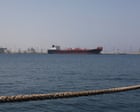
Night falls over the highway just like it falls over the port. Somewhere, a tanker hums through dark water while a driver checks a gauge and a trader watches a screen.
The number on the barrel is just a figure on a ledger.
The weight of it is carried on the road.