The spotlights hum before the speech even begins.
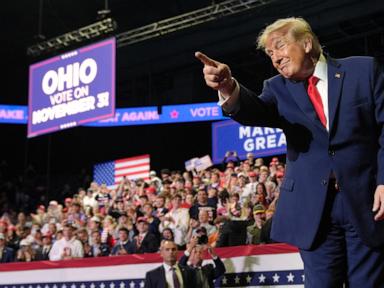
Inside an Ohio arena, thousands of people stand shoulder-to-shoulder under a ceiling hung with bunting and flags, waiting for the cadence of a campaign rally to lift the weight off a hard week. Outside, autumn air smells like damp leaves, exhaust, and fried dough from a food truck parked near the loading dock. Inside, the room vibrates with shared grievance and shared pride as Donald Trump rallies for Republican candidates, turning distant names like Somalia and Haiti into shorthand for everything people feel is slipping out of their control. You might also find this related article interesting: Halted Flights Over Riyadh Prove Everybody Has This Conflict Backwards.
Listen.
I have stood on the edges of crowds like this long enough to know the sound of a room locking into rhythm. You feel it in your boots first—the low thud of bass and applause—and then in your chest, where anger often disguises itself as urgency. When a speaker points toward faraway places and ties them to local strain, the crowd does not hear a geography lesson. They hear a story about who gets heard, who gets protection, and who gets left behind when factory whistles have been quiet for decades. As highlighted in recent reports by The Washington Post, the effects are worth noting.
That is what standard political coverage misses. A wire report can tell you who spoke, which Republican candidates stood behind the podium, and which nationalities were singled out from the stage. Facts matter. Accuracy matters. Yet cold bullet points cannot tell you what happens at 6:15 the next morning on a quiet street in Ohio when a man carrying a thermos walks past a neighbor whose eyes suddenly linger a second too long.
To trace what is really happening beneath the rally headlines, it helps to step away from the podium and look at the lives caught inside the echo. (Note: The following characters—Tomasz, Nadia, and Jean-Luc—are hypothetical composites created to illustrate documented economic, demographic, and civic dynamics in small and mid-sized industrial communities; they are not real individuals.)
The Stage and the Street
Political theater thrives on compression. A speaker on a campaign stage in Ohio has ninety minutes to compress inflation, housing shortages, strained clinics, school budgets, and shifting demographics into lines a crowd can chant in three seconds. Naming immigrants from Somalia and Haiti gives abstract anxiety a concrete target, binding voters together around a shared threat while rallying support for local and statewide Republican candidates.
Think of a rally like a magnifying glass held over dry grass. The sunlight was already there—years of deindustrialization, uneven wage growth, and rising rents—but the lens concentrates the heat onto a single point. Once the spark catches, nobody asks how dry the grass was last spring. Everyone is looking at the smoke.
I do not pretend that small cities and towns in Ohio have felt no friction. They have. When a mid-sized town experiences rapid population shifts alongside tight housing supply, emergency rooms fill up faster, English-language classes run out of seats, and long-time residents who have paid taxes for forty years can feel like strangers in their own zip code. Admitting that friction is not weakness; it is honesty. If we pretend every block adjusts effortlessly, people who are genuinely stretched will stop trusting anything we say.
Still, there is a vast gulf between real municipal growing pains and sweeping condemnation of entire communities from Somalia or Haiti. One asks how to pave the road, fund the clinic, and house the families already living there. The other turns neighbors into symbols.
Three Lives in the Same Zip Code
Start with Tomasz, a hypothetical machinist in his late fifties whose family has lived in a brick ranch outside Dayton for three generations. His knees ache when the barometer drops, his property tax bill climbed again this year, and his youngest brother moved two states away after the plant downsized. When Tomasz watches a rally clip on his phone with the sound turned up loud enough to drown out the refrigerator, he is not thinking about foreign policy. He is thinking about whether his pension will stretch and whether his own kids will ever afford a starter home without moving away.
Two miles across town, in a hypothetical two-bedroom duplex with peeling trim near a bus line, Nadia is folding laundry while her son sleeps through a late shift. She came from Somalia years ago after violence made staying impossible, worked third-shift warehouse jobs until her arches screamed, and learned to count every dollar with a calculator before stepping into the grocery aisle. She knows the names of every pothole on her route because she walks them when her car is in the shop. When she hears people from her home country spoken of on a political stage as a menace, her stomach drops—not because she ignores town rules, but because she knows how quickly suspicion turns a working mother into a suspect.
A few blocks over, Jean-Luc—another hypothetical resident—is sitting at a kitchen table cluttered with pay stubs and a half-finished cup of coffee. Having arrived from Haiti under temporary legal status, he takes pride in showing up on time for every shift at a food-processing facility, sending money home when he can, and keeping his head down. He has heard rumors spread online that sound nothing like the life he lives—wild stories that turn ordinary errands into moments of quiet dread.
None of these three people caused global instability, supply-chain shocks, or decades of rust-belt hollowing. Yet all three live inside the pressure cooker when campaign rhetoric turns immigration into a zero-sum battle.
Why Scapegoating Travels Faster Than Policy
History has a predictable habit when economic ground shifts under people's feet. During the late nineteenth and early twentieth centuries, industrial booms and busts across the American Midwest repeatedly collided with waves of immigration—from Ireland, Italy, Eastern Europe, and elsewhere. Newspapers and stump speeches often blamed newcomers for lower wages, crowded tenements, and urban disorder, even as industries quietly relied on their labor to build railroads, mills, and cities.
Behavioral researchers call this pattern out-group projection: when complex systems feel too big to fix—global markets, interest rates, housing supply—the human brain looks for a visible face to hold responsible. It is faster to blame a newcomer than to reform zoning laws, train more nurses, or rebuild regional manufacturing supply chains.
Consider what happens next when a rally frames immigrants from Somalia and Haiti as a threat rather than fellow residents navigating the same strained systems:
- Trust erodes at the kitchen-table level. Small acts of courtesy—a nod on the sidewalk, a wave from a porch—give way to guarded silence.
- Local leaders get squeezed. Mayors, school superintendents, and police chiefs who just need practical resources end up caught between national soundbites and daily neighborhood realities.
- Real solutions get delayed. Arguing over who belongs takes oxygen away from building housing, expanding clinics, and helping every worker—native-born or newly arrived—get ahead.
Here is the part that makes me pause and check my own assumptions: I have seen communities fracture over fear, and I have also seen communities surprise everyone by solving problems quietly when the cameras leave. I cannot hand you a neat formula that makes every voter in Ohio agree on immigration rules, border enforcement, or asylum policy. Anyone who claims the answer is simple is selling certainty where there is real complexity.
What Is Actually at Stake in Ohio
Ohio has always been a barometer of American tension because it holds both booming metros and towns still waiting for their second act. Rallying Republican candidates there is smart politics for a campaign looking to energize a loyal base and turn out low-propensity voters. Nobody in politics wastes a prime-time speech by accident; every line is tested for applause, clippability, and contrast.
Yet a campaign speech is a moment, while a neighborhood is a place you have to live tomorrow morning. When rhetoric paints broad brushes over people from Somalia or Haiti, the cost lands hardest on ordinary routines: a teenager walking home from band practice, an elder waiting at a clinic, a business owner trying to keep a crew steady. At the same time, ignoring the frustration of long-time residents like Tomasz only feeds the next wave of anger.
We do not have to choose between honesty and humanity. We can tell the truth about tight budgets, stressed schools, and housing crunch points without treating entire nationalities as villains. We can debate legal pathways and national standards firmly while remembering that real human beings—with real kids, real bills, and real hopes—are standing on the other side of every political line.
The arena lights eventually dim. The bunting comes down. The buses pull away from the back gate, leaving behind empty plastic cups and the cool Ohio night.
Down the block, a porch light stays on so someone coming off a late shift can find the keyhole without stumbling in the dark.