Steel groans before it tears.
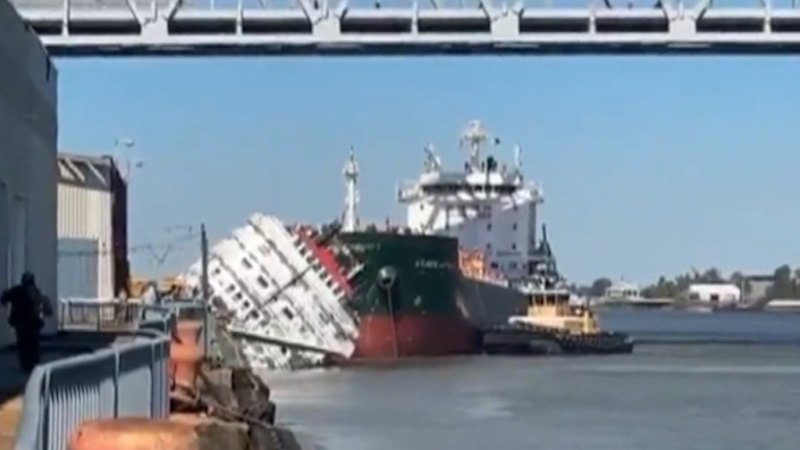
Anyone who has stood along the Mississippi levee in New Orleans near midnight knows the sound—not the sharp crack of a car crash on Interstate 10, not the boom of thunder rolling off Lake Pontchartrain, but a slow, heavy, vibrating shriek that travels straight through the soles of your boots into your teeth. Two massive hulls meeting in dark water do not bounce. They bite. Meanwhile, you can find similar stories here: What Happens When US Flights Ground While a Student Pilot Is Airborne.
When a ship collision happens off New Orleans and rescue crews scramble into the night, a wire-service headline reduces the whole event to a few cold lines: vessels involved, channel status, rescue underway. Facts matter. Accuracy keeps us honest. Yet a dry bulletin tells you almost nothing about what it feels like to be inside a listing steel hull at three in the morning while brown water surges against a bulkhead. Nor does it tell you what those collisions mean for the families waiting on shore, the Coast Guard crews launching into swift currents, or the quiet, delicate machinery of American commerce that runs past the French Quarter every single hour.
Let's be clear from the start: because no specific collision report or live incident docket was provided in the reference, the details below describe how rescues and vessel collisions on the lower Mississippi operate in reality, alongside clearly labeled hypothetical scenarios and metaphors used to trace the human and systemic stakes. To explore the complete picture, we recommend the excellent report by Associated Press.
Night on the Muddy Current
To understand a ship collision in New Orleans, you first have to stop picturing calm blue ocean.
The lower Mississippi is a brown, muscular river carrying half the continental drainage basin toward the Gulf of Mexico. Above New Orleans, the river narrows and bends sharply—places like Algiers Point, where the current slams against the outside bank and whips around in eddies that can spin an unwary tow or push a deep-draft vessel sideways faster than a rudder can correct. Even on a clear night, fog rises off warm water or hangs low over industrial terminals. Commercial ships sit high out of the water when empty or tower like apartment blocks when loaded, while low-profile tugboats and barges move through the same corridor with heavy momentum and limited braking room.
A ship does not stop on a dime. A large ocean-going vessel moving at ten knots in swift water can take miles and several minutes to bleed off speed or swing clear, even with engines astern. When two vessels miscalculate a crossing, lose steering, or battle a sudden current shear, physics takes over.
Consider a hypothetical scenario to ground what happens in the first ninety seconds after impact. Picture Elena, a hypothetical second mate on watch aboard a coastal cargo vessel near the New Orleans harbor stretch, and Marcus, a hypothetical petty officer aboard a Coast Guard response boat waiting downriver.
Elena hears the VHF radio crackle with urgent traffic before she even feels the shudder through the deck plates. When metal strikes metal, the sound is cavernous—like dropping a steel shipping container onto concrete inside a closed warehouse. Alarms chime on the bridge. Tilt indicators shift. On a vessel taking on water or listing after a bow-to-hull strike, crew members move through narrow companionways with flashlights cutting through steam, spilled fuel fumes, and darkness. Every door, hatch, and ladder suddenly carries a different weight. A crew member who walked that corridor ten times a shift now has to brace against an unnatural angle while checking who is accounted for and whether watertight bulkheads are holding.
Downriver, Marcus is already pulling on dry suit gear as the watch stander calls out coordinates, vessel types, and reported status. A rescue response on the Mississippi is a race against current and time. Cold or fast-moving water pulls a person in the river downstream rapidly; debris, vessel wake, and zero visibility turn a search grid into a shifting puzzle. Rescue boats buck heavy chop and cross-currents, searchlights sweeping the dark surface for a reflective strip, a bobbing life ring, or a raised hand.
I have spent enough time around ports, rescue crews, and maritime incident briefings to know that Hollywood rescues—dramatic slow-motion leaps from burning decks—rarely match the real work. Real rescues are methodical, wet, loud, and tense. Someone has to hold a station in roaring current while a line is passed. Someone has to talk a shaken mariner through climbing a Jacob's ladder or boarding a rescue boat without slipping. And someone on shore has to answer a phone at 4:00 a.m. when dispatch says a vessel is in distress.
Why a River Crash Ripples Far Beyond the Water
It is tempting for people far from the docks—or even locals sitting a mile inland—to view a ship collision as a contained maritime mishap. Two hulls hit, rescue boats respond, investigators ask questions, life goes on.
That view misses how tightly the river is wired into daily life.
Use a simple metaphor: think of the lower Mississippi through New Orleans as the aorta of North American bulk trade. Grain from the Midwest, chemicals and refined fuels from Gulf Coast plants, steel, timber, and containers move along this corridor in staggering volume. When a collision damages a vessel, blocks a stretch of the channel, or forces a safety zone closure, the ripple does not stop at the levee wall.
First come the immediate human and environmental stakes. If fuel, lube oil, or cargo leaks into fast-moving river water, responders face a dual crisis: saving lives and containing pollution before currents carry slicks toward marshes, intakes, or shorelines. Even when no one is critically hurt and no major spill occurs, near-misses and collisions rattle everyone who works the water—pilots, tug crews, dockworkers, and Coast Guard personnel who know how thin the margin can be when heavy steel meets heavy current.
Second come the economic and supply-chain consequences. Delays on the river stack up like cars behind a fender-bender on a single-lane bridge, except each "car" can carry tens of thousands of tons of cargo. Scheduling shifts. Barges wait. Terminals adjust. Those delays eventually show up in freight costs, manufacturing timelines, and commodity prices far from Louisiana.
I will admit something candidly: maritime accident reporting often leaves everyday readers feeling lost in jargon. Terms like draft, allision, grounding, VTS (vessel traffic service), and captain of the port zone get tossed around as if everyone reads the Coast Guard navigation rules before breakfast. There is nothing shameful about finding that confusing. Most people never step onto a commercial bridge or watch a radar scope at night. You do not need to memorize maritime law to care about what happens when massive ships collide in a working port—you just need to see how human judgment, river hydraulics, and heavy machinery intersect.
What Actually Happens During a Rescue and Investigation
When people read that a rescue is underway after a collision, a few practical questions almost always surface. How do responders coordinate? How do they decide whether to abandon ship or stay aboard? And how do investigators figure out who—or what—went wrong?
Coordination starts fast and in layers. Watchstanders monitor distress calls, radar, and AIS (Automatic Identification System) tracks, while local port authorities, pilots, tug operators, and Coast Guard units share real-time updates. If a vessel is taking on water, listing, or disabled in the channel, immediate priorities are simple and unforgiving: keep people safe, stabilize the vessels if possible, keep them from drifting into other traffic or shore structures, and protect the waterway.
Deciding whether a crew stays aboard or evacuates depends on stability, fire or flooding risk, vessel condition, and weather or current. Sometimes staying aboard a large, stable hull is safer than launching small lifeboats into swift water at night; other times, rapid evacuation is essential because a compartment is flooding or danger is escalating. Every call carries risk.
Once immediate life-safety needs are addressed, the quiet, painstaking work begins. Investigators look at voyage data recorders, radar logs, radio audio, weather and current conditions, mechanical records, and crew accounts. Collisions rarely come down to a single cartoon villain. Usually, several factors line up like dominoes: visibility, traffic density, current velocity, equipment performance, communication timing, and human fatigue.
History shows that river safety has always evolved through hard lessons learned after incidents on big water. Every bend, passing rule, and traffic protocol exists because someone once paid a price for not having it. Progress on the river is built on honest scrutiny rather than blame-seeking headlines.
The Human Weight on Both Sides of the Levee
Listen.
Out on the water, the engines quiet down once a rescue boat holds position beside a damaged hull, and all you hear is water slapping steel and a radio murmuring coordinates into the dark.
Think about the people in that moment. Think about the mariner thousands of miles from home, heart hammering against ribs, staring at dark water past a bent railing while rescue lights sweep across the foam. Think about the Coast Guard crew member leaning out from a rocking deck to reach a cold, exhausted hand. Think about the family member back home refreshing a screen or staring at a silent phone, waiting for word that their loved one is safe and dry.
A collision in New Orleans is never just steel hitting steel. It is human nerve tested in dark water, a reminder of how much quiet labor keeps goods moving across the country, and a call to pay attention to the people working the river long after the breaking news banner fades.