Saltwater tastes different when you are swimming sideways.
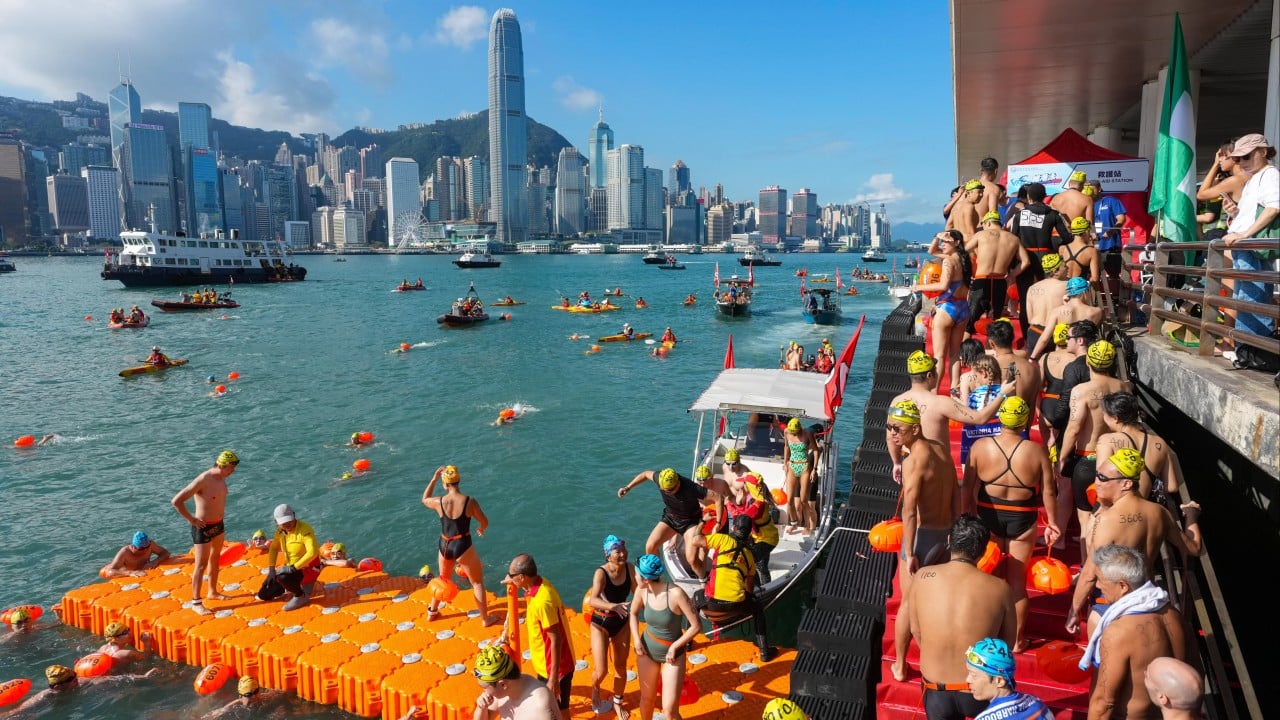
For the first four hundred meters, it is just cold, metallic, and sharp against the back of your throat—the familiar baptism of open-water endurance. You find your rhythm. Breath, stroke, sight the yellow buoy, repeat. The skyline of Hong Kong rises like a jagged circuit board to your left and right, glass towers catching the flat morning light, ferries paused like polite spectators in a channel normally churning with commercial steel. You are crossing Victoria Harbour. You are part of a tradition stretching back more than a century, a civic rite of passage where thousands of ordinary people prove that the water separating Kowloon from Hong Kong Island is not a barrier, but a bridge.
Then, somewhere near the middle of the shipping lane, the geometry breaks.
You lift your head to sight the finish line at the Wan Chai waterfront, expecting the Golden Bauhinia Square promenade to have grown noticeably larger. Instead, it has drifted forty yards to your right. You kick harder. You lengthen your pull, digging deep into the murky green chop, feeling the burn bloom across your deltoids. Thirty strokes later, you look up again. The promenade hasn't moved closer. You are on an invisible treadmill made of millions of tons of moving ocean, and the current has quietly decided it owns you now.
On a recent Sunday morning, that exact sensation stopped being a private athletic struggle and became a mass maritime emergency. Roughly seven hundred swimmers—amateurs, seasoned masters athletes, weekend warriors who had trained for months in chlorinated twenty-five-meter lanes—found themselves caught in the grip of unexpectedly fierce currents during the annual Victoria Harbour Race. Organizers made the agonizing, necessary call to halt the event mid-crossing, leaving hundreds of exhausted bodies bobbing in deep, unpredictable water as rescue boats scrambled to pluck them from the tide.
On paper, it reads like a clean logistical hiccup. A weather anomaly. An operational cancellation.
In the water, stripped of goggles, timing chips, and dry-land certainty, it was a visceral lesson in human hubris—and the terrifying speed with which a controlled sporting spectacle reverts to raw survival.
The Illusion of the Painted Line
To understand how seven hundred capable swimmers end up stranded in one of the world’s busiest waterways, you first have to understand the quiet lie of the swimming pool.
Consider a hypothetical swimmer—let’s call her Clara, though she represents dozens of first-time entrants who stepped onto the Wan Chai pier that morning with neoprene caps pulled tight over their ears. Clara spent six months preparing for this one-kilometer crossing. Three mornings a week before work, she stared at a black T-shaped tile line at the bottom of a municipal pool. In that world, effort equals distance. Push harder off the wall, shave two seconds off your hundred-meter split. The water is sterile, transparent, and entirely indifferent to the moon.
Open water does not care about your split times.
A harbour is not a giant swimming pool; it is a living throat connecting the South China Sea to the Pearl River Delta. Every tidal shift forces staggering volumes of water through a narrow bottleneck between Kowloon Peninsula and Hong Kong Island. Think of putting your thumb partially over the end of a garden hose: the water doesn't just move, it accelerates, jetting sideways with sudden, localized violence.
When you drop thousands of human beings into that bottleneck, you are staging a delicate negotiation between civic ambition and fluid dynamics. For weeks leading up to the race, meteorological models and tide tables are scrutinized like sacred texts. Organizers look for slack tide—that brief, miraculous pause between the incoming flood and the outgoing ebb when the harbour holds its breath.
Except nature rarely signs contracts.
Wind shear pushing across Lei Yue Mun, residual swells from distant weather systems, freshwater runoff pouring down from the Pearl River—any subtle shift in atmospheric pressure can turn a predicted slack tide into a relentless cross-current. To a swimmer at water level, eyes six inches above the chop, there are no landmarks until it is already too late. You don't feel a current pickup the way you feel a gust of wind on your face; you are moving with the medium. You only realize you are being swept off course when the stationary world on the shore begins sliding past you like a movie set on wheels.
Panic in Slow Motion
I have been caught in a coastal rip once in my life, off a rocky headland where the water looked glassy right up until the moment the sandy bottom vanished beneath my toes. The most shocking thing wasn't the strength of the water. It was the silence.
There is no cinematic roar when the ocean takes you. Just the slosh of water against your own cheekbones, the sudden heaviness of your limbs, and a cold, prickling clarity in the base of your skull as your brain calculates distance versus energy and realizes the math no longer works.
Now multiply that private reckoning by seven hundred.
When race officials recognized that the currents were pushing swimmers dangerously off the designated safety corridor—away from the Wan Chai landing pontoons and toward open shipping channels and concrete seawalls—the whistles began to blow. Jet skis cut sharp white arcs across the grey-green surface. Marine police launches, inflatable dinghies, and kayak marshals converged on the scattered field of bright swim caps.
For the swimmers still in the water, the cancellation didn't arrive as a neat press release. It arrived as confusion.
Imagine being six hundred meters from shore, salt stinging your eyes, lungs heaving, when a lifeguard on a paddleboard waves both arms frantically above their head and shouts at you to stop swimming forward. Every instinct drilled into an endurance athlete screams keep moving. Stopping in open water feels like sinking. Treading water in a choppy harbour, surrounded by hundreds of other disoriented swimmers bumping shoulders and legs, drains glycogen twice as fast as swimming freestyle.
Fear in open water is contagious, yet strangely quiet. A swimmer swallows a mouthful of harbour water—bitter with diesel trace and brine—coughs, loses rhythm, and suddenly forgets how to float. Arms windmill wildly. Hands reach instinctively for the nearest bright buoy, or the shoulder of the person next to them. Experienced open-water swimmers know the cardinal rule: never let a panicking swimmer grab your neck. You duck under, create space, offer a calm voice, keep your own breathing slow enough to anchor someone else's terror.
Along the safety perimeter, volunteers hauled exhausted competitors over the gunwales of inflatable boats by their armpits, leaving bruised ribs and scraped knees as small prices for solid footing. Some swimmers clung to the ropes lining the rescue craft, legs dangling in the dark pull below, waiting their turn as vessels ferried groups back toward the piers. Others, stronger or luckier with the pockets of current they caught, watched the race dissolve around them before finally feeling the solid, miraculous resistance of a pontoon ladder beneath their feet.
The History Beneath the Surface
There is a reason this race means so much to Hong Kong, and why cancelling it mid-stream carries an emotional weight far heavier than a rained-out marathon.
The Victoria Harbour Race—historically known as the Cross Harbour Race—was born in 1906. For decades, it was one of the city's defining annual spectacles, a gritty, joyful celebration of resilience and maritime identity. Then, in 1978, it vanished. Rapid industrialization and unchecked sewage dumping had turned the harbour into an open biological hazard; swimming across it wasn't an athletic feat anymore, it was a medical emergency.
For thirty-three years, the water remained closed to the event. When the race finally returned in 2011, bolstered by massive harbour-area treatment schemes and cleaner water, it felt like the city reclaiming a piece of its own soul. Every autumn since, doctors, teachers, bankers, students, and retirees have lined up at dawn to plunge into the channel that built their home.
That context matters. Nobody enters the Victoria Harbour Race casually. People train through humid subtropical summers, wake up at four in the morning to catch buses to the pier, and carry their finisher medals to Monday morning office meetings like badges of quiet defiance.
Which is why the aftermath of an early stoppage tastes so bittersweet.
On the promenade at Wan Chai, wrapped in foil thermal blankets, shivering against the harbor breeze, hundreds of swimmers stood looking back at the water they hadn't been allowed to conquer. There was relief, certainly—profound gratitude for the eagle-eyed safety crews, the marine police, and the race directors who chose caution over pride. History is littered with mass-participation endurance events where organizers hesitated too long, blinded by sponsorship pressures or fear of public backlash, turning preventable weather shifts into tragedies. Pulling seven hundred people out of a moving tidal channel without a single fatality is not a failure of event management; it is the exact reason safety protocols exist.
Yet alongside the gratitude sat an unmistakable ache. Unfinished business. The strange grief of preparing for months for a test that gets torn up halfway through the exam.
What the Water Reminds Us
We live in an era obsessed with smoothing out friction. We track our heart rates on wristwatches, map every elevation gain before we lace up our running shoes, check hyper-local radar down to the minute, and convince ourselves that with enough data and preparation, nature becomes just another predictable gym floor.
Open water refuses to play along.
The swimmers who stepped out of those rescue boats on Sunday morning didn't get the finisher photos they planned on. Their timing chips recorded incomplete arcs, digital lines cut abruptly short in the middle of a map. Many of them went home with salt-crusted hair, bruised shins from boat ladders, and the lingering phantom sway of harbour chop in their inner ears.
They also walked away with something no clean, predictable crossing could ever have given them: the visceral, unforgettable truth of how small a human body really is against a moving tide—and how fiercely strangers will reach down from a rocking boat to pull you back into the light.
Out beyond the Wan Chai seawall, the ferries eventually resumed their steady, rhythmic crossings, slicing clean white wakes across the grey water as if nothing had happened at all.


