He does not look like a man who constructs ghosts.
Arthur sits in a dimly lit pub outside Devonport, his fingernails permanently stained with a mixture of grease and anti-corrosive primer. For thirty-four years, his family has built the bones of the Royal Navy. His grandfather welded plates on the hulls that chased the Bismarck; his father spent his life in the belly of cold war frigates. Arthur himself knows the specific, rhythmic thrum of a Type 23 frigate engine the way a mother knows her child's breathing. He knows that when a ship is alive, it vibrates with the nervous energy of two hundred souls drinking tea, scrubbing decks, and writing letters home.
"A ship needs people to keep it from feeling like a coffin," Arthur says, staring into his pint.
But the ship Arthur is working on now will never hold a single letter home. It will never smell of burned toast or damp wool.
The British Ministry of Defence is quietly reshaping the future of maritime warfare through a series of initiatives known under titles like Project CABOT and the Type 91 arsenal ship program. To the defense analyst reading white papers, it sounds like an elegant equation: uncrewed surface vessels designed to carry deep magazines of vertical missile launchers, moving in lockstep with manned destroyers to absorb the shock of massed missile saturation attacks. It is a mathematical solution to a terrifyingly modern problem.
To the people who build them, and the sailors who will command them from hundreds of miles away, it is something entirely different. It is the arrival of the Ghost Fleet.
The problem facing modern navies is brutal in its simplicity. Building a single modern destroyer costs upwards of a billion pounds. They are exquisite, towering achievements of engineering, packed with sensors so sensitive they can track a tennis ball moving at Mach 3. But they have a fatal flaw. They can only carry a finite number of missiles. In a high-intensity conflict, an adversary doesn't need a better ship; they just need more missiles than your destroyer has interceptors. Once the magazine runs dry, that billion-pound asset becomes an exceptionally expensive target.
Consider a hypothetical scenario on a gray Tuesday in the North Atlantic. A Type 83 destroyer detects a swarm of forty incoming anti-ship cruise missiles. It fires. It hits. But the math is relentless. The destroyer's vertical launch cells are empty. It must retreat to a specialized port to reload, a process that takes days.
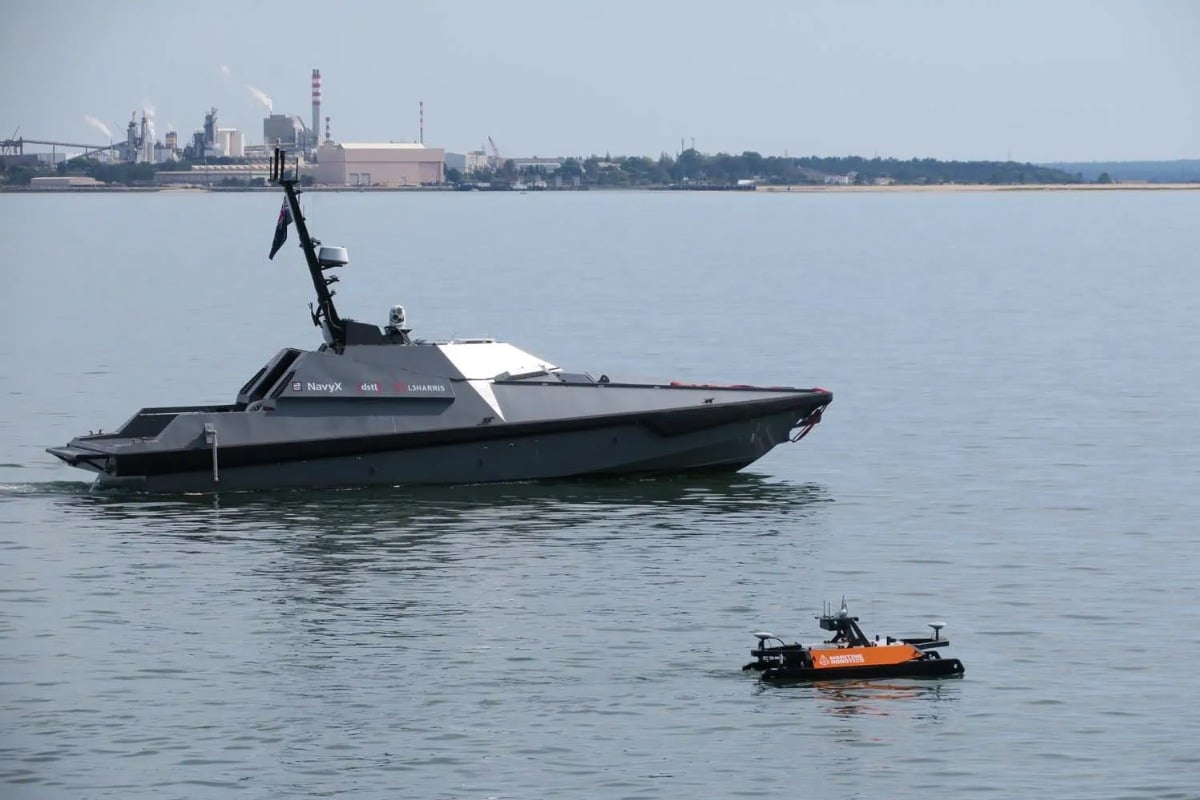
This is where the Type 91 comes in. It is a drone ship, roughly 180 feet of sleek, low-profile steel. It has no bridge. No windows. No mess deck. It is essentially a floating, armored box of missiles that tags along behind the main destroyer like a loyal hound carrying extra ammunition. When the enemy attacks, the destroyer retains the human command, but it pulls the missiles from the robotic hull trailing miles away.
But drawing a blueprint is easy. Breathing life into a machine that must survive the violent, unforgiving wilderness of the ocean without human hands to fix a leaking valve or clear an encrusted filter is a terrifying engineering mountain.
The ocean hates machinery. It eats steel. It jams gears with salt crust. On a traditional warship, a significant portion of the crew's daily life is spent simply fighting back the sea—chipping rust, lubricating seals, repairing electrical shorts caused by creeping dampness. When a pump fails on an uncrewed vessel in the middle of a force-nine gale, there is no twenty-year-old technician with a wrench to go below decks and fix it.
The Royal Navy has already begun testing these waters with smaller experimental craft like MADFOX, which successfully proved that a remote command signal could fire a missile from an uncrewed hull. But scaling that up to a persistent, heavy-hitting fleet means outsourcing the soul of the navy to algorithms.
The strategy behind the current push involves creating a "Digitalisation of the North Atlantic." Through Project CABOT, autonomous sloops and drone submarines will weave an invisible, digital net across the ocean floor, listening for the faint, rhythmic signature of foreign submarines. Artificial intelligence will triage the massive ocean of acoustic data, filtering out the songs of whales and the grinding of tectonic plates, looking for the one sound that matters.
Once found, that data is flashed via satellite to a secure Remote Operations Centre back in the UK. There, sitting in a climate-controlled room under fluorescent lights, a human operator will look at a glowing screen and decide whether to send a kill command back across the world to a ship that has never known a crew.
It is a clean way to plan for war. It keeps British sailors out of the direct line of fire, transforming the bloody business of naval defense into a distributed, disaggregated system-of-systems.
Yet, there is an invisible weight to this shift that the white papers leave out. Sailors are a superstitious breed. They believe in the spirit of a ship, a collective consciousness forged by the shared hardship of deployment. When you remove the people, you remove the heartbeat.
"I watched them test one of the smaller autonomous hulls last year," Arthur says, his voice dropping. "It came slipping into the harbor at twilight. No lights on in the superstructure because there was no one inside who needed to see. It moved completely silent. It felt wrong. Like watching a ghost ship come into port, except we built the ghost on purpose."
The transition is moving forward regardless of the melancholy it stirs in the old shipyards. The Royal Navy is currently procuring dozens of uncrewed vessels as testbeds, preparing for a world where the sea is populated by automated sentinels. The traditional image of a captain standing on the bridge, binoculars in hand, staring into the spray of an oncoming storm, is fading into history.
In its place is an operator at a console, looking at a data feed from a vessel they will never touch, preparing to fire a missile launcher mounted on a piece of steel floating alone in the dark. We are not just building better weapons; we are rewriting our relationship with the sea itself, populating the horizon with silent, hollow guardians that wait for a radio signal to scream.
Learn more about the Royal Navy's Type 91 drone warship program
This video provides an in-depth visual breakdown of the Type 91 concept, illustrating how these uncrewed arsenal ships are designed to integrate with the broader digital fleet structure.