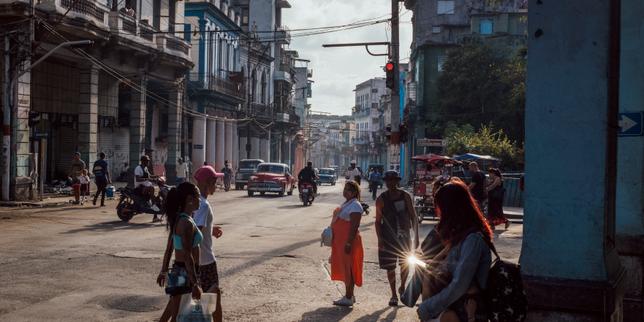
Havana doesn't just look like a city trapped in time. It feels like a city waiting for a floor to drop out. If you walk through the streets of Old Havana today, you won't just see the crumbling colonial facades or the classic cars that tourists love. You'll see a specific kind of exhaustion in the eyes of people who are caught between two distinct, terrifying possibilities. On one hand, there's the crushing weight of a socialist system that can no longer provide basic electricity or bread. On the other, there's the looming shadow of a potential American intervention that could change everything—for better or worse.
It's a strange vibe. Usually, when a country hits a breaking point, you expect a loud explosion. In Cuba, it's a low, constant hum of anxiety. People are tired of the shortages. They're tired of the blackouts that last twelve hours a day. Yet, mention the possibility of a "liberation" from the North, and the mood shifts. They want change, sure. But they’ve seen what happens when the US decides to fix a country. They don't want to become a battlefield.
The Reality of Living in a Totalitarian Gridlock
The Cuban government keeps blaming the US embargo for every single failure. While the "bloqueo" definitely hurts, it's not the reason the state-run bakeries don't have flour. It's not the reason the power plants, built with aging Soviet technology, are literally falling apart. The systemic rot is deep. You see it in the lines for eggs that stretch around three blocks. You see it when a doctor, someone who spent years in medical school, decides to drive a taxi because the tips from foreigners are worth more than a government salary.
Life in Havana right now is basically a full-time job of problem-solving. How do I get milk? Who has gasoline? Is the power going to stay on long enough for me to cook dinner? It’s a grind. It wears people down until the only thing left is the desire to leave. And they are leaving. Since 2022, we've seen the largest exodus in Cuban history. We aren't talking about a few political dissidents. We're talking about the youth. The people who should be building the future of the island are instead selling their refrigerators to buy a one-way ticket to Nicaragua.
That Lingering Fear of the American Giant
For decades, the Castro regime used the threat of an American invasion as a way to keep people in line. It was the ultimate "boogeyman." If you complain about the government, you're a mercenary for the Yankees. If you want more freedom, you're inviting a military strike. For a long time, younger Cubans stopped believing it. They saw the US as a land of iPhones and freedom, not a threat.
But things have changed recently. The rhetoric coming out of Florida and Washington has sharpened. When people in Havana hear talk about "regime change" or "military options" from certain American politicians, it triggers a very real trauma. They remember the Bay of Pigs. They know the history of US intervention in Latin America. There's this gnawing worry that a desperate government in Havana might provoke a conflict just to stay in power, or that a miscalculation in the Florida Straits could turn their neighborhoods into a war zone.
Most Cubans I know don't want a war. They want a supermarket. They want to be able to speak their minds without a neighborhood watch committee taking notes. They want the freedom to start a business without the state breathing down their necks. They want a transition that looks like a peaceful evolution, not a scorched-earth invasion.
The Disconnect Between Diaspora Dreams and Island Realities
There's a massive gap between what the Cuban community in Miami wants and what the people in Central Havana need. In Miami, the talk is often about total collapse and starting over from scratch. It's ideological. It's passionate. But on the ground in Cuba, "starting over" sounds like more years of starvation.
The average Habanero isn't thinking about geopolitical strategy. They’re thinking about the fact that a pound of pork now costs more than a week's wages. When the West talks about sanctions, they see it as a tool to pressure the government. When a Cuban mother sees sanctions, she sees fewer medicines in the local pharmacy. It's a brutal irony. The tools meant to "help" the people often end up making their daily survival even more precarious.
Why the Current Stagnation Cannot Last
You can't run a country on nostalgia and fear forever. The 1959 revolution is a lifetime ago. Most Cubans alive today weren't even born when Fidel Castro gave his first speeches. The old slogans don't work when the lights are off. The government tried to open things up slightly with "MSMEs"—small private businesses—but it's been a messy process. It created a new class of people who can afford imported Nutella while the rest of the population survives on rice and beans.
This inequality is a new poison for Cuban society. It’s breaking the social contract that the revolution promised. "We are all poor, but we are all equal" was the deal. Now, it's just "Most of us are poor, and the ones with family in Miami are okay." That's a recipe for civil unrest. We saw it on July 11, 2021, when thousands took to the streets. The government cracked down hard, but the underlying anger didn't go away. It just went underground.
Security Concerns and the Russian Shadow
To make matters more complicated, the Cuban government has been cozying up to Russia and China again. You've probably seen the reports of Russian warships docking in Havana harbor. This isn't just about trade. It's a middle finger to the United States. It's a way for Havana to say, "If you pressure us, we'll bring your rivals to your doorstep."
For the residents of Havana, this is terrifying. Nobody wants their city to become a pawn in a new Cold War. They don't want to be the center of a 21st-century Missile Crisis. They’ve seen this movie before, and it didn't end well for the Cuban people. The presence of Russian assets on the island only increases the chance of an American reaction, which brings that fear of an "attack" back to the forefront of everyone's mind.
What a Real Transition Might Actually Look Like
If we're being honest, the most likely path forward isn't a sudden democratic revolution or a US-led invasion. It's a slow, painful, and probably corrupt transition toward a model like Vietnam or China. The military will likely keep control of the big industries while allowing more and more private enterprise just to keep the economy from flatlining.
The people of Havana are watching this play out in real-time. They see the generals trading their olive-drab uniforms for Italian suits as they run the state's tourism arm, GAESA. It’s cynical. It’s frustrating. But for many, it’s better than the alternative of a chaotic collapse. They want the "desire for change" to be met with something stable.
Watching the Horizon
Every evening, thousands of people gather on the Malecón, the famous sea wall that protects the city from the Atlantic. They sit there to catch a breeze, to escape the heat of their fan-less apartments, and to look North. Some look North because they're planning their escape. Others look North with a mix of resentment and hope.
The uncertainty is the only constant. Is the next cargo ship going to bring oil or is it going to be turned away? Will the next protest be the one that actually changes things? Or will we just keep waking up in the dark, waiting for a future that never seems to arrive?
Stop looking at Cuba as a political museum. It’s a pressure cooker. If you want to understand what's coming, don't listen to the official government broadcasts or the loudest voices in exile. Listen to the silence in the streets of Havana. It's the sound of a population that has run out of patience but hasn't yet found a way out. The next few years won't be about ideology; they'll be about survival. Keep an eye on the food prices and the fuel lines. That's where the real revolution is happening. If the state can't fix the grid, the people will eventually find a way to flip the switch themselves.