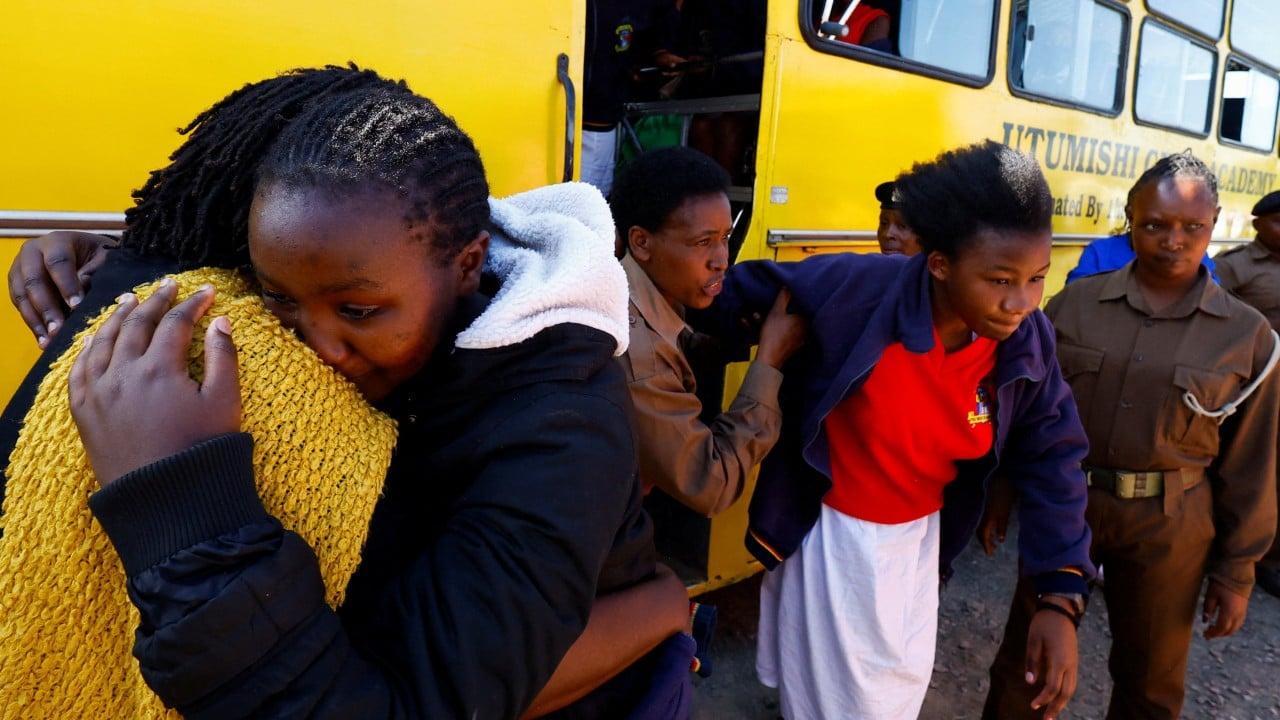
Midnight in Nyeri County usually tastes like cold mist and woodsmoke. It is a quiet place, tucked into the central highlands of Kenya, where the hills roll softly and the night is supposed to be a sanctuary. For the young girls sent here to study, to build a future out of textbooks and strict discipline, the boarding school dormitory is meant to be a fortress of safety.
Then comes the smell of melting plastic. The crackle of seasoned timber. The sudden, suffocating absence of oxygen.
We often consume tragedy through the cold arithmetic of breaking news alerts. Fourteen dead. Sixteen dead. Scores injured. The numbers flash across our screens, brief and sterile, before being swallowed by the endless scroll of digital noise. We nod, we sigh, we move on. But a statistic is just a tragedy with the skin stripped off. To understand what happened in that Kenyan girls' high school, you have to look past the tally. You have to look at the shoes left scattered in the mud, the charred metal frames of bunk beds, and the profound, systemic failures that turn simple building materials into death traps.
Fire is a swift thief. It does not wait for a formal introduction.
The Architecture of Vulnerability
Picture a standard boarding school dormitory in rural East Africa. It is often a long, rectangular structure, built to maximize space and minimize cost. Rows of metallic bunk beds are packed tightly together, separated by narrow aisles just wide enough for a teenage girl to walk through sideways. The windows are frequently fitted with heavy iron burglar bars—a necessary security measure against external threats in the minds of administrators, but a lethal cage when the threat originates from within.
When a fire ignites in a space like this, the timeline moves with terrifying speed.
Within sixty seconds, a small spark from a faulty extension cord or a knocked-over candle can catch the edge of a foam mattress. These mattresses are not treated with flame retardants. They are dense blocks of polyurethane. When they burn, they do not just create fire; they liquefy. They drip like burning wax, igniting everything beneath them while releasing a thick, black, toxic soup of hydrogen cyanide and carbon monoxide.
Two minutes in, the smoke reaches the ceiling, hits the wall, and begins to roll backward, creating a descending blanket of pure poison. In the dark, amid the screams, the air becomes unbreathable long before the flames ever touch a person's skin.
This is the chemistry of a dormitory fire. It is predictable. It is cruel. And it is entirely preventable.
The immediate reaction from authorities is almost always a frantic search for blame. Was it an electrical fault? Was it arson? In Kenya's history of school fires, both answers have surfaced with troubling frequency. Arson, sometimes sparked by student unrest or protests against harsh academic pressures, has plagued the educational system for decades. But focusing solely on the spark misses the larger, more harrowing truth: the spark only matters because we have built environments that are waiting to explode.
The Weight of the Missing
The true horror of these events does not end when the firefighters finally douse the embers. The real devastation begins at dawn, when the smoke clears and the families arrive.
Imagine standing outside a cordoned-off school gate, the morning dew freezing on your skin, waiting for a roll call that you pray your daughter's name will be on. You look at the other parents. Nobody speaks. To speak is to acknowledge the void. Instead, you listen to the low, rhythmic wailing of a mother who has just been handed a singed notebook or a recognizable scrap of a green school uniform.
This is where the cold facts of a news report dissolve into pure, agonizing human reality. Boarding schools in Kenya are not just educational institutions; they are investments of a community’s collective hope. Families sacrifice livestock, sell land, and take on crippling debt to pay the school fees that will grant their daughters a chance at a university education. A girl sent to a boarding school carries the aspirations of an entire lineage on her shoulders.
When a dormitory burns, those aspirations do not just vanish—they are incinerated in a matter of minutes.
The aftermath is a chaotic blur of bureaucracy and grief. Identifying victims in the wake of an intense polyurethane fire is a agonizingly slow process, often requiring DNA testing that can drag on for weeks. For the surviving students, the trauma settles deep into their bones. They return home, but the sound of a closing door or the smell of toast burning can trigger full-blown panic attacks. They are haunted by the memory of the dark, the heat, and the hands that reached out for them in the smoke but suddenly let go.
A Legacy Written in Ash
To view this latest tragedy as an isolated incident is to ignore a long, scarred history.
Turn the clock back to 1998, to the Bombolulu Girls' High School fire, where over twenty students lost their lives. Consider the Kyanguli Secondary School tragedy in 2001, where a fire claimed the lives of nearly sixty boys. Think back to 2017, at the Moi Girls' School in Nairobi, where ten more students perished. Each time, the public outcry followed an identical script. There were grand promises of reform. There were government task forces formed. There were mandatory safety guidelines published, dictating the required width of doors, the banning of window bars, and the necessity of multiple emergency exits.
Yet, here we are again.
The gap between policy and practice in rural schools is a chasm filled with ash. The guidelines exist on paper, stored in neat binders in ministry offices in Nairobi. But out in the counties, where budgets are tight and oversight is scarce, those rules are treated as luxury options rather than life-saving mandates. Inspections are rare, and when they do happen, a lack of resources—or a well-placed bribe—frequently ensures that violations are overlooked.
The problem lies in a culture that prioritizes compliance over culture. We check boxes. We verify that a school has a fire extinguisher, but we rarely check if the extinguisher has been serviced in the last five years, or if a single teacher on the premises actually knows how to pull the pin under pressure.
We must ask ourselves hard questions about what we value. If we treat the safety of these girls as an afterthought, a secondary concern to be dealt with only when surplus funds allow, then we are complicit in the next tragedy before it even happens. Safety cannot be an administrative line item that gets cut when budgets tighten. It must be the foundation upon which the entire institution is built.
The morning sun eventually breaks through the highland mist in Nyeri, casting long, stark shadows across the blackened ruins of the dormitory. The investigators will take their measurements. The politicians will deliver their somber speeches, promising swift action and justice for the families. The news cycles will move on to the next political scandal or economic crisis.
But in the quiet villages surrounding the school, the silence will remain. It will sit in the empty bedrooms where teenage girls should be studying by the light of a solar lamp. It will linger in the hearts of parents who sent their children away to learn how to live, only to receive them back in coffins. That silence is the loudest indictment of all, a haunting reminder of the cost of our collective forgetting.