The Dust That Remembers
Walk through the Dung Gate early in the morning, before the heat settles over Jerusalem like a heavy wool blanket, and you can smell the centuries.
Wild thyme, ozone, damp lime, old dust.
Underfoot, limestone flags have been polished slick by millions of bare, sandaled, and leather-clad feet across three millennia. Each stone is an anchor. People here do not merely walk on history; they tread upon a fuse.
On a morning when high-ranking officials walk into the elevated sanctuary known to Muslims as Haram al-Sharif and to Jews as the Temple Mount, the ambient hum of the Old City changes pitch. The daily chatter of spice vendors trading jokes with coffee sellers stalls. The rhythmic click of prayer beads pauses.
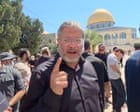
When National Security Minister Itamar Ben-Gvir made his high-profile entry onto the elevated courtyard alongside groups of Jewish activists, it was not merely another line item on a regional security brief. It was an intentional act played out in front of millions of watchful eyes.
For the shopkeeper sitting on a wooden stool just beyond the gate, for the grandmother quietly sweeping the rug inside the Al-Aqsa Mosque, and for the young Israeli soldier standing watch with a rifle pressed against his tactical vest, the arrival of political figures at this exact spot changes the air pressure in the room.
Jerusalem does not do quiet symbolism. Here, every step is a declaration.
A Delicate Agreement Whispered Across Decades
To understand why a few dozen steps across a open plaza can vibrate across capital cities thousands of miles away, you have to look at the ground beneath your boots.
The status quo at the site is simple on paper, yet impossibly intricate in reality.
Under decades-old diplomatic understandings rooted in Ottoman-era precedents and reinforced after the 1967 war, the site is administered by the Jordanian Islamic Waqf, while Israel maintains military and police security control at the perimeter. Non-Muslims are permitted to visit during designated hours, but they are forbidden from conducting formal religious prayers.
"The fragile balance of Jerusalem is not kept by iron locks, but by the shared restraint of human beings who know what happens when restraint breaks."
For years, this unwritten boundary served as a fragile dam holding back an ocean of political and religious passions.
Consider a hypothetical shopkeeper named Tariq, who has sold cardamom-spiced coffee outside the Lion’s Gate for forty years. He does not read international diplomatic cables. He does not care about speech transcripts.
Tariq measures stability in sound.
When the morning calls to prayer float across the valley uninterrupted, the day is quiet. When sirens begin to echo through the narrow alleys, his shutter comes down. His income disappears. His children stay inside.
When prominent national figures openly challenge the established norms by entering the compound surrounded by armed guards and vocal supporters, the fragile dam shows clear cracks. What looks to a politician like an assertion of sovereignty feels to the community on the ground like a deliberate match tossed into dry grass.
The Weight of the Plaza
The stone plaza surrounding the Dome of the Rock is vast. The golden dome catches the morning sun, reflecting a yellow light that warms the surrounding courtyard.
On quiet days, children play soccer on the outer stones. Elders sit under olive trees, speaking softly about family, harvest, and the price of olives.
Then comes the escort.
Security officers formation up, boots stepping crisply against the ancient flags. High-profile political figures move through the center of the perimeter, escorted by heavily armed police. Activists in the group raise their voices, chanting assertions of ownership and religious right.
Across the courtyard, Muslim worshipers gather near the porticoes. Some fold their arms; others record the moment on mobile phones, their knuckles white as they grip their devices. The atmosphere grows dense.
It is a study in stark contrasts.
On one side: the legal and political argument that citizens of a state should have total, unrestricted freedom to pray and walk anywhere within lands controlled by their government.
On the other side: the deeply felt conviction that this specific sanctuary represents one of the final remaining spaces of Palestinian religious and cultural identity, protected by international consensus and sacred tradition.
When these two worldviews collide on a patch of open stone, abstract political theory turns instantly into raw, human tension.
Beyond the Headlines
Political commentators like to describe events in Jerusalem as strategic maneuvers, tactical signals, or domestic base-building.
Those words are far too clean. They erase the human strain.
- The Guard at the Door: A young security officer stands at the chain-link partition, calculating risks in real time. One misplaced push, one shouted insult, and a routine shift turns into a flashpoint.
- The Pilgrim: An elderly woman who traveled hours to pray peacefully under the arches finds herself surrounded by ringing phones, shouting crowds, and flashing cameras.
- The Neighborhood: In the surrounding alleyways, family owners watch the security presence swell, knowing that any outbreak of violence means economic ruin and locked gates for weeks.
When leaders choose to use sacred geography as a backdrop for political messaging, they do not carry the immediate risk. The local residents carry it.
The Ripple Effect
What happens within the stone walls of the Old City never stays inside them.
Within hours of the visit, statements were dispatched from Amman, Cairo, Riyadh, and Washington. Diplomatic channels lit up with warnings of escalation. The language in these official communications was carefully chosen, but the underlying alarm was genuine.
History in this valley does not move in a straight line; it moves in sudden, unpredictable explosions. The second intifada was sparked nearby. Multiple regional conflicts have found their emotional ignition point in disputes over this single hill.
Every person living between the Jordan River and the Mediterranean Sea knows this rhythm by heart. They know how quickly a quiet Tuesday morning can turn into a night of sirens and locked doors.
The Unspoken Cost
Standing in the shadow of the Dome, listening to the security boots clatter against the stone, the real issue becomes impossible to ignore.
This is not a debate about administrative access hours. It is not a legal disagreement over property lines.
It is about the human right to exist in a space without feeling erased.
When powerful figures use holy ground to prove a point, they reduce centuries of deep religious faith and lived human experience down to a political wedge. They take a place meant for divine reflection and turn it into an arena for tribal dominance.
The stones of Jerusalem have survived Romans, Crusaders, Mamluks, and Ottomans. They will survive modern politicians too.
As the security detail finishes its circuit and the gates swing shut behind them, the heavy silence returns to the courtyard. But it is not a peaceful silence. It is the tense, held breath of a city waiting to see if the spark took hold.