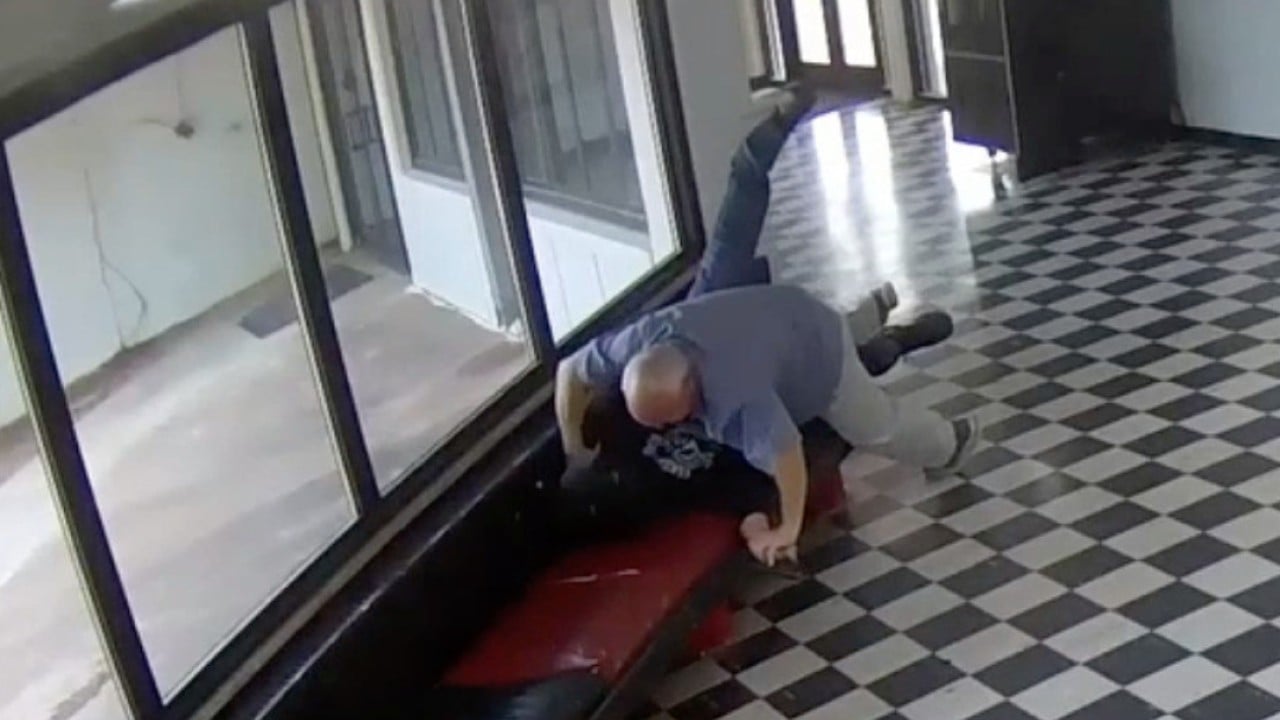
We love a hero. It is a biological imperative. When a video surfaces of a high school principal lunging at a gunman, tackling him to the waxed linoleum floor while teenagers scramble for their lives, the collective narrative machine hums to life. The media calls it "bravery." The community calls it "a miracle." The school board probably calls it "an inspiration."
I call it a catastrophic failure of institutional duty.
Celebrating the "hero principal" is the ultimate lazy consensus. It allows us to ignore the systemic rot that placed a middle-aged educator in the position of being a human shield. When we fetishize the individual act of courage, we provide cover for the collective incompetence of safety infrastructure. We are essentially saying that our plan for school safety relies on the hope that a math teacher or an administrator has the tackle form of an NFL linebacker and the suicidal altruism of a saint.
That isn't a safety strategy. It’s a gamble with children’s lives.
The Liability of the Lone Wolf
Every time a principal disarms a shooter, a thousand safety consultants shudder. Why? Because "heroism" is unpredictable, unscalable, and statistically an anomaly.
Standard operating procedure in high-stress tactical environments—which, let’s be honest, American hallways have become—demands a cold, calculated adherence to protocol. When an untrained individual goes "off-book" to play hero, they frequently exacerbate the chaos. They block lines of fire for responding officers. They leave their command post—the one place they are actually trained to be—vacant.
In the security industry, we have a term for this: Role Contamination.
A principal’s job during an active shooter event is communication and coordination. They are the central node of the emergency response. The moment they decide to tackle a gunman, the "brain" of the school goes dark. The teachers in the north wing don’t know where to go because the person with the radio is currently wrestling for a barrel.
We are cheering for the collapse of the command structure. It is the equivalent of a ship's captain leaving the bridge during a storm to go patch a hole in the hull with his bare hands. It’s gutsy, sure. But who is steering the ship?
The Fallacy of "Disarm and Defuse"
The common "People Also Ask" query is: Should teachers be trained to disarm gunmen?
The brutal, honest answer is no. Training educators in hand-to-hand combat is a grotesque pivot from their actual purpose. More importantly, it is tactically unsound.
I’ve spent years analyzing physical security benchmarks. Real-world violence is not a choreographed movie scene. It is messy, fast, and dictated by physics. The distance between a principal and a shooter—the "OODA loop" (Observe, Orient, Decide, Act)—is often closed by pure luck.
If we move toward a model where we expect "disarmament" as a viable outcome, we are encouraging more people to run toward the fire. This contradicts every data-driven survival metric we have, which prioritizes Run, Hide, Fight in that specific, non-negotiable order. By praising the "Fight" above all else, we are subtly telling students and staff that the bravest thing to do is the deadliest thing to do.
Stop Looking for Heroes and Start Looking for Hardware
The reason we focus on the principal’s tackle is that it’s a human story. It’s easier to talk about "heart" than it is to talk about ballistic glass, door-locking mechanisms, and the terrifying failure of early intervention.
Most modern schools are still designed like 1970s malls: open, airy, and impossible to secure. When an intruder enters, we rely on a person to fix the problem. This is a 19th-century solution to a 21st-century nightmare.
- Redundancy over Reflexes: A school's safety should be "passive." It should not require a human to be brave. It should require a door to be locked.
- The Perimeter Paradox: I have seen districts spend $50,000 on "leadership seminars" while their back-entry points have broken latches.
- The High Cost of Cheap Courage: Heroism is free. Infrastructure is expensive. Guess which one the taxpayer prefers?
We are using the principal's bravery to subsidize our own stinginess. If we actually cared about these kids, we wouldn’t need the principal to be a hero because the gunman wouldn't have made it past the vestibule.
The Psychological Aftermath Nobody Films
The video ends when the gunman is pinned. The "miracle" is recorded. But the "hero" is usually broken.
Post-Traumatic Stress Disorder (PTSD) among "hero" educators is a silent epidemic. These people are not soldiers. They did not sign up for the moral injury of having to decide who lives and who dies in a hallway. By framing their actions as a "triumph," we make it impossible for them to admit they are traumatized. They have to live up to the image of the fearless protector we’ve projected onto them.
It is a cruel expectation. We are asking educators to be part-time tactical operators and then expecting them to go back to grading papers and managing budgets on Monday morning.
The Uncomfortable Truth
The "hero principal" narrative is a sedative. It makes us feel like the "good guys" will always win because they have more "grit." It’s a lie. Grit doesn't stop a .223 Remington round.
If you see a video of a principal tackling a gunman, you shouldn't feel inspired. You should feel incandescent with rage. You should be asking why the magnetic locks failed. You should be asking why the threat assessment team missed the red flags for six months. You should be asking why a 55-year-old educator was the last line of defense.
We need to stop praising the tackle and start questioning the sequence of events that made it necessary. Every time we celebrate a "hero," we are essentially admitting that our systems have failed and we are now relying on luck.
And luck is a terrible security policy.
Stop looking for "brave" leaders. Start demanding boring, effective, and redundant safety systems that make bravery unnecessary. An educator’s greatest contribution to a school should be their mind, not their ability to bleed out in a corridor.
Demand better than heroes. Demand a system that doesn't need them.