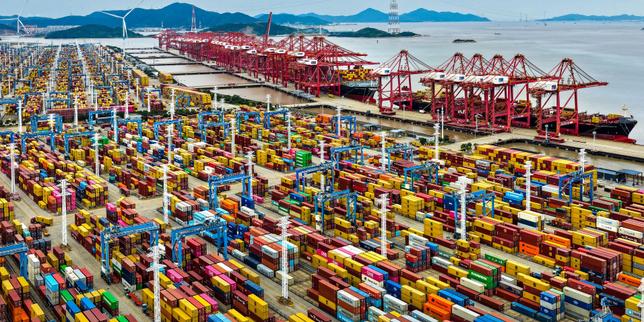
Salt air tastes sharper at three in the morning. Standing above a deep-water berth in East Asia, you hear the low, vibrating hum of diesel generators, the metallic clack of twist-locks snapping into steel corners, and the steady hiss of hydraulic brakes as a gantry crane lowers a twelve-meter box onto a deck already crowded with thousands of others. Every container carries a promise made somewhere else: solar panels bound for European rooftops, electric vehicles headed to Southeast Asian showrooms, circuit boards and machine tools ordered by factories an ocean away.
Numbers tell us that this engine is roaring. Record trade surpluses, surging outbound shipments in clean energy and automobiles, factory floors humming with automation. On a spreadsheet, an export boom looks like triumph.
Yet out on the quay, past the floodlights and the painted hulls, a quieter tension lingers. Why does a country capable of building high-speed rail networks, orbiting space stations, and shipping goods to every corner of the globe still feel hesitant when ordinary families walk past a real estate sales office or check their retirement balances?
I have spent years walking port terminals and watching industrial supply chains expand from dusty coastal towns into automated megahubs. Every time I see a fresh stack of exports roll toward the dock, I feel two things at once: awe at the sheer engineering scale, and a nagging unease. Because I have also sat in small apartments where the air conditioner runs only in peak heat, listened to young graduates talk about saving rather than spending, and watched local shops wait for customers who are still nursing bruises from a property downturn.
When I try to untangle the macroeconomics of export-led growth versus domestic consumption, I sometimes feel like a student staring at two equations that refuse to cancel out. Economists argue over real estate debt, household savings rates, demographic shifts, and foreign tariffs. None of those phrases is simple, and pretending they are neat only hides what is really happening to people.
When the Factory Outruns the Living Room
To make sense of an economy leaning heavily on exports, it helps to use a metaphor: a household where one person works nonstop overtime to bring in cash while the family keeps patching a leaky roof instead of buying groceries. This is a metaphor, of course—nations are not single households—but it captures the imbalance between making things for the rest of the world and building confidence at home.
Consider a hypothetical scenario to see how that imbalance plays out behind closed doors. Suppose Lin is a thirty-two-year-old software and automation engineer living in a bustling southern city. Her company’s overseas orders are up, and her team works late to meet foreign delivery schedules. Lin earns a decent salary, yet she keeps her spending tight. Years ago, like millions of peers, she watched apartment prices climb on borrowed optimism, only to see unfinished towers, falling resale values, and anxious neighbors when the property boom cooled.
Lin is not broke. She is cautious.
When a family’s wealth is tied up in housing that suddenly feels fragile, every extra yuan feels like armor rather than spending money. A new sofa can wait. A weekend trip across the province can wait. Even medical checkups or private tutoring get weighed against an uncertain future. Meanwhile, factories keep churning out goods because external buyers—from North America to Europe and the Global South—still want competitive prices and scale.
But the real problem lies elsewhere: relying on foreign demand to carry an economy that has grown to roughly nineteen trillion dollars is like trying to power a skyscraper with a garden hose. Even record exports can only lift so much weight when domestic consumption drags behind.
Look closely at what that image represents in human terms. Each steel box is a triumph of logistics, cost discipline, and industrial grit. Behind every shipment stand engineers who stayed up perfecting battery chemistry, logistics planners routing vessels around bottlenecks, and factory operators running precision lines.
Still, a container ship leaves value at the dock only if the money earned from selling to the world circulates back into higher wages, stronger social safety nets, and households that feel secure enough to open their wallets. When export growth races ahead while domestic demand limps, the economy can look mighty from the outside while feeling heavy on the inside.
The Weight of Unfinished Towers and Empty Desks
History shows that no major industrial power stays reliant on external buyers forever. For decades, rapid urbanization and property construction acted as a second engine alongside exports. Cranes rose over every skyline. Concrete, steel, glass, and household appliances flowed into newly built apartments.
Then the tide turned. Years of overbuilding left millions of unsold or half-finished homes, straining local government finances that had leaned heavily on land sales and leaving households wondering what their biggest asset is actually worth.
Consider another hypothetical scenario: Ming, a forty-six-year-old contractor who spent fifteen years managing interior fit-outs for residential complexes. Five years ago, his phone rang nonstop with jobs tiling bathrooms, installing cabinets, and wiring lighting fixtures for families moving into new neighborhoods. Today, his calendar has wide gaps. When he does take a job, margins are thin and payments arrive slowly.
Ming knows how to build interiors for a domestic market. He cannot easily pack his drywall tools into a shipping container and sell them to a buyer in Rotterdam or Jakarta.
This is the invisible stake inside an export-heavy economy. Trade statistics highlight winners—electric vehicles crossing oceans, solar modules powering distant grids, industrial robots replacing repetitive labor. Those sectors are genuinely dynamic and globally competitive. Yet they employ a fraction of the workforce compared to services, retail, construction, and local small businesses.
When domestic consumption stays subdued, price competition turns fierce inside the country too. Companies fight for a limited pool of local buyers by cutting prices. Lower prices sound like a bargain at first glance, yet across an entire economy, persistent price wars can squeeze business profits, hold back wage growth, and nudge consumer prices toward deflationary pressure.
And what happens when foreign governments push back against a flood of cheap exports with tariffs, investigations, or supply-chain rules? Suddenly, the very engine pulling the train meets headwinds at the border.
Why Fixing the Balance Is Harder Than It Looks
If the answer were as simple as telling people to spend more, policymakers would have solved it years ago. Spending is not a light switch; it is a mirror of trust.
A young worker looks at healthcare costs, eldercare responsibilities, and job stability in a shifting market. If out-of-pocket medical bills feel unpredictable or retirement pensions feel thin, saving feels rational. Even when interest rates are low or incentives are offered on appliances and trade-ins, households often treat a discount as a reason to buy what they already planned—not a reason to take on new commitments.
Local governments face their own bind. For years, selling land leases funded roads, schools, and clinics. As property revenues shrank, many municipalities found themselves carrying heavy debt loads while trying to keep public services running. You cannot easily stimulate household confidence when local budgets are stretched tight.
Yet dismissing the strengths of this economy would be just as distorted as ignoring its cracks. Few places on earth can match the speed at which supply chains adapt here. When a design changes on a Tuesday, prototypes can be machined, tested, and scaled with astonishing speed. That industrial muscle is real, hard-won, and unlikely to vanish overnight.
Perhaps the hardest truth is this: rebalancing an economy is slow work. Shifting from investment-and-export momentum toward consumption-led growth means strengthening social protection so families feel less exposed to shocks, resolving property overhang without triggering panic, and helping domestic service sectors thrive alongside high-tech manufacturing.
None of that happens in a single quarter. It takes patience, coordination, and a willingness to measure success not only by tonnage leaving the port, but by peace of mind inside ordinary homes.
Back on the Quay at Dawn
By five in the morning, the East Asian sky begins to bruise from black to slate blue. Out beyond the breakwater, another vessel waits for its pilot boat, dark hull riding low in the swell. Behind the terminal gates, trucks line up in neat rows, headlights cutting through coastal mist as drivers sip hot tea before another shift begins.
The cranes keep moving. The spreadsheets will keep tallying billions in outbound trade, and analysts will keep debating whether exports alone can carry the load.
Somewhere across town, an alarm clock rings in a quiet apartment, a parent checks the cost of groceries and school fees, and a young engineer decides whether this is the year to save a little more—or finally take a chance on a life built at home.


