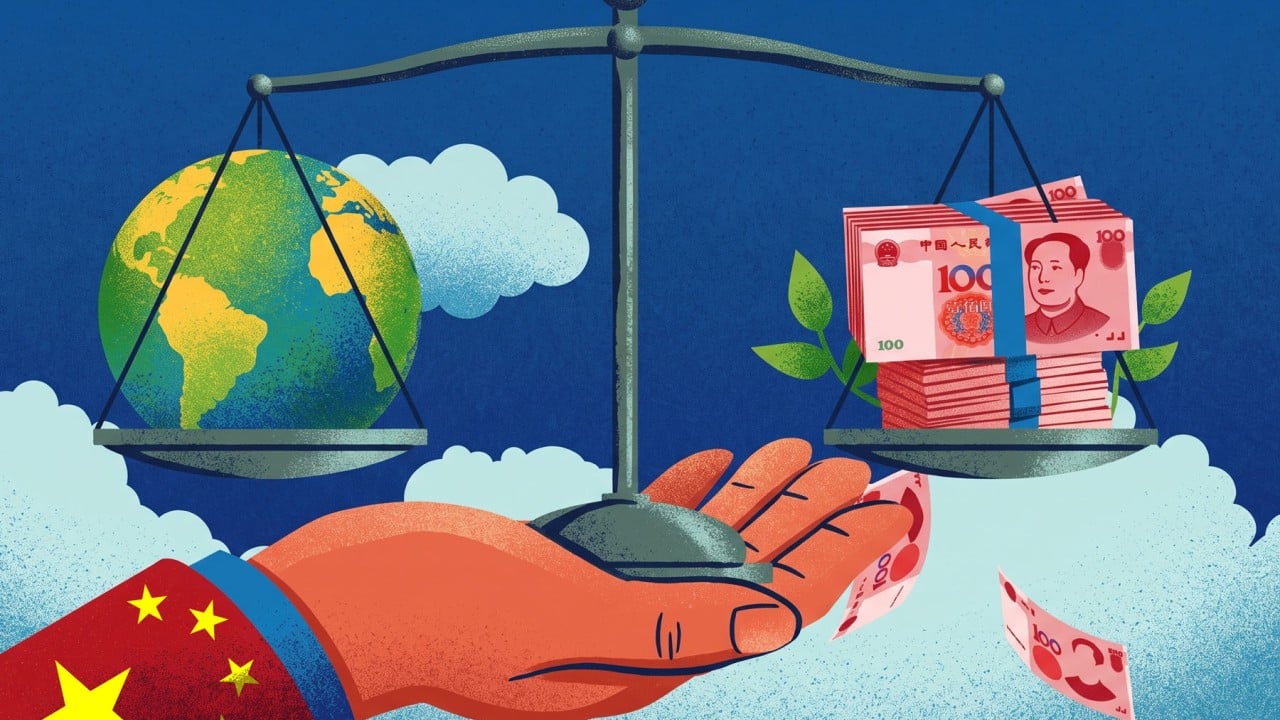
Two trains leave the same station at dawn. One carries lithium batteries, solar wafers, and high-voltage grids humming with quiet ambition. The other carries concrete dust, unsold apartments, and the heavy sigh of an unpaid invoice.
Look at the map from thirty thousand feet and the lines blur together. Call it China. Call it an economic miracle hitting a speed bump. Call it whatever polite phrase economists use when they want to sound calm about billions of dollars of friction. Yet down on the platform, the noise is deafening, and the air smells like ozone on one track and wet plaster on the other.
Economist Robin Xing has spent years mapping that split—a "two-speed" economy where surging advanced manufacturing and green industries run at one pace while property, local government debt, and domestic consumption drag at another. On paper, a two-speed economy looks like a textbook puzzle. In living rooms, factory floors, and county treasuries, it feels like trying to steer a car whose left wheels are spinning on ice and whose right wheels are sunk in mud.
I have stood in Shenzhen glass towers where engineers drink iced Americanos at midnight while servers compile code for autonomous drones. I have also sat on plastic stools outside half-finished apartment blocks in third-tier cities where the cranes stopped turning months ago and the weeds already know the names of the cracks in the pavement. Watching both worlds in a single week does something strange to your sense of time. One hour feels like 2035. The next feels like a bad memory.
And honestly, if you find this whole picture confusing, you are in good company. Even seasoned analysts sometimes stare at the numbers and wonder how a nation can lead the world in electric vehicles and clean energy hardware while wrestling with sluggish household confidence at home. When a system pulls in opposite directions at once, conventional wisdom starts sounding like guesswork.
Two Clocks Ticking in the Same Room
To see why this split matters, let's build a hypothetical scenario—a composite picture drawn from real economic mechanics rather than a single real person. Let's call him Lin Wei, an electrical engineer in his late twenties working on grid storage systems in southern China, and let's place him beside his cousin Meihua, who runs a small home-decor shop two provinces away.
For Lin Wei, the engine is roaring. Global demand for solar modules, batteries, and smart industrial equipment has pushed export-oriented high-tech sectors forward with fierce momentum. Orders arrive. Supply chains hum. Factories automate faster than training manuals can be rewritten. Lin Wei sees colleagues getting promoted, laboratories expanding, and export containers stacking up like colorful blocks bound for ports across Europe, Southeast Asia, and Latin America.
Now walk into Meihua's shop on a Tuesday afternoon.
The shelves are neat. The lighting is warm. Almost nobody comes in.
Meihua isn't failing because her curtains are poorly sewn. She is feeling the gravity of the slower speed. For years, property values sat near the center of household wealth and confidence across China. When housing cools and local governments—long dependent on land sales—face tight budgets and debt pressures, the ripple moves slowly, quietly, like cold water seeping under a door. Families hold onto cash. A municipal contractor waits months to get paid. A shopkeeper watches foot traffic thin out and wonders whether a discount will bring buyers back or just shrink already thin margins.
One cousin lives inside a sprint. The other lives inside a stall.
This is the central tension Robin Xing highlights when examining how a two-speed economy can address contrasting problems: China does not face a single uniform crisis or a single uniform boom. It faces two realities colliding inside one national balance sheet. Treating them with one blunt instrument—either flooring the gas pedal everywhere or slamming the brakes—risks overheating what already works while starving what still hurts.
Think of it like heating an old house with a single thermostat in the draftiest hallway. If you crank the heat to warm the freezing back room, the front parlor turns into a sauna and your utility bill skyrockets. If you turn the dial down to save money, the parlor stays comfortable while pipes freeze in the back.
Why Old Fixes Stop Fitting New Cracks
History rarely repeats itself in neat costumes, though it loves reusing old habits. For decades, credit-fueled infrastructure and real estate expansion served as the reliable heavy lifter whenever growth cooled. Pour concrete, lay track, build towers, hire crews, watch steel and cement demand jump. Simple. Visible. Measured in tons and square meters.
That playbook built modern cities and world-class transit networks. Nobody who rides a high-speed train at three hundred kilometers per hour doubts what physical build-out achieved.
Yet physical build-out has a ceiling. Once a city already has bridges, subways, airports, and plenty of housing stock, pouring more concrete yields smaller returns and heavier debt. You cannot solve a confidence or balance-sheet drag in property and local finances simply by building another empty commercial plaza. Worse, funneling cheap credit into low-return projects when advanced industries already have strong momentum can widen imbalances rather than heal them.
Consider what happens next when policymakers look at both speeds at once:
If support goes almost exclusively to high-tech manufacturing and exports, the fast track gets faster—potentially running into trade friction, tariff walls, or intense price wars at home—while household spending and property stabilization lag behind. If stimulus instead floods old property channels indiscriminately, it can delay necessary balance-sheet cleanup and waste scarce capital.
Neither extreme solves the contrast. Both leave half the room uncomfortable.
A two-speed economy forces a sharper question. How do you let the fast engine keep innovating without letting it carry all the weight alone, while gently unclogging the slow engine without blowing up the transmission?
Turning Speed Into Balance
Here is where the idea of a two-speed economy shifts from a diagnosis to a strategy. Instead of viewing the gap between fast and slow sectors purely as a flaw to erase overnight, policy and business leaders can treat those two speeds as complementary tools—provided each is matched to the right problem.
Let's stay with Lin Wei and Meihua for a moment—again, a fictional pairing built to make abstract economic trade-offs tangible.
On the fast track, the priority is productivity, technological upgrading, and moving up the value chain. Advanced manufacturing, green transition technologies, and industrial automation thrive on patient capital, engineering talent, scale efficiencies, and fierce competition. When these sectors stay efficient and competitive, they generate high-value output and long-term industrial strength.
Yet even a fast train needs stations where passengers actually step off with money to spend.
On the slower track, the problems are more delicate and more human: easing debt burdens carefully, stabilizing real estate expectations without reigniting speculation, repairing local government fiscal health, and giving households stronger reasons to spend rather than hoard precautionary savings. Better social protection, steadier job quality in service industries, and cleaner balance sheets do not make flashy headlines the way a new factory launch does. They do something quieter. They help Meihua see a customer walk through her door with a smile instead of a furrowed brow.
Watch what happens when those two efforts align.
Targeted structural support—such as debt resolution, interest relief where appropriate, housing inventory management, and measures that bolster household income and social safety nets—addresses the slow track directly. Meanwhile, letting high-value manufacturing and green industries pursue efficiency and innovation—while avoiding disorderly race-to-the-bottom price wars—keeps the fast track productive without forcing it to shoulder every social or fiscal burden by itself.
It is delicate work. Timing matters. Sequencing matters. A policy that sounds clever in a research note can feel clumsy on a main street if rolled out too late or too timidly. And uncertainty remains real: external trade headwinds, shifting global supply chains, and cautious consumer psychology do not vanish on command.
Still, recognizing that different parts of the economy are moving at different speeds is already half the battle. You cannot prescribe cough syrup for a sprained ankle, and you cannot fix household caution with another steel mill.
The Human Ledger Behind Every Number
Economists love clean charts. Red line up, blue line down, shaded gray boxes for recessions or transitions. Those charts are useful—essential, even—for spotting turning points before the naked eye catches them.
Still, numbers don't feel tired. People do.
A young engineer in a cleanroom feels the thrill of building next-generation hardware, alongside the quiet pressure of long hours and fierce competition. A small-business owner in an inland city feels the weight of fixed rent against unpredictable foot traffic. A local official tries to pay public workers and maintain roads while land revenues shrink. A parent wonders whether housing prices will stabilize enough to make buying a home feel sane again.
When people talk about China's two-speed economy, the debate often gets trapped in slogans—boom or bust, miracle or stall, factory of the world or stuck in transition. Both slogans flatten a complex reality into a caricature.
The truth is messier and more interesting. A giant economy is recalibrating its gears while still in motion. One set of gears spins fast toward advanced industry and green energy. Another set grinds slowly through post-property adjustment, debt repair, and the hard work of convincing everyday families that tomorrow feels steadier than yesterday.
Reconciling those two speeds will not happen with a single dramatic speech or a magic switch. It takes steady hands, honest accounting, targeted relief where friction is highest, and room to innovate where momentum is real.
Picture Lin Wei stepping out of a sleek transit station at dusk, phone buzzing with project updates, while across the country Meihua locks her shop door, counts the day's modest receipts, and looks up at a sky turning deep indigo. Two clocks. One roof. And the quiet, urgent work of making sure both of them keep time.