Small.
That is the first word that surprises almost anyone who steps into the quiet conservation lab after staring at the towering ranks of the Terracotta Army. Standing in front of a life-sized clay soldier, your eyes lock onto armor plates, heavy boots, mustaches, and stern imperial expressions. You picture broad-shouldered men hauling sacks of damp earth and rolling thick coils of clay until a general takes shape.
Then you look at the ridges pressed into the wet clay behind an ear, inside a hollow leg, or along the rim of a sleeve.
The ridges are narrow. Tightly packed. Finer than what you expect from a grizzled stonemason or a seasoned veteran soldier.
For decades, the popular story of Qin Shi Huang's mausoleum in Xi'an leaned heavily on a single image: vast battalions of men laboring under state command to guard the First Emperor in the afterlife. Some of those men were certainly there. Master sculptors shaped distinctive faces. Skilled craftsmen assembled limbs and heads. Yet forensic scrutiny of batch fingerprints pressed into the clay has complicated that tidy picture, pointing toward a far wider workforce—one that likely included women and children—and forcing us to rethink who actually built the monument.
Let me admit something right away: when you first hear that women and children may have played a major role in shaping the terracotta warriors, a quiet knot of skepticism can form in your chest. History has a habit of turning every new clue into a sensational headline. Is a narrow fingerprint proof of a child's hand, or could it belong to a petite adult? How do researchers separate genuine patterns from guesswork when clay shrinks, warps, and bakes in a kiln?
Those doubts are healthy. If we rush past uncertainty, we trade one myth for another.
To see how a tiny ridge in baked earth becomes a human story, think of a fingerprint like a signature left in wet snow. (This comparison is a metaphor to illustrate how soft clay preserves physical contact.) If a boot steps into fresh snow at dawn and the sun softens the edges by noon, you might still tell whether the tread belonged to a heavy work boot or a small shoe, even if you cannot read every micro-detail. Clay behaves in a similar way. Before firing, it yields to every press of a thumb or fingertip. Once fired in high heat, it hardens into stone-like durability—locking those impressions in place for more than two millennia.
The Myth of the Monolithic Workshop
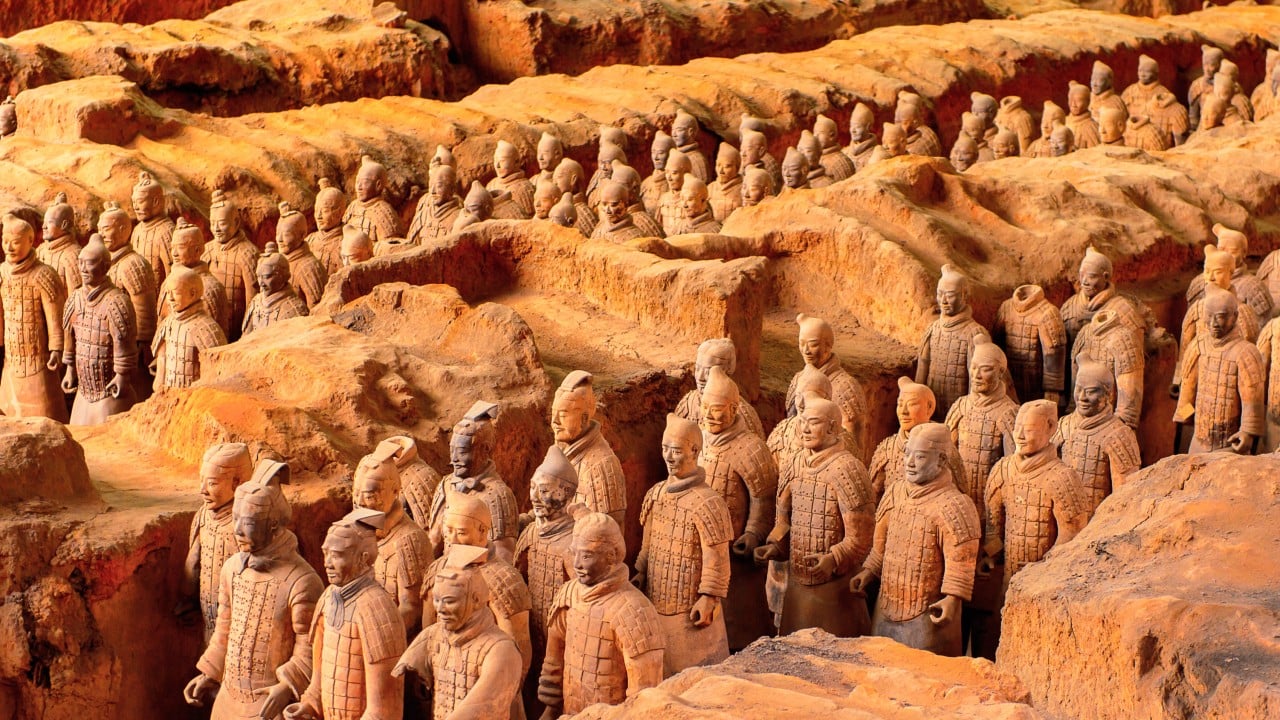
Walk down the sunken trenches of Pit 1 in Xi'an, and the sheer scale presses on your ribs. Rows of warriors stretch into the distance, facing east, frozen in silent formation. Each figure is roughly life-sized, heavy, and constructed in sections—legs, torso, arms, head—joined together so kilns could fire them without shattering.
When historians and visitors imagine an enterprise of that scale in the third century BCE, they often default to a single mental template: big projects belong to big men. War, heavy industry, imperial construction—we subconsciously assign them all to adult male laborers.
Consider what happens next: we look at the finished warrior and project the soldier's outward toughness onto the maker.
A fierce jaw and layered cuirass look masculine, so we assume masculine hands sculpted them from start to finish. Yet ancient Chinese state projects—from road building and canal digging to workshop production—regularly mobilized broad swaths of the population through corvée labor, penal service, and family-linked obligations. Workshops were not isolated monasteries of solitary geniuses. They were organized production lines.
Someone dug and tempered the clay. Someone rolled slabs and coils. Someone smoothed seams, attached ears, or pressed details into armor and hair.
A single warrior required coordination across stages. When researchers examine recurring ridge patterns and ridge spacing across sections of figures—often referred to in archaeological reporting as batch fingerprints—they are looking for clues about who handled the clay during those stages. Ridge density, or how closely packed the friction ridges are within a given area, tends to correlate on average with hand and finger size. Younger hands and smaller hands generally leave finer, more closely spaced ridges than large adult hands, though overlap always exists and scientists treat ridge spacing as a statistical clue rather than a magic lie detector.
That distinction matters. Science does not whisper neat answers; it argues carefully with probabilities.
A Morning in the Clay Yard
To feel what workshop life might have been like without pretending we have a time machine, let us picture a hypothetical morning in an ancient kiln yard near Mount Lishan. (Note: The following scene and characters are hypothetical reconstructions built to illustrate plausible workshop conditions based on archaeological and historical context.)
Lin is eleven years old, her knuckles gray with dried loess clay before the sun clears the ridge. Beside her kneels Mei, a woman in her late twenties whose hair is pulled back tightly so stray strands do not fall into the wet paste. Neither of them holds a chisel that carves an emperor's likeness. Instead, their job is relentless repetition: wedging clay to drive out air pockets, pressing coils along an interior wall, smoothing a joint before the surface dries too fast.
Air trapped inside a thick clay wall is a death sentence in the kiln. Heat expands trapped air, and a single pocket can blow a warrior's torso apart during firing. So Mei's thumbs press firmly, methodically, overlapping stroke after stroke. Lin's smaller fingers reach into tighter corners, bracing a seam from the inside while an older craftsman works the outside.
Their fingertips are raw. Clay pulls moisture from skin hour after hour, leaving cracks near the nails that sting whenever water or grit gets in. When they pause, they do not admire a finished statue. They look at a stack of damp components waiting for the next step, listening to the crackle of wood fires and the shouts of overseers pacing the floor.
If you have ever spent a long afternoon working with stiff modeling clay or kneading heavy dough until your forearms ache, you know a fraction of that physical toll. Now stretch that effort across seasons, under strict imperial quotas, where a cracked piece or a missed schedule carries real consequences.
Suddenly the warriors do not look like cold stone guards alone. They start to look like archives of human endurance.
Why Fingerprints Are Both Revealing and Tricky
If batch fingerprints tell such a compelling story, why do careful scholars urge caution rather than sweeping certainty?
Because ancient evidence is messy.
First, clay changes shape. When wet clay dries, water evaporates and the body shrinks slightly. When it fires in a kiln, further physical and chemical changes occur. A ridge pattern preserved on baked terracotta is a faithful record of the impression left before firing, yet interpreting exact age or biological sex from ridge breadth alone has real limits. A small adult woman can have narrower ridges than a large man, and an older teenager's hands can approach adult proportions.
Second, a single warrior may carry marks from multiple people. One worker might shape a lower leg; another might join an arm; another might smooth a collar. Finding fine ridges on one part of a statue does not automatically prove every part of every statue was made by a child or a woman.
Third, context must anchor the measurement. Fingerprint analysis is strongest when paired with workshop layouts, tool marks, historical records of Qin labor mobilization, and studies of skeletal remains from the wider mausoleum complex. When all those lines of evidence point in a similar direction—showing a massive, multifaceted labor force drawn from diverse social groups—the picture gains weight.
Admitting these uncertainties does not weaken the story. It makes it honest. History is not a photograph; it is a mosaic with missing tiles, and pretending every tile is whole only invites distortion.
The Invisible Stakes of Who Gets Remembered
Why does it matter whether women and children made up a major share of the hands behind the Terracotta Army?
At first glance, an emperor's tomb is an ancient curiosity. Thousands of years have passed. Nobody alive today is owed back wages by the Qin dynasty.
But the real problem lies elsewhere: how we write human history shapes who we believe counts.
When monumental achievements are told exclusively as stories of rulers, generals, and adult male artisans, whole populations vanish from the cultural memory. Women's labor—especially unpaid, domestic, or auxiliary workshop labor—has historically been undercounted or treated as incidental. Children's labor in the ancient world is even easier to overlook, even though young hands were routinely put to work in agriculture, textiles, mining, and crafts across pre-modern societies.
Look at what happens when we recognize those smaller prints in the clay.
The monument stops being merely a vanity project of an autocrat who feared death. It becomes a mirror of an entire society's mobilization—a reminder that grand spectacles of power rest on thousands of ordinary bodies, many of them vulnerable, many of them nameless.
There is an emotional weight to that realization that no textbook summary captures. You stand before a warrior with broad shoulders and an imposing stance, and beneath the heroic exterior you sense the quiet presence of people whose names never made it onto any tablet. A mother pressing clay so her family could survive the season. A child learning the rhythm of wet earth before learning how to read or rest.
We do not have to romanticize harsh labor to honor the people who endured it. In fact, honoring them requires refusing to erase them.
Reading the Clay With Clear Eyes
Suppose you visit the pits in Xi'an—or look at photographs from home—and want to see the terracotta warriors with sharper eyes. You do not need a magnifying glass or a forensic lab to shift your perspective. You just need to slow down and ask different questions.
Look past the face first. Notice how the sculpture is built. Think about the clay itself: dug from the earth, carried, wedged, shaped, dried, fired, and moved into position. Every stage required time, fuel, coordination, and human muscle.
Ask who stood at each station. Ask what skills required years of specialized training versus what tasks demanded steady hands, stamina, and obedience. Ask what happens to our understanding of ancient economies when we stop assuming that monumental art came solely from elite workshops.
When you do that, the Terracotta Army becomes richer, stranger, and more human. It holds both imperial ambition and everyday labor, both grand design and tiny, accidental marks left behind in soft mud.
A single ridge in baked clay cannot speak a name or tell a whole life story. Yet across thousands of figures, those quiet impressions accumulate like whispers in a long hall.
Look closely at the clay, and the army is no longer made of soldiers alone.