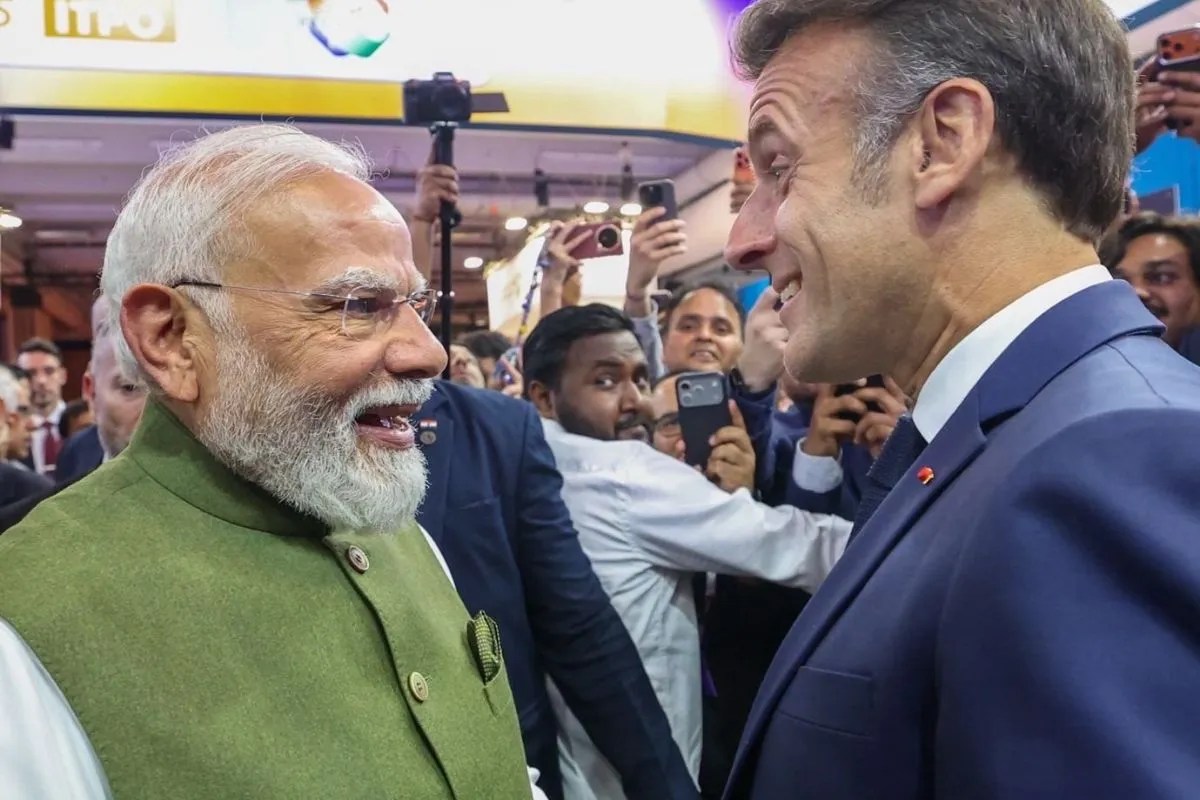
The grand halls of the Élysée Palace are built to intimidate. For centuries, these high ceilings, gilded mirrors, and echoing marble floors have witnessed the cold chess match of global politics. Here, treaties are signed with practiced indifference. Handshakes are calculated down to the millimeter. Whispers in French or English carry the weight of empires, structured by a rigid, unspoken protocol that strips away the messy reality of being human.
But every so often, the script breaks.
When the formal dinners end and the television cameras are packed away, a different kind of diplomacy begins. It is quiet. It is deeply personal. It happened recently when French President Emmanuel Macron sat down, looked at a screen, and decided to bypass the centuries of French linguistic pride to type a message entirely in Hindi.
“प्रिय मित्र नरेंद्र, मुझे बहुत खुशी हुई।”
Dear friend Narendra, it gave me great joy.
To a casual observer scrolling through a social media feed, it was a polite gesture. A routine PR move. But look closer. In the high-stakes theater of international relations, where every syllable is weighed by committees of seasoned diplomats, a European head of state adopting the script of New Delhi is not just polite. It is a calculated act of emotional resonance. It is an acknowledgment that the old world order, dominated by Western defaults, is shifting beneath our feet.
The Cold Friction of Modern Diplomacy
International relations usually feel detached from ordinary life. We read about trade deficits, defense procurement, joint communiqués, and strategic autonomy. These words feel heavy, dry, and entirely devoid of blood. They sound like legal contracts because, fundamentally, that is what they are.
Consider the sheer friction of a state visit. Two leaders from entirely different worlds, carrying the burdens of billions of citizens, sit across a table. One represents a Western European republic with deep colonial histories and a fierce protective instinct over its language and culture. The other represents an ancient civilization turned economic powerhouse, fiercely proud of its sovereignty and cultural resurgence.
The natural default in these rooms is caution. You state your terms. I state mine. We find a middle ground, sign the paper, and smile for a photograph that looks exactly like every other photograph taken in that room since 1945.
But treaties do not hold nations together during crises. Trust does. And trust is a remarkably fragile human emotion that cannot be manufactured by bureaucrats in a boardroom. It requires something raw. It requires a breaking of the formal posture.
When Macron chose to send his farewell message in Hindi, he was doing something far deeper than translating a press release. He was signaling a vulnerability. To speak another leader’s language badly, or even to use it in a formal public space, is to step off your own pedestal. It is an admission that the relationship matters enough to warrant the effort of crossing the linguistic divide.
The Power of the Mother Tongue
Language is an emotional map. When you speak to a leader in English, you speak to their intellect, their education, and their office. When you speak to them in their native tongue, you speak to their home.
Imagine walking into a room where everyone speaks a language you learned for business. You navigate it easily. You are competent, sharp, and alert. Then, someone walks up and speaks the specific dialect of your childhood neighborhood. Instantly, your shoulders drop. Your guard lowers. The psychological distance between you and that person collapses.
This is the invisible leverage Macron used. By addressing Narendra Modi not just as a prime minister but as a "dear friend" in Devnagari script, he bypassed the sterile diplomatic channel. He made the relationship personal in front of a global audience.
The gesture stands out because France is historically obsessed with its language. This is a nation that has a state academy dedicated to protecting French from foreign influence. For a French president to elevate Hindi on his official channels is a profound departure from tradition. It tells the Indian public that France does not just see India as a market for fighter jets or a strategic counterweight in the Indo-Pacific. It sees India as an equal.
History shows us that these small, human deviations from protocol are often what define eras. Think of the historic walk through the woods between Mikhail Gorbachev and Ronald Reagan at Geneva in 1985. The formal negotiations had stalled. The air was thick with Cold War tension. But when the two men walked away from their advisors and sat by a fireplace in a small cabin, the humanity of the situation broke the ideological deadlock. They realized they were just two men terrified of nuclear annihilation. The treaty followed the human connection, not the other way around.
The Unspoken Stakes of the Indo-French Alliance
Behind the warmth of the Hindi tweet lies a complex web of modern anxieties. The world is fracturing into new power blocs. The old alliances that defined the post-Cold War era are fraying at the edges.
France finds itself in a delicate position. It wants to maintain its leadership within Europe while asserting its independence from the foreign policy dictates of Washington. India, meanwhile, is navigating its own rise, balancing its historical ties with Russia against its growing partnerships with the West, all while keeping a watchful eye on its borders.
They need each other.
- France needs a reliable, powerful anchor in Asia that shares its vision of a multipolar world where no single nation dictates the rules.
- India needs a partner in Europe that understands the nuances of strategic autonomy—a partner that will sell advanced technology without attaching moralizing lectures to the contract.
But how do you convey that deep, structural alignment to the average citizen in Paris or Mumbai? You cannot do it with a 40-page defense agreement. You do it by showing the leaders sharing a moment of genuine mutual respect.
The farewell message was the exclamation mark at the end of a visit filled with symbolic weight. Modi had been the guest of honor at the Bastille Day parade, an honor reserved for the closest of allies. Indian troops had marched down the Champs-Élysées. The message in Hindi was the final piece of the puzzle, wrapping a weekend of military and economic pageantry in a warm, human blanket.
Moving Beyond the Script
We live in an era deeply cynical of political theater. We assume every smile is rehearsed, every handshake is timed, and every tweet is drafted by a 22-year-old staffer trying to optimize an algorithm. That skepticism is healthy. It protects us from being deceived by superficial charm.
Yet, even within the theater, the choice of script matters. The fact that Macron’s team knew that a Hindi message would resonate so deeply within India shows an understanding of the modern Indian psyche. It acknowledges a nation that no longer wishes to be spoken to only in the colonial language of the past, but expects its own culture to be recognized on the global stage.
It leaves us with a striking realization about how power operates in the modern world. The nations that will thrive are not necessarily those with the largest armies or the biggest economies, though those matter immensely. The nations that will thrive are those that understand the human element of statecraft.
The true test of the Indo-French partnership will not be measured by the poetry of a social media post. It will be measured in the quiet rooms where bureaucrats argue over technology transfers, climate finance, and maritime security. The cold facts of geopolitics will always demand their due.
But as the dust settles on another historic state visit, the image that remains is not one of steel or treaties. It is the image of a French leader reaching across a cultural chasm to say, in the language of his guest, that he was glad they spent time together. In a world defined by rising walls and bitter divisions, that small moment of translation remains a powerful reminder that beneath the grand titles and the heavy burdens of state, history is still written by human beings.


