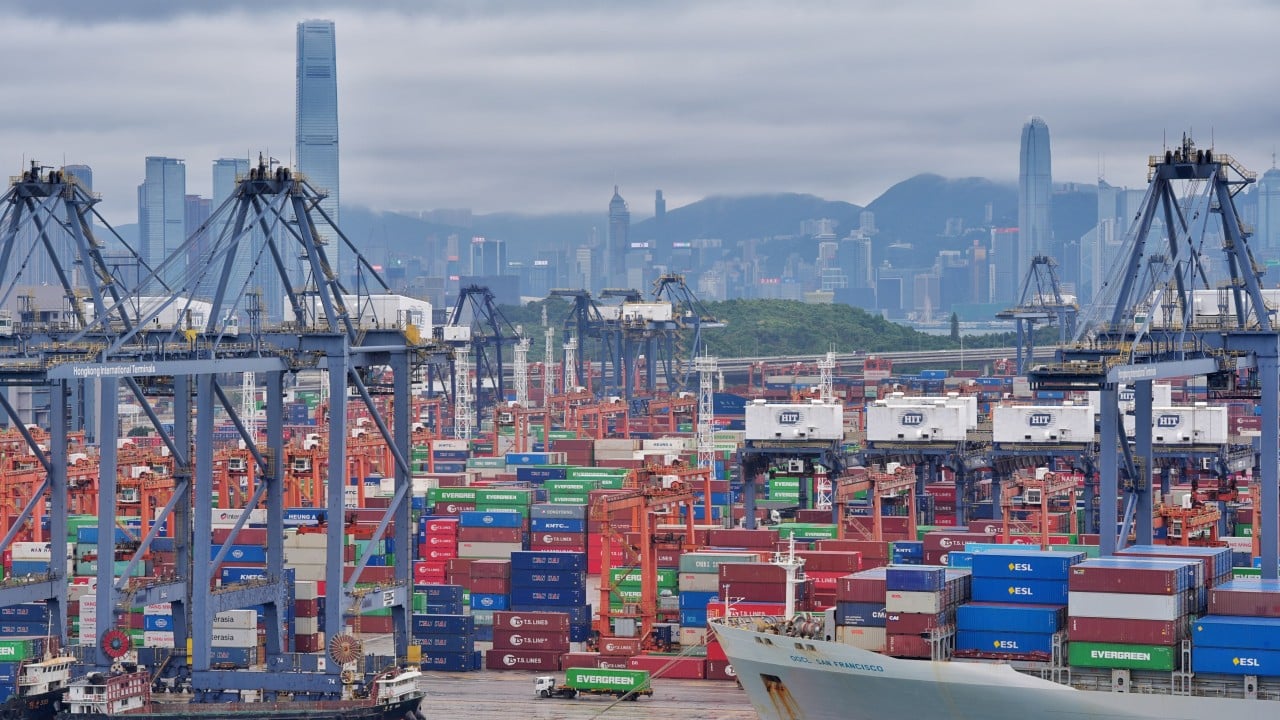
Hong Kong just posted a staggering 41 percent increase in exports for May, a number that sent shockwaves through regional trade offices. At first glance, the data points to a massive, roaring recovery driven entirely by the global hunger for artificial intelligence infrastructure. But numbers this large always hide a secondary narrative. While the headlines credit a generic tech boom, the actual engine of this surge is a highly concentrated, fragile trade in advanced semiconductors and electronic components being re-routed through the territory. It is less about a broad economic awakening and more about a high-stakes bottleneck.
To understand how a city-state can suddenly pump out 41 percent more outbound cargo in a single month, you have to look past the finished consumer gadgets. You have to look at the silicon.
The Transshipment Pipeline and the Silicon Appetite
Hong Kong does not manufacture microchips. It moves them.
For decades, the territory has operated as the primary free port for mainland China's massive electronics manufacturing ecosystem. When tech giants in Shenzhen, Guangzhou, or Hangzhou require specialized integrated circuits to build AI servers, high-performance computing clusters, or advanced telecommunications gear, those parts frequently clear customs through Hong Kong.
The current surge reflects an intense, synchronized push by hardware manufacturers to stock up on vital components. The global supply chain for high-bandwidth memory and advanced graphics processing units is notoriously tight. Manufacturers are buying everything they can get their hands on, as fast as factories in Taiwan, South Korea, and Japan can output them. Hong Kong role as a logistical frictionless zone means that when global chip supply loosens even slightly, the volume moving through its ports spikes violently.
This is not a steady rise in consumer demand. It is an industrial scramble. Companies are building massive war chests of physical components, anticipating both tighter export controls and potential future shortages.
The Distortion of Re-Exports
The raw data can easily mislead observers into believing Hong Kong domestic economy is experiencing an unprecedented industrial renaissance. It is not.
Nearly 99 percent of Hong Kong export volume consists of re-exports—goods that are imported into the territory and then shipped out to another destination without undergoing any significant manufacturing transformation.
Suppose a shipment of memory chips leaves a facility in Seoul. It lands at Hong Kong International Airport, sits in a logistics warehouse in the New Territories for 48 hours, and is then driven across the border into Shenzhen to be soldered onto an AI server motherboard. That single transaction registers as a massive spike in both Hong Kong imports and exports.
When the value of those specific chips inflates due to high global demand, the total export value of Hong Kong skyrockets, even if the actual physical volume of boxes moved does not increase at the same rate. We are witnessing a value inflation driven by the premium prices commanded by AI-grade hardware.
The Geopolitical Knife Edge
This trade volume thrives on a delicate legal and political status that is constantly under threat.
The Western world, led by the United States, has systematically tightened export controls on advanced computing technology destined for mainland China. These restrictions create a powerful counter-incentive for supply chain managers. The threat of future sanctions creates a "buy now" panic.
Every time a new restriction is rumored or announced, trade volumes spike in the short term. Companies rush to fulfill existing contracts and clear shipments before the legal window closes. Hong Kong remains the preferred channel for these rapid-response logistics maneuvers due to its deep capital markets and highly efficient customs processing.
But relying on a trade boom built on regulatory evasion and panic hoarding is incredibly risky. If Western regulators decide to close the remaining loopholes or treat Hong Kong trade status identically to mainland China's restrictive framework, this entire export pipeline could evaporate overnight. It is a growth engine running on borrowed time.
The Divergence of the Local Economy
The most glaring contradiction of this export boom is how little it reflects the reality on the ground for ordinary Hong Kong businesses.
Step away from the cargo terminals at Kwai Tsing and walk through the retail districts of Tsim Sha Tsui or Causeway Bay. The picture changes completely. Local retail sales have been sluggish, property values face persistent downward pressure, and domestic consumption remains muted.
- The logistics sector is generating high revenue, but the wealth is concentrated in multinational freight forwarders and chip distributors.
- Small and medium enterprises in Hong Kong do not participate in the semiconductor supply chain and see no benefit from a 41 percent jump in tech re-exports.
- Tourism and local services are recovering at a fraction of the speed of the electronic components trade.
This creates a dual economy. On one side is a hyper-efficient, globally connected air freight network moving billions of dollars in silicon every week. On the other side is a local service economy struggling to find its footing.
The Limits of the AI Freight Wave
Can this momentum be sustained through the rest of the year? The math suggests otherwise.
The massive percentage jump in May is partially a reflection of low base effects from the previous year, combined with an extraordinary concentration of high-value shipments clearing simultaneously. AI infrastructure deployment happens in waves. Hyperscale data centers order their components in massive blocks, leading to massive lurches in trade data rather than a smooth, predictable upward curve.
Once the current phase of data center build-outs nears completion, or when manufacturing capacity for advanced chips hits its physical ceiling, the export numbers will normalize just as rapidly as they spiked.
Physical infrastructure requires physical space. There are only so many specialized servers a data center can host before it runs into power and cooling limitations. The breakneck speed of hardware accumulation observed in May is an anomaly born of a unique historical moment where capital is flowing boundlessly into AI hardware, and supply chains are flying blind through a geopolitical storm.
Relying on a 41 percent export surge as proof of long-term economic health misses the structural vulnerability beneath the surface. Hong Kong has proven once again that its logistics network is unmatched in its speed and adaptability. But a port that lives by the volatility of the global tech supply chain can just as easily see its numbers plummet when the hoarding stops and the regulatory squeeze tightens.