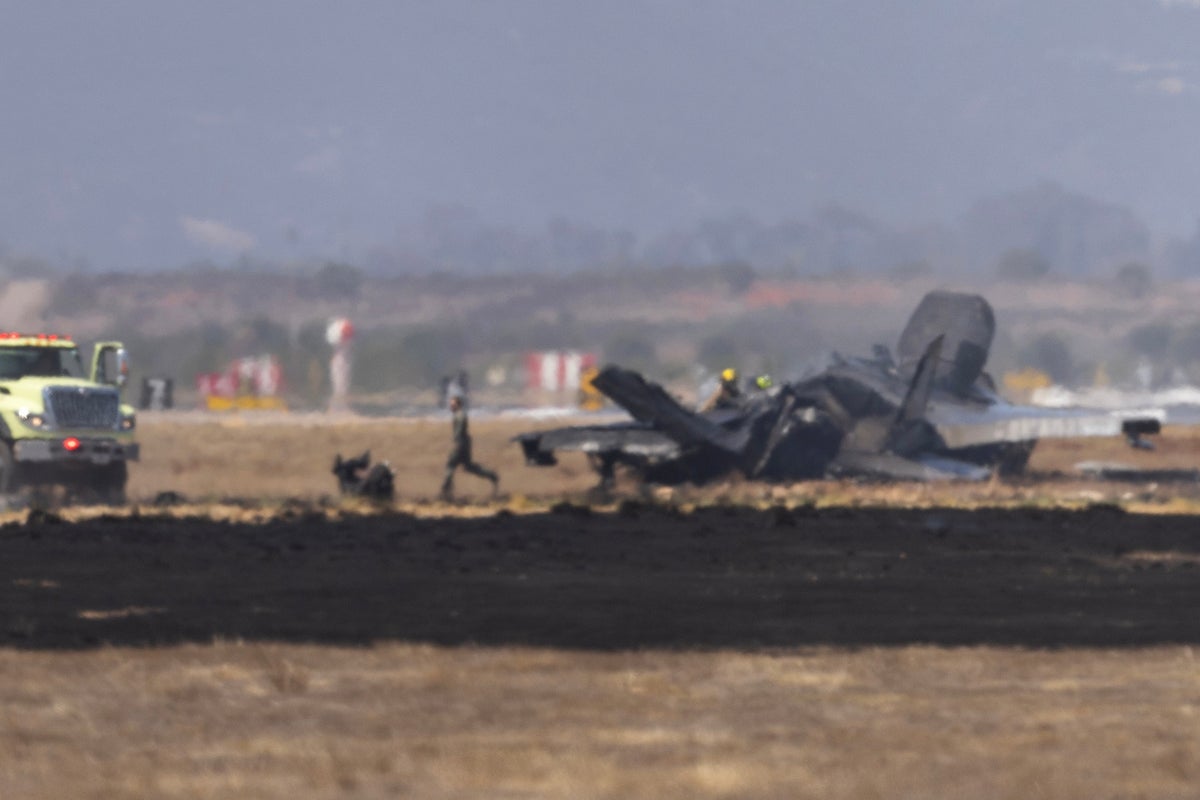
The pilot walked away. That is the headline defense contractors and military public affairs officers prefer you to focus on whenever an F-35B Lightning II goes down in the California desert or off the coast. A successful ejection is always celebrated as a victory of engineering, a testament to the Martin-Baker US16E ejection seat saving a life during a catastrophic failure. Yet beneath the relief of a surviving aviator lies an uncomfortable reality that aerospace analysts and defense insiders discuss in hushed tones away from the microphones. The F-35B crash statistics do not point merely to isolated pilot error or random mechanical anomalies. They expose a systemic friction point born from the extreme demands of short takeoff and vertical landing operations.
When an F-35B experiences a critical malfunction during the most critical phases of flight, the margin for human or machine recovery vanishes in milliseconds. Unlike the conventional Air Force F-35A or the carrier-variant F-35C, the short takeoff/vertical landing model carries an extraordinarily complex mechanical burden. It features a heavy, heat-ductile lift fan directly behind the cockpit, a drive shaft spinning at staggering RPMs linked to the engine, and a three-bearing swivel module capable of vectoring massive thrust downward. Every single one of these components represents a potential failure mode unique to the B-model. When something goes wrong close to the ground, the pilot has virtually no altitude to trade for time. Ejection is often the only remaining option, forcing the human element out of a multi-million-dollar machine because the flight envelope simply collapsed.
The Weight of Complexity in Vertical Flight
Engineering a fifth-generation fighter that can hover like a Harrier while maintaining supersonic capability is an exercise in compromise. To achieve vertical flight, the aircraft must divert massive amounts of power away from forward propulsion and into vertical lift infrastructure. This architectural necessity introduces profound weight penalties and intricate mechanical linkages that endure punishing thermal and physical stress.
During hover transitions, the aircraft relies on a computerized control system to continuously adjust aerodynamic control surfaces alongside reaction control valves on the wingtips and nose. If a sensor misreads atmospheric pressure, or if a hydraulic actuator hesitates by a fraction of a second, the aircraft can transition from a stable hover into an unrecoverable yaw or roll.
Veterans of the aerospace beat remember the promises made decades ago during the Joint Strike Fighter competition. We were told that advanced computing and fly-by-wire automation would completely eliminate the inherent hazards of vertical descent. That promise was oversold. Computers process data at lightning speed, but mechanical hardware still obeys the brutal laws of physics. High ambient temperatures, common across military testing ranges in California and the American Southwest, degrade engine performance and reduce thrust margins precisely when aviators need them most. When thrust drops unexpectedly in a hover, gravity does not negotiate.
The Human Toll and the Cost of Training
Ejecting from a modern fighter jet is an inherently violent event. The explosive charges that blast the canopy away and fire the pilot out of the cockpit subject the human spine to forces exceeding twenty times the pull of gravity. Even when a pilot survives an ejection with stable condition reports issued by military hospitals, the physical and psychological toll lingers for years.
Compressive spinal fractures, neck injuries, and traumatic vestibular damage are common occupational hazards for aviators who pull the ejection handle. Beyond the physical trauma sits the professional reality. A pilot who ejects loses an irreplaceable aircraft, triggering a cascade of safety stand-downs, fleet-wide inspections, and intensive board investigations.
Training pipeline requirements compound the pressure. Teaching a young officer to master the conventional flight characteristics of an invisible stealth fighter is difficult enough. Demanding that the same pilot also master the eccentricities of vertical landing on an amphibious assault ship deck or a dusty forward operating strip stretches human cognitive limits to the breaking point. The cognitive workload during a vertical descent is immense. The pilot must monitor engine temperature, lift fan door status, vectoring angles, ship motion or ground contour, and a flood of symbology projected onto their helmet-mounted display. Information overload is a constant threat. When multiple systems fail simultaneously, the transition from managing a complex aircraft to abandoning it happens almost instantaneously.
Supply Chain Realities and Maintenance Strain
Maintenance backlogs remain an unspoken contributor to operational incidents across the entire Joint Strike Fighter enterprise. Depot-level maintenance facilities face chronic shortages of spare parts, particularly for specialized subsystems unique to the B-model. When replacement parts are scarce, maintenance units are forced to stretch inspection intervals or rely on cannibalizing components from other airframes to keep operational readiness rates afloat.
This pressure trickles down to the flight line. Crew chiefs and avionics technicians work exhausting hours under immense pressure to maintain sortie generation rates mandated by leadership. While these technicians perform heroically under difficult conditions, the sheer complexity of the aircraft means that microscopic maintenance oversights can cascade into major in-flight emergencies. A loose electrical connector, a marginally seated hydraulic line, or a degraded sensor seal can trigger fault codes that confuse both the onboard diagnostics and the human crew trying to troubleshoot them.
Looking Past the Public Affairs Spin
Whenever an F-35B goes down, the standard public relations playbook swings into motion immediately. Officials emphasize that the pilot is safe, an investigation is underway, and flight operations will resume shortly after precautionary checks are completed. While these statements are factually accurate, they serve to sanitize the underlying structural issues plaguing the program.
The defense establishment is financially and strategically locked into the F-35 ecosystem. There is no alternative waiting in the wings to replace the Marine Corps' short takeoff/vertical landing requirement. Consequently, institutional inertia dictates that every crash is treated as a localized anomaly rather than a symptom of systemic over-engineering.
Until the Department of Defense and its primary contractors confront the fundamental limits of trying to force a single airframe to fulfill conflicting aerodynamic missions, pilots will continue to face unnecessary risks. The ability of an ejection seat to save a life is a magnificent achievement of safety engineering. It should never be used as a substitute for aircraft reliability.