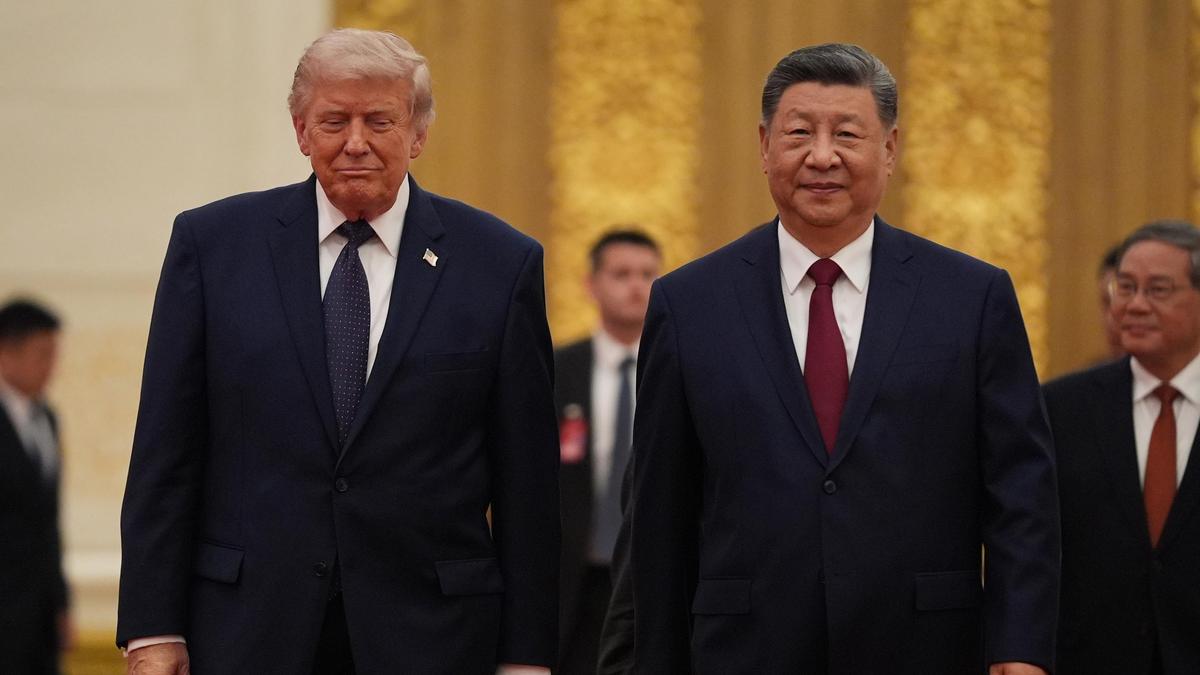
The official readout from the White House regarding the latest sit-down between Donald Trump and Xi Jinping used a specific, curated vocabulary to describe the encounter. They called it "good." They called it "productive." In the high-stakes theater of global hegemony, these words are effectively blank spaces. While the administration attempts to project an image of a stabilizing relationship, the underlying reality is a calculated stalemate. This meeting was not about a breakthrough. It was a tactical pause in a trade war that neither side can afford to lose, but neither side knows how to end.
The primary objective for the American delegation was to secure a massive purchase of agricultural goods, a move designed to shore up political support in the Midwest. China, meanwhile, sought a reprieve from the tightening noose of semiconductor export controls. On paper, both sides got a version of what they wanted. In practice, they simply reset the clock on a ticking bomb. For a different look, consider: this related article.
The Mirage of Agricultural Stability
For the American farmer, the "good" meeting translates to a temporary surge in soybean and corn exports. These are the visible wins that look excellent on a balance sheet during an election cycle. However, the reliance on these bulk purchases creates a dangerous feedback loop. By tethering the American agricultural sector to Chinese state-directed buying, the administration has handed Beijing a massive lever of economic coercion.
China does not buy American grain because it lacks alternatives. It buys it as a diplomatic deposit. The moment tensions flare over Taiwan or the South China Sea, those purchase orders can vanish overnight. We have seen this script before. When the market is dictated by political whims rather than supply and demand, the long-term health of the industry is sacrificed for a short-term headline. Similar insight regarding this has been shared by The New York Times.
The Silicon Ceiling and Technical Sovereignty
While the public face of the summit focused on trade deficits and farming, the private tension centered on the "Silicon Ceiling." The United States has aggressively restricted China's access to the extreme ultraviolet lithography machines and high-end AI chips necessary for the next generation of computing. Xi’s primary goal in Florida was to find a crack in this wall.
He found none.
The administration remains committed to a "small yard, high fence" strategy. This involves protecting a narrow set of technologies with significant military implications while allowing general trade to continue. The problem is that the "yard" is expanding every month. As AI becomes integrated into everything from logistics to healthcare, the definition of a dual-use technology becomes impossibly broad. China responded by accelerating its internal push for "technical sovereignty." They are pouring hundreds of billions into domestic chip fabrication, effectively forced into a corner where their only option is to build a parallel technological universe.
The Currency Question and Capital Flight
One factor conspicuously absent from the official briefings was the status of the Renminbi. For years, the U.S. has accused China of currency manipulation to keep exports cheap. Today, the situation is reversed. Beijing is burning through its foreign exchange reserves to prop up its currency against a dominant dollar.
A sudden devaluation of the yuan would be a nightmare for American manufacturing, making Chinese goods even cheaper and widening the trade gap that Trump has vowed to close. During the summit, there was a quiet understanding that China would maintain a level of stability in its exchange rate. This is a fragile peace. The Chinese property market is in a slow-motion collapse, and the pressure to devalue the currency to stimulate growth is becoming unbearable for the People's Bank of China.
The Supply Chain Decoupling Paradox
We hear the word "decoupling" frequently, but the Florida summit highlighted the impossibility of a clean break. The American consumer is still deeply reliant on Chinese manufacturing for basic goods, and American corporations are still reliant on Chinese consumers for growth.
The Hidden Costs of Diversification
- Logistics Inflation: Moving manufacturing to Vietnam or India sounds simple but requires massive infrastructure investment that adds 15% to 20% to the final cost of goods.
- Quality Control Gaps: The specialized labor force in Shenzhen cannot be replicated overnight in North America or Southeast Asia.
- Mineral Monopolies: China still controls over 80% of the processing for rare earth elements. You can build an EV factory in Tennessee, but the battery materials still flow through a Chinese supply chain.
These are the structural realities that no amount of "good" meetings can solve. The administration is trying to manage a managed decline in the relationship, hoping to prevent a hot war while slowly extracting the U.S. economy from its Chinese dependencies. It is a tightrope walk performed in a hurricane.
The Taiwan Shadow
Every discussion about trade or technology eventually hits the wall of Taiwan. The White House insists that the status quo remains, but the status quo is deteriorating. During the meetings, Xi reportedly emphasized that Taiwan is the "reddest of red lines." For the U.S., any concession on trade is seen as a sign of weakness that might embolden a move on the island. For China, any American military aid to Taipei is seen as a violation of the One China policy.
The "good" result of the meeting was simply that both leaders agreed to keep the lines of communication open between their respective militaries. This is the diplomatic equivalent of installing a fire extinguisher in a house that is already smoldering. It doesn't put out the fire; it just gives you a tool to use once the flames become visible.
The Strategy of Strategic Ambiguity
The U.S. approach under the current administration has shifted from the chaotic tariffs of 2018 to a more calculated, surgical economic pressure. This is more effective but also more dangerous. By targeting specific sectors like quantum computing and biotech, the U.S. is hitting China where it hurts most: its future.
China’s response is to play the long game. They are patient. They are betting that the political volatility of the American system will eventually lead to a relaxation of these rules. They see the Florida summit as a way to buy time, hoping that the next administration—or the one after that—will be more interested in cheap goods than in geopolitical containment.
The Myth of the Grand Bargain
Wall Street analysts often talk about a "Grand Bargain" where China opens its markets and protects intellectual property in exchange for the removal of all U.S. tariffs. This is a fantasy. The two systems are fundamentally incompatible. One is a state-led model designed for national power; the other is a market-led model designed for shareholder profit.
The Florida summit proved that the best we can hope for is a series of "mini-deals" that prevent a total collapse. These deals are fragile, temporary, and subject to the whims of the next viral tweet or naval incident.
Practical Realities for Global Business
Companies operating in this environment cannot wait for a definitive resolution. The "good" news from the White House is a signal to maintain the status quo, but the smart money is moving toward a "China Plus One" strategy.
- Redundancy is Mandatory: Any company with a single-source supplier in China is a liability.
- IP Localization: Research and development must be siloed. What is built in China must stay in China, and what is built in the U.S. must be shielded from any Chinese network.
- Political Risk Insurance: The cost of doing business now includes a permanent premium for the possibility of sudden, sweeping sanctions.
The Erosion of International Institutions
The fact that this meeting happened at a private club in Florida rather than within the framework of the World Trade Organization (WTO) is telling. The multilateral trade system is effectively dead. Global trade is now governed by "might makes right" and bilateral muscle-flexing.
The White House calling the meeting "good" is an admission that the system is broken. They are no longer trying to fix the global trade order; they are trying to manage the chaos. This shift toward personalized, leader-to-leader diplomacy bypasses the guardrails that were supposed to prevent trade wars from escalating. When the relationship depends entirely on the rapport between two men, the entire global economy is one misunderstanding away from a tailspin.
The Florida summit was not a peace treaty. It was a ceasefire in a war that is moving from the ports to the laboratories. The rhetoric of cooperation is a thin veil for a competition that is becoming more existential by the day. To believe the "good" headline is to ignore the structural shifts that are currently tearing the global economy apart. The real story isn't what they said in the room, but the fact that they had to meet at all just to keep the world from falling into a trade abyss.
The pressure on the yuan will likely force a major move by the Chinese central bank before the end of the year. When that happens, the "good" vibes of this summit will evaporate, replaced by a new round of accusations and retaliatory tariffs. Investors and policymakers should prepare for the volatility that the White House is currently trying to hide behind a mask of diplomatic success.


:max_bytes(150000):strip_icc():focal(819x186:821x188)/Murdaugh-Family-e90854a716884d608fb6fd925e18d840.jpg)
