The floorboards of modern art museums possess a specific, agonizing frequency. They do not creak so much as sigh under the weight of thousands of pairs of designer sneakers, damp winter coats, and the heavy, collective confusion of the public. If you stand in the center of a gallery for eight hours a day, that sound becomes your heartbeat.
You learn to read the room not by the art on the walls, but by the posture of the people staring at it. There is the tilted-head squint of the skeptic. There is the rapid-fire nodding of the art history student pretending to understand the existential dread of a blank canvas. And then, there is the slow, deliberate stride of someone who is just incredibly, desperately hungry. If you found value in this piece, you should look at: this related article.
Art is an industry built on the manipulation of scarcity. We take things that are common, wrap them in historical context, place them under halogen spotlights, and declare them priceless. But what happens when the art itself is entirely, aggressively perishable?
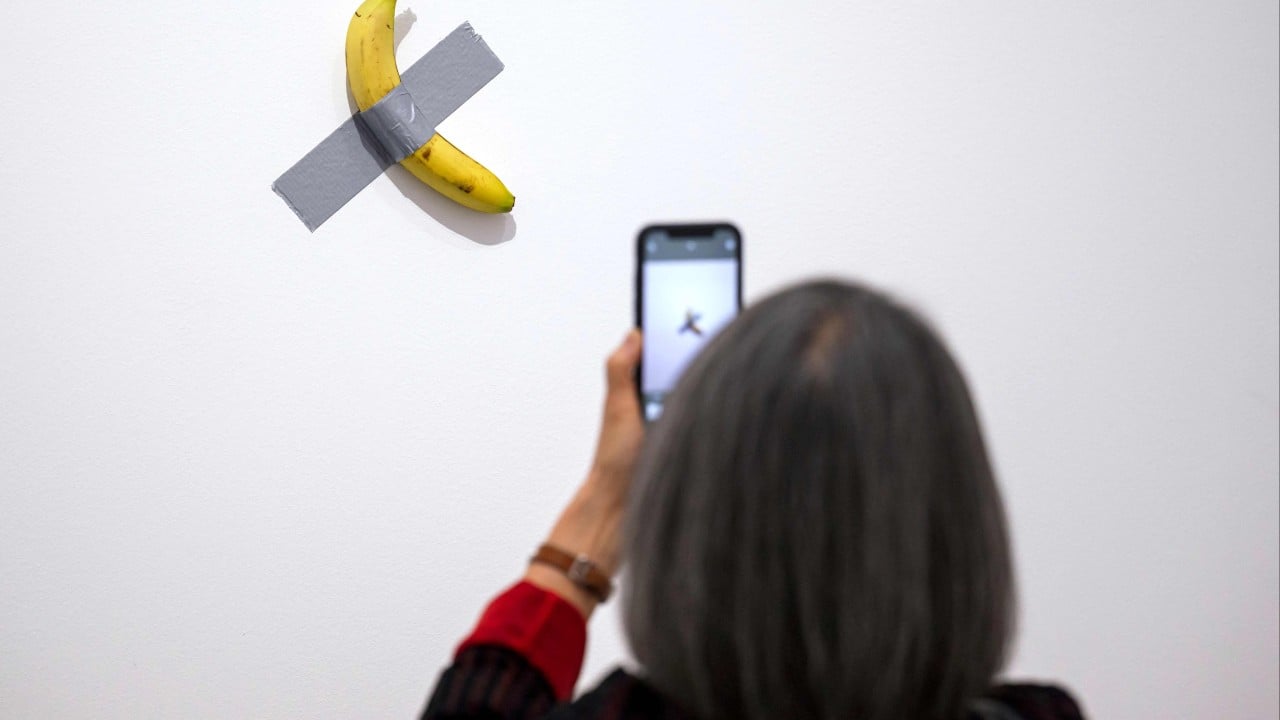
Consider the modern masterpiece that is a piece of fruit duct-taped to a wall. For another angle on this development, refer to the recent update from NPR.
Maurizio Cattelan’s Comedian is not just a piece of conceptual art; it is a multi-million-dollar experiment in human restraint. The premise is devastatingly simple: a fresh banana, secured to a vertical surface with a single strip of silver industrial tape. It is brilliant. It is infuriating. It is worth more than the average human being will earn in a decade.
But a banana does not care about the global art market. A banana does not respect the invisible barriers of high culture. Left to its own devices, a banana turns brown. It spots. It softens. It begins to weep sugar onto the pristine white paint of the gallery wall. To maintain the illusion of permanence, the museum must replace the fruit every few days. The art is eternal; the medium is grocery store produce.
Then came the afternoon at a prominent French contemporary art museum where the conceptual boundary collapsed into pure, survivalist reality.
An elderly woman walked into the gallery. She was not a radical performance artist looking to make a statement about late-stage capitalism. She was not a masked thief operating under the cover of a smoke bomb. She was simply a visitor whose blood sugar was dipping, navigating an environment that felt increasingly alien.
She looked at the wall. She saw a piece of fruit.
To her, it was not a searing critique of wealth inequality or a commentary on the fleeting nature of existence. It was a snack.
The Anatomy of an Accidental Heist
We tend to think of art theft as an elaborate ballet of laser grids and glass cutters. The reality is often much more mundane, happening in the quiet spaces between a security guard’s blink.
The woman approached the installation. There was no alarm. No red spotlights descended from the ceiling. With the casual efficiency of someone preparing breakfast in their own kitchen, she peeled the silver tape away from the wall. The adhesive resisted for a fraction of a second, releasing a sharp, synthetic snap that echoed through the quiet room.
She peeled the fruit. She ate it.
By the time the floor staff realized that a vital component of a multimillion-dollar installation had vanished, there was nothing left but a discarded skin and a sticky residue on the drywall.
The immediate reaction within the museum walls was a wave of quiet panic. Phone calls were made to curators. Security footage was rewound and analyzed frame by frame. The police were notified, not out of malice, but because the insurance policies governing works of this magnitude require a paper trail for every single disruption. A report had to be filed. The word "theft" had to be typed into a computer terminal by an officer who undoubtedly wondered if he was being pranked.
But the real problem lay elsewhere. How do you value the loss of something that was purchased for fifty cents at a local market that morning?
The Fiction of Value
To understand the absurdity of this moment, we have to look at what the buyers of Cattelan’s work actually purchase. When a collector pays hundreds of thousands of dollars for Comedian, they do not receive a specific, immortal banana shipped in a climate-controlled crate. They receive a certificate of authenticity.
The certificate is the true art. It is a legal document that grants the owner the right to tape any banana to a wall and call it a Maurizio Cattelan.
The banana itself is a ghost. It is a placeholder.
Metaphorically speaking, the elderly visitor hadn't stolen the artist's work at all. She had merely consumed the physical manifestation of an idea. The museum understood this, of course. Within minutes of the incident, an assistant curator was dispatched to the nearest corner store, returning with a fresh bunch of yellow fruit. A new banana was taped to the wall. The exhibition continued. The universe righted itself.
Yet, the act of eating the art lingers in the mind far longer than the image of the tape itself. It exposes the fragile truce we all sign when we walk into a museum. We agree to play along with the fiction. We agree that a pile of candy in a corner is a monument to a lost lover, that a unmade bed is a portrait of depression, and that a banana is a profound philosophical statement.
When someone breaks that truce—not out of malice, but out of basic, primal human need—the entire structure wobbles.
The View from the Floor
Imagine being the guard assigned to that room for the remainder of the exhibition.
Your job has shifted. You are no longer protecting a canvas painted by a dead master, shielded behind bulletproof glass. You are guarding a grocery item against the collective appetite of the public. Every time a visitor gets too close, you have to wonder: are they appreciating the texture, or are they wondering if it’s perfectly ripe?
There is a profound vulnerability in that position. The museum world prides itself on sophistication, on being a sanctuary removed from the dirt and chaos of everyday life. But you cannot isolate a banana from the laws of nature. It rots. It attracts fruit flies. It reminds us that no matter how much money we pour into preservation, the physical world is constantly trying to break things down.
The woman who ate the artwork was eventually track down by the staff. There were no handcuffs. There was no dramatic interrogation. When confronted with the magnitude of what she had done, her confusion was absolute. She genuinely did not know she was doing anything wrong.
That is the most damning indictment of all. The line between high culture and everyday life has become so blurred, so wrapped up in irony and provocation, that a regular person can walk into a world-class institution and mistake a masterpiece for a complimentary refreshment.
Consider what happens the next time you walk into a contemporary gallery. You will see things that look like trash. You will see things that look like construction sites. You will see things that look like dinner.
You will feel that familiar, creeping doubt. Is this art, or did someone just leave their keys on the pedestal?
That doubt is not a failure of your education. It is the exact space where the art lives. The value isn't in the object on the wall; it is in the friction between the object and the person looking at it. It is the realization that we are all just a few missed meals away from looking at a multimillion-dollar monument to human ingenuity and seeing nothing more than a quick snack to get us through the afternoon.
The silver tape remains on the wall in France, holding up a fresh piece of fruit. The drywall has been wiped clean of fingerprints. But the air in the room feels different now. Visitors look a little closer at the yellow skin. They aren't looking for the artist's signature.
They are looking for bite marks.