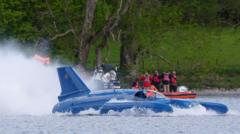
The return of the Bluebird K7 to Coniston Water represents more than a commemorative event; it is a live-site validation of mid-20th-century aerodynamic principles and modern structural restoration. When Donald Campbell attempted the world water speed record on January 4, 1967, the vessel failed not due to a single mechanical error, but because of a catastrophic breach of the longitudinal stability envelope. Analyzing the K7 today requires a dual-track investigation: first, the physics of high-speed planing hulls on a liquid surface, and second, the material science involved in reclaiming a complex aluminum alloy frame after decades of sub-aquatic immersion.
The Three Pillars of High-Speed Hydrodynamic Stability
The Bluebird K7 was designed as a three-point hydroplane. This configuration is engineered to minimize the "wetted surface area," thereby reducing skin friction drag, which increases proportionally to the square of the velocity ($v^2$). At peak speeds, the vessel is supported by three distinct points: the two forward sponsons and a small section of the rear hull.
1. The Aerodynamic-Hydrodynamic Interface
In a three-point hydroplane, the air-water interface creates a ground-effect lift. As speed increases, the air trapped between the hull and the water surface provides a significant percentage of the total lift. The K7 functioned as a hybrid between a boat and an aircraft. The stability of this system is governed by the relationship between the Center of Pressure (CP) and the Center of Gravity (CG). If the CP moves forward of the CG, the vessel enters a "blow-over" state—a pitch-up moment that becomes self-reinforcing as the angle of attack increases.
2. Thrust-Line Dynamics
The integration of the Bristol Siddeley Orpheus turbojet engine provided roughly 4,500 lbf of thrust. Because this thrust line was located above the center of drag, it created a natural nose-down pitching moment. This was a critical design feature intended to counteract the aerodynamic lift generated at speeds exceeding 300 mph. The failure in 1967 occurred when Campbell decelerated and then immediately re-accelerated into his own "wash" or wake. The turbulence disrupted the clean airflow under the hull, shifting the CP forward and overcoming the stabilizing thrust-down moment.
3. Surface Tension and Cavitation
At speeds approaching 300 mph, water no longer behaves as a fluid in the traditional sense; it acts as a rigid, incompressible surface. Any perturbation in the water surface—such as the wake from a previous run—exerts massive vertical G-loads on the sponsons. The K7’s return to Coniston requires a rigorous assessment of the "lake state." Even minor ripples can trigger cavitation at the sponson edges, leading to a sudden loss of lift on one side and a subsequent roll-instability.
The Recovery and Restoration Matrix
Rebuilding a vessel that spent 34 years at a depth of 45 meters involves more than mechanical repair; it is a battle against galvanic corrosion and structural fatigue. The Bluebird Project faced a non-linear restoration path where every decision regarding material replacement affected the historical integrity and the functional safety of the craft.
Material Fatigue and Stress Fractures
The original K7 utilized a Birmabright (aluminum-magnesium alloy) hull over a chrome-molybdenum steel spaceframe. The primary challenge in the restoration was identifying microscopic stress fractures caused by the 1967 impact. While the steel frame provided the primary structural rigidity, the aluminum skin bore the hydrodynamic loads. Using non-destructive testing (NDT), such as ultrasonic thickness gauging and dye penetrant inspection, the restoration team had to differentiate between "historically significant" metal and "structurally compromised" components.
The Propulsion Bottleneck
The original Orpheus engine was lost or destroyed in the 1967 crash. Finding a period-accurate replacement required sourcing an engine with identical thrust-to-weight ratios to maintain the original CG. Any deviation in engine weight ($W$) would require a recalibration of the static trim, which is expressed by the moment equation:
$$M = W \cdot d$$
where $d$ is the distance from the transom. If the new engine is lighter, the CG shifts forward, potentially making the boat too "nose-heavy" to plane effectively. If heavier, the blow-over risk at high speed increases.
Operational Risk Variables on Coniston Water
The 2026 return to the water is not a record attempt, but a "demonstration of technical proficiency." However, the risks inherent in operating a 70-year-old aerodynamic shape remain significant. These risks are categorized into three operational domains.
- Acoustic Vibration and Rivet Integrity: The Orpheus engine produces high-frequency vibrations that can loosen period-authentic rivets. The restoration utilizes modern epoxy-bonding agents in conjunction with traditional riveting to create a redundant load path.
- Thermal Expansion of the Spaceframe: Operating a jet engine within a metal hull creates localized heat zones. The difference in the coefficient of thermal expansion between the steel frame and the aluminum skin can lead to "oil-canning"—a phenomenon where the skin buckles and snaps, disrupting the aerodynamic profile.
- The Human-Machine Interface (HMI): Unlike modern record-breakers that use computer-stabilized trim tabs, the K7 is a purely mechanical system. The pilot must manually balance the throttle against the perceived "feel" of the hull's pitch. At 150+ mph, human reaction time ($~250ms$) is often the limiting factor in preventing a pitch-up event.
Quantifying the Legacy through Structural Analysis
The K7 was a breakthrough because it transitioned from the "brute force" era of water speed records—where massive engines were dropped into heavy hulls—to the "aerodynamic efficiency" era.
| Feature | Pre-K7 Designs | Bluebird K7 |
|---|---|---|
| Hull Geometry | Displacement/Stepped | Three-Point Hydroplane |
| Construction | Wood/Heavy Steel | Al-Mg Alloy / Steel Spaceframe |
| Power-to-Weight | Low (Massive Piston Engines) | High (Turbojet) |
| Stability Control | Static Buoyancy | Aerodynamic Ground Effect |
The transition to a jet engine allowed for a lower profile, but it introduced the "transonic" problem. As the hull approaches the speed of sound in air (roughly 760 mph), the air moving through the narrow gap between the hull and water can reach supersonic speeds, creating shockwaves that destroy lift. While Campbell was far from the sound barrier, the "compression lift" he experienced was a precursor to the challenges faced by modern craft like the Spirit of Australia.
Technical Requirements for the 2026 Run
For the K7 to operate safely today, the team must manage the "Density Altitude" of the lake. High humidity or low air density changes the engine's thrust output and the lift-coefficient of the hull. A cooler, denser air day provides more oxygen for the turbine but also increases the air resistance the boat must punch through.
The second constraint is "Water Hardness." This does not refer to mineral content, but the surface tension. A glassy lake surface is ironically dangerous for a hydroplane; it can create a "suction" effect that prevents the boat from breaking free of the water and getting onto the plane. A light "chop" is required to break the surface tension, yet too much chop introduces the risk of "hooking" a sponson.
The restoration of the Bluebird K7 is a masterclass in forensic engineering. It proves that the "limits" reached in 1967 were not just psychological, but the hard physical boundaries of fluid dynamics. By bringing the craft back to Coniston, the team is not just honoring a pilot; they are validating a specific set of equations regarding how a solid object moves across a liquid-gas interface at the edge of control.
The strategic imperative for future high-speed nautical design lies in active lift management. While the K7 relied on static geometry, the next generation of record-seekers must utilize automated, variable-geometry surfaces that can adjust the CP in real-time ($<10ms$) to compensate for surface irregularities. The K7 remains the definitive case study in why passive stability is insufficient for speeds exceeding 300 mph. Any attempt to surpass current records must start by solving the "Campbell Equation"—the point where aerodynamic lift exceeds the gravitational and thrust-down forces holding the vessel to the water.