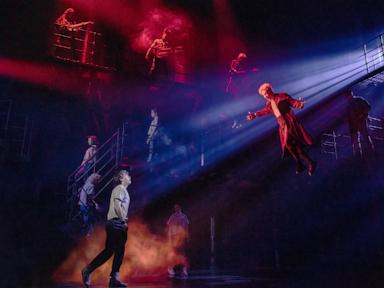
The human body is not meant to fly. It resists the air, yields to gravity, and panics when its feet leave the solid earth. Yet, eight times a week in a darkened theater on Broadway, an actor steps off a Gothic ledge, catches the wind, and soars into the rafters with the terrifying elegance of an apex predator.
To the audience sitting in the orchestra rows, it looks like magic. It looks like a creature of the night discarding the laws of physics.
But behind the velvet curtains, thirty feet above the stage, the reality is a bruising, high-stakes collision of industrial engineering, intense physical endurance, and absolute, unwavering trust. The illusion of effortless flight is, in truth, exhausting. It is a grueling athletic feat masked by theatrical showmanship, where a single miscalculation can break a performer's ribs or shattering the collective hypnosis of a packed house.
The Weight of the Unseen
Consider a hypothetical performer named Marcus. He plays the undead lead in a sweeping new musical adaptation. In the second act, he must float down from a castle turret to terrorize a sleeping heroine.
Before Marcus even opens his mouth to sing, he is strapped into an apparatus that feels less like a costume and more like mountaineering gear. Beneath his velvet coat lies a custom-molded fiberglass and nylon harness. It wraps tightly around his thighs, grips his pelvis, and squeezes his torso. It must be tight enough to distribute his weight evenly, yet flexible enough to allow his lungs to expand fully for a high C.
If the harness is off by a fraction of an inch, it pinches. It bruises.
Then come the wires. These are not thin fishing lines. They are aircraft-grade, galvanized steel cables, wrapped in black coloring to absorb the stage lights. They are incredibly thin—often only an eighth of an inch thick—yet capable of holding thousands of pounds of pressure.
When Marcus hooks into the rig, he surrenders control. He cannot climb, run, or dodge on his own. He is tethered to a system of counterweights and motorized winches controlled by a technician sitting in the fly loft, a dark, cramped platform suspended high above the stage.
This technician is the invisible partner. If Marcus moves too fast, the wire jerks, exposing the machinery of the trick. If the technician pulls too hard, Marcus is launched like a projectile. The relationship is a silent dance of mathematics and muscle memory.
The Physics of Fear
The human brain is wired to protect itself from falling. When you lift off the ground, your inner ear sends frantic distress signals to your nervous system. Your muscles naturally tense up. Your arms want to flail.
For a Broadway vampire, flailing is a creative death sentence.
A creature of the night must look completely relaxed. The torso must remain steady while the limbs move with an eerie, liquid grace. To achieve this, actors spend months training before technical rehearsals even begin. They work with aerial choreographers to build core strength that rivals Olympic gymnasts.
The secret to flying effortlessly is actually immense resistance. To look like you are floating, you must constantly engage your abdominal muscles, pushing against the harness to create a stable center of gravity. You are fighting the metal straps every second you are in the air.
Imagine singing a soaring ballad while suspended upside down, the harness pressing directly into your diaphragm, all while pretending you are as light as smoke.
The mechanical systems that facilitate this vary. Some productions rely on manual counterweight systems, where a crew member throws their own body weight around on the backstage ropes to lift the actor. This requires a human touch, a sensory understanding of the actor's momentum. Other modern shows use computerized automated winches, programmed to move the wire at precise velocities down to the millimeter.
Automation brings consistency, but it lacks intuition. A computer does not know if an actor is slightly off-balance or if a cape has caught on a piece of scenery. It simply executes the code. That is why human spotters stand in the wings, their eyes locked on the lines, ready to hit an emergency stop at the first sign of a tangle.
When the Magic Fails
Every stage actor who flies lives with a quiet, persistent anxiety. Theater is live. Things break. Cables twist.
There is an old theatrical adage that if something can go wrong, it will do so in front of two thousand paying patrons. When a flying sequence glitches, the illusion vanishes instantly, replaced by a cold dose of reality. An actor stuck dangling mid-air, spinning slowly like an unwanted ornament, transforms an epic horror story into an accidental comedy.
Dealing with these moments requires a specific kind of mental fortitude. The performer must remain in character while navigating physical vulnerability. They cannot look up at the ceiling to see what is stuck. They cannot break the fourth wall. They have to trust that the crew above them is working frantically to lower them safely to the stage floor.
This vulnerability builds a rare bond between the cast and the deck crew. The people pulling the ropes hold the actors' lives in their hands. It is a level of trust that is rarely demanded in other professions.
The Final Chord
The lights dim to a deep, cinematic blue. The fog rolls thick across the stage floor, obscuring the actors' boots. Marcus steps out onto the highest platform.
The audience holds its breath. They see no wires, no harnesses, no mechanical winches hiding in the shadows of the grid. They see only a figure defying the earth.
He steps off the edge.
For a fraction of a second, the steel cable catches, tension ripples through the harness, and his core locks into place. He glides down through the artificial mist, arms outstretched, landing silently on the stage floor without a single stumble. The crowd erupts.
They are cheering for the vampire. But the real triumph belongs to the hidden machinery, the bruised ribs, and the quiet technicians sweating in the dark overhead, holding up the sky.