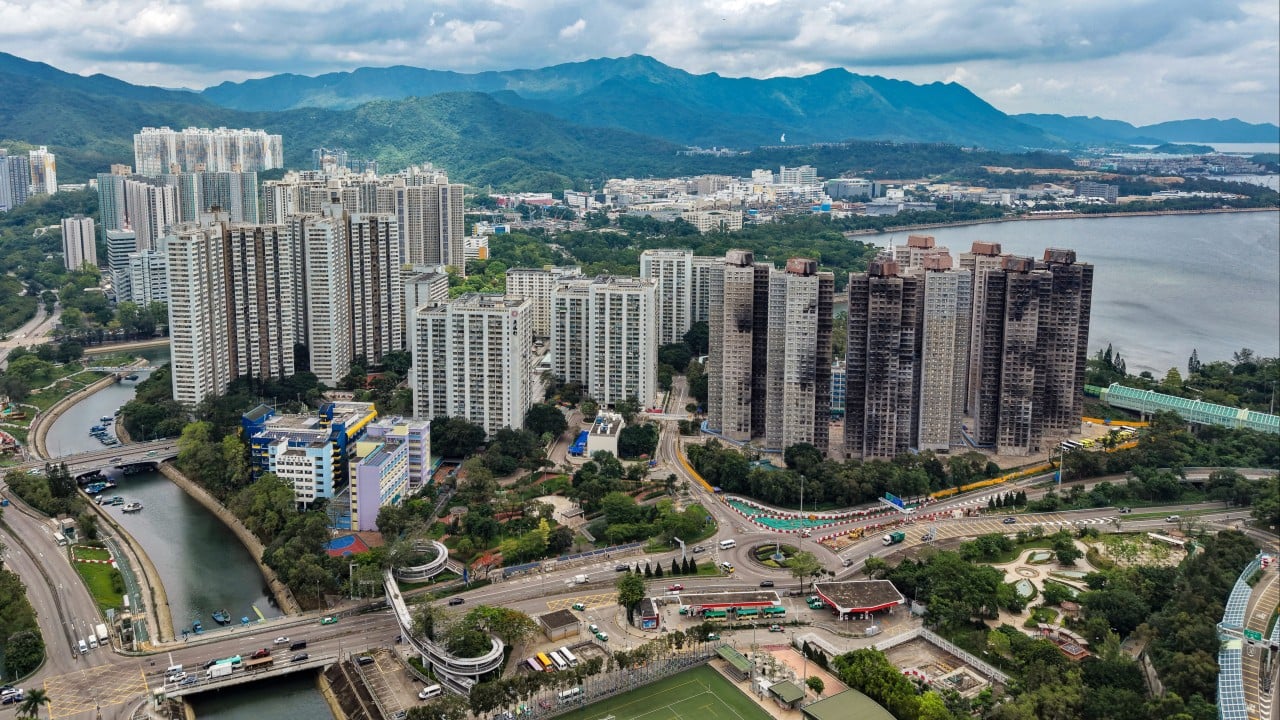
For months, the residents of Wang Fuk Court lived inside a green cocoon.
To the casual observer driving through Hong Kong’s suburban Tai Po district, the massive bamboo scaffolding and protective netting encasing the high-rise estate was just another sign of urban renewal. But for those living inside, the reality was suffocating. The green mesh blocked the autumn breeze. To make matters worse, thick, grey blocks of expanded polystyrene foam—Styrofoam—were taped directly over the windows near the lift lobbies and exterior walls, blocking out the light.
It felt temporary. It felt like the price of progress.
But on the afternoon of November 26, 2025, that green cocoon transformed into a towering chimney of fire. In just minutes, a small ignition on the lower floors of Wang Cheong House roared upward, fed by the highly flammable Styrofoam boards and substandard construction mesh. The blaze raged for over 44 hours, consuming seven of the estate’s eight residential towers. It became Hong Kong’s deadliest disaster in decades, claiming 168 lives—including a firefighter who ran toward the inferno while others fled.
Now, as the independent inquiry into the tragedy reaches its final stages, a sobering, infuriating picture is emerging. The disaster was not an act of God. It was a tragedy of paper trails, shrugged shoulders, and a systemic failure of accountability where everyone had a checklist, but no one had a conscience.
The Paper Firewalls
To understand how 168 people perished in a modern high-rise complex, one must look at the invisible lines drawn between government departments.
In the months leading up to the fire, residents were terrified. They saw the sheer volume of Styrofoam stacked against their building. They noticed that the green safety mesh felt cheap, brittle, and highly flammable. A resident—let us call him Mr. Kong, representing the real, living voices who tried to sound the alarm—began writing letters. He contacted the Urban Renewal Authority (URA). He warned them about the estate’s renovation contractor, Prestige Construction, which held a staggering history of 140 safety convictions.
The response? A polite shrug. The URA replied that the matter "should be referred to the relevant authorities". They did not forward the email. They did not even name the department Mr. Kong should contact. During the inquiry, when asked why they stayed silent, a URA representative explained simply that there was "no formal referral mechanism" between agencies.
The buck did not stop there. It was tossed in a perpetual, tragic circle.
- The Buildings Department claimed Wang Fuk Court fell under the Housing Bureau's remit because it was a government-built estate.
- The Housing Bureau’s Independent Checking Unit denied it was their role to regulate the flammability of Styrofoam on external walls.
- The Fire Services Department repeatedly told anxious residents that the Styrofoam fell "beyond its ambit".
It was a masterclass in bureaucratic self-preservation. On paper, every official followed their protocol to the letter. In reality, their narrow focus left a fatal blind spot. While departments debated who held the correct clipboard, the mountain of kindling outside the residents’ windows grew larger.
The Perfect Deception
While the government fell short in its oversight, the contractors on site actively exploited the system's blind trust.
During the hearings, a chilling detail emerged regarding the green safety netting that wrapped the buildings. To get approval for construction projects in Hong Kong, contractors must submit fire-safety certificates proving their materials are flame-retardant. The Buildings Department admitted it relied entirely on these paper certificates submitted by the contractors. They did not conduct physical, on-site flammability tests, nor did they have a system to verify if the certificates were authentic.
This trust was betrayed. To mislead inspectors, flame-resistant netting was placed only at the very base of the scaffolding—the exact, easily reachable spot where inspectors would typically take samples.
Higher up, in the hard-to-reach areas hidden from view, the contractor installed cheap, highly flammable mesh. When subsequent independent testing was done on twenty samples of the netting after the disaster, seven failed the basic fire safety test. The safety net that was supposed to protect the public had been turned into a vertical fuse.
And then, there was the silence.
As the fire broke out and smoke began to seep under doors, no alarms sounded. The complex’s fire alarm system was fully powered, but the sirens remained dead. Investigations revealed that an in-house electrician from the property management company had inadvertently switched off the fire alarm system while emptying water tanks. It was a simple, stupid mistake that could have been caught instantly if the fire service installation contractor had been on-site as required.
Instead, there was only silence, followed by the sound of breaking glass.
The Weight of the Aftermath
In the final closing arguments of the inquiry, government lawyers argued that the "primary responsibility" for the disaster rested on the shoulders of the private contractors, pointing to their deceit, inaction, and deliberate omissions.
But blaming the contractors, however guilty they may be, does not absolve the system that let them operate. When the government admitted it "fell short," it was a cold acknowledgment of a devastating truth: the regulatory framework is only as strong as its willingness to enforce its own rules.
The cost of this regulatory vacuum is not measured in fines or amended building codes. It is measured in the lives of the people who trusted that the walls around them would keep them safe. It is measured in the quiet, empty spaces of Tai Po, where families once lived, and where now only memories—and a desperate search for justice—remain.
The green mesh is gone now, burned away alongside the lives of 168 people. What remains is a stark reminder that when safety is treated as someone else's department, eventually, everyone pays the price.