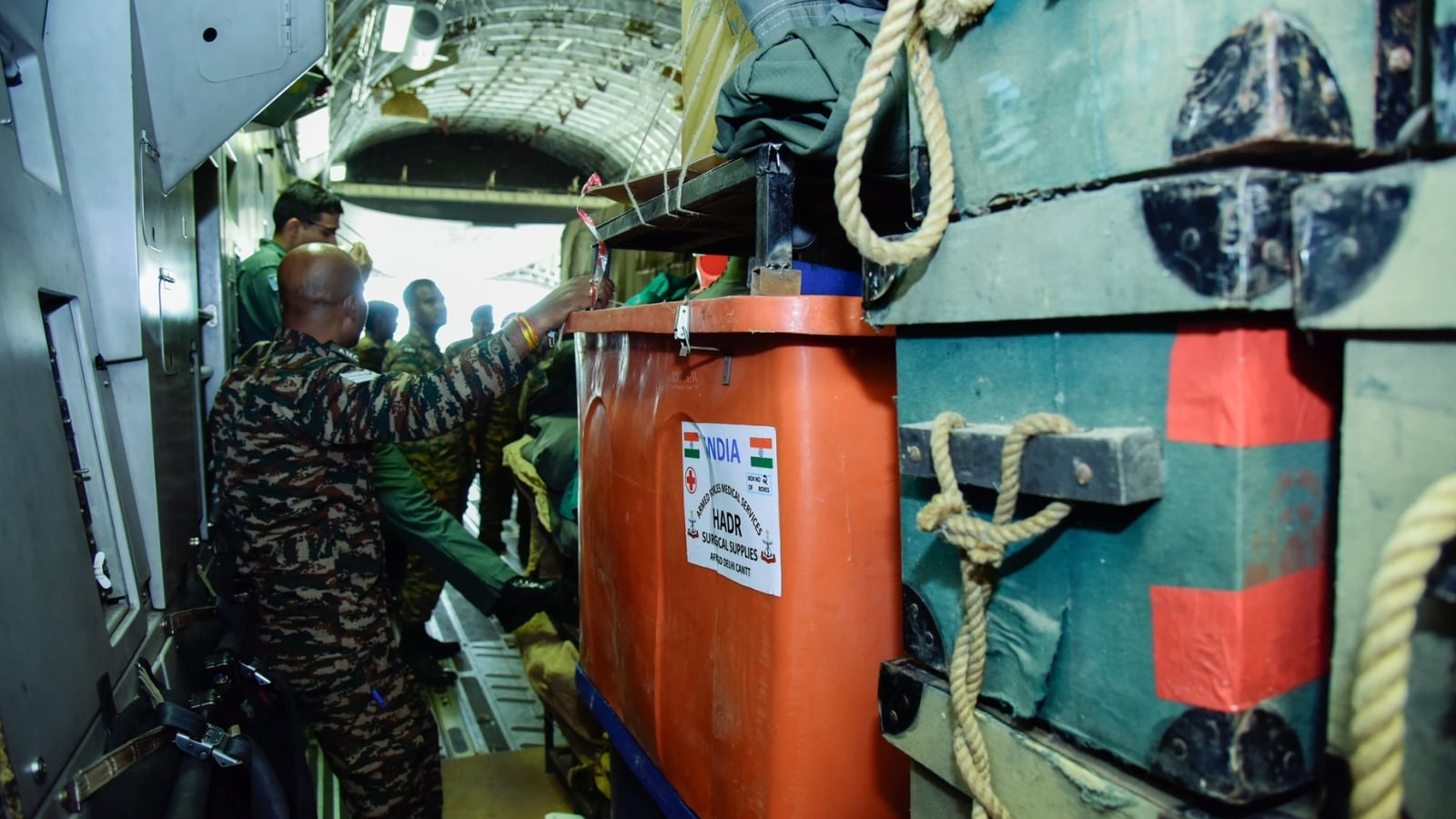
When disaster strikes a country thousands of miles away, the immediate international response usually follows a familiar geopolitical pattern. Nearby neighbors send rescue teams, regional superpowers offer financial aid, and global bodies issue statements of solidarity. But when twin earthquakes shattered northern Venezuela, collapsing residential blocks near Caracas and leaving hundreds dead, something unexpected happened. Two massive Indian Air Force C-17 Globemaster transport planes took off from New Delhi, loaded with military medics and tactical field hospitals, bound straight for South America.
It is called Operation Amistad.
This isn't just a standard charity drop. The scale and speed of this mission signal a massive shift in how India handles international relations and disaster relief. If you think this is just about handing over blankets and bottled water, you're missing the bigger picture.
The crisis on the ground in northern Venezuela
Venezuela is currently dealing with its worst natural disaster in decades. On Wednesday night, two major earthquakes struck the northern region less than a minute apart. The United States Geological Survey clocked them at magnitudes 7.2 and 7.5, centering the destruction right near the capital city of Caracas.
The timing was brutal. Because the tremors hit back-to-back, buildings that survived the first shock collapsed during the second.
The numbers coming out of the Venezuelan Ministry of Health are grim and climbing fast. Health Minister Carlos Alvarado confirmed that at least 235 people have died, and more than 4,300 are injured. Local hospitals in Caracas were instantly overwhelmed, with hundreds of patients arriving with severe crush injuries and trauma requiring immediate surgery. Acting President Delcy Rodriguez has already announced a 200 million dollar emergency reconstruction fund using International Monetary Fund resources, but cash doesn't fix a ruptured spleen or a crushed limb when the local operating rooms have no power.
That is where India's intervention comes in, and the specific kit they sent tells you everything about the nature of modern emergency medicine.
What Operation Amistad actually brought to the crisis
India's external affairs minister, Subrahmanyam Jaishankar, announced the launch of Operation Amistad as the C-17s cleared Indian airspace. They aren't just carrying cargo; they're carrying an entire elite medical ecosystem.
The core of the deployment is a 41-member medical contingent from the Indian Army's 60 Para Field Hospital. These aren't regular doctors. They are paratrooper medics trained to drop into active combat zones and natural disasters, establish sterile surgical theaters within hours, and perform complex trauma surgeries under the worst possible conditions. The team includes nine specialized medical officers, orthopedic surgeons, and critical care specialists.
Alongside the personnel is 35 tonnes of specialized medical equipment, but the real talking point among logistics experts is the inclusion of two BHISHM Cubes.
If you aren't familiar with military medical tech, the BHISHM (Bharat Health Initiative for Sahyog Hita and Maitri) Cube is a game-changing piece of emergency engineering. It is a completely modular, portable field hospital packed into compact, rugged cubes that can be flown in, unpacked, and fully operational in minutes.
Each BHISHM Cube contains everything needed to treat up to 200 patients simultaneously. We are talking about mini operating theaters, ventilators, diagnostic machines, blood transfusion setups, and an independent power source. By sending two of these, the Indian Army can essentially set up a 400-bed advanced trauma center right in the middle of the rubble without drawing a single watt of electricity from Venezuela's fragile power grid.
The logistical nightmare of a 14000 kilometer rescue mission
To appreciate what India is doing here, look at a map. New Delhi to Caracas is roughly 14,000 kilometers. Flying two massive, fuel-heavy C-17 Globemasters across multiple continents and oceans during an active global crisis requires an insane amount of diplomatic clearance and refueling coordination.
Honestly, it would have been much easier for India to write a check or ship supplies via sea, even if it took weeks to arrive. But speed is everything in earthquake response. Doctors know that the first 24 to 72 hours are the critical window for saving lives trapped under structural debris. After that, the survival rate plummets. By flying a highly mobile paratrooper medical team directly into the zone, India is betting that its immediate presence will directly lower the final death toll.
Why India is acting as a global first responder
This isn't India's first time playing the role of an international first responder, but it is definitely one of the most distant. Over the last few years, New Delhi has steadily built a reputation for rapidly deploying humanitarian aid and disaster relief assets. We saw it during the massive earthquake in Türkiye, during the crisis in Myanmar, and during the Nepal earthquake.
Indian officials often point to the civilizational philosophy of "Vasudhaiva Kutumbakam," which translates to "The World Is One Family". It sounds like a great talking point for a press release, but the hard reality of foreign policy is always driven by strategy.
By sending top-tier military medical assets to Latin America—a region traditionally seen as within the geopolitical orbit of the United States and European powers—India is flexing its logistical muscle. It's proving that its military can project soft power and humanitarian relief anywhere on Earth at a moment's notice. While the US Southern Command has deployed its own C-17 and C-130 transport aircraft to handle high-capacity airlifts for the affected areas, India's independent arrival shows that New Delhi wants a seat at the table as a reliable global leader in crisis management.
Tracking the relief effort
If you are tracking how the international community is responding to the double tremors in Venezuela, keep your eyes on the coordination between these arriving foreign medical units and the local Venezuelan emergency framework. The immediate challenge won't be a lack of goodwill; it will be sorting through the sheer chaos of distribution, language barriers, and broken infrastructure in northern Venezuela.
The Indian Army medical team has already signaled their intent, releasing their mission statement in Spanish: "Compartimos su dolor. Estamos con ustedes" (We share your pain. We stand with you). Now comes the hard work of pulling people out of the concrete.