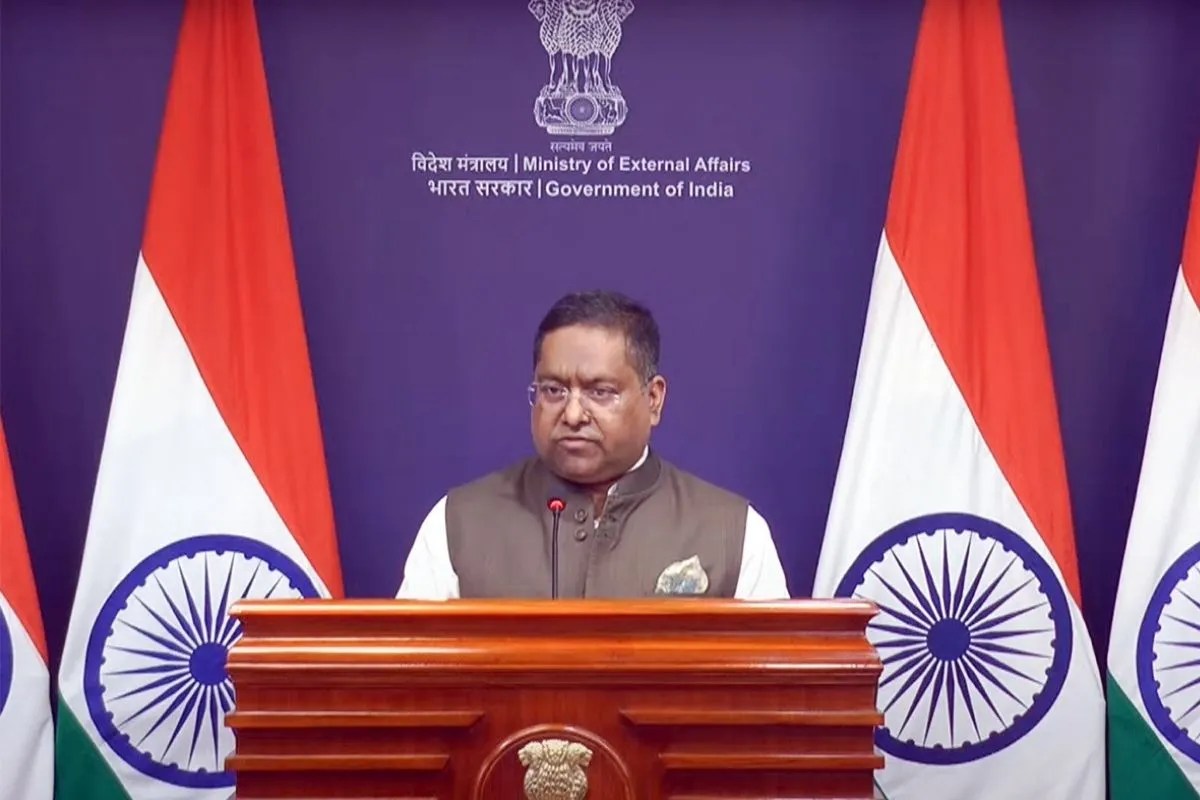
The Strait of Hormuz is currently the most dangerous stretch of water on the planet, and New Delhi knows it. While headlines focus on the immediate diplomatic back-and-forth between the Ministry of External Affairs (MEA) and Tehran, the reality on the water is far more precarious than a standard press briefing suggests. India is currently engaged in a high-stakes balancing act to protect its energy security and the lives of its seafarers trapped in a geopolitical crossfire.
Recent escalations have forced India to move beyond passive observation. The MEA has confirmed it is in constant touch with Iranian authorities, specifically regarding the safety of Indian crew members aboard seized vessels. This isn't just about diplomacy; it is about survival. India imports over 80% of its crude oil, and a significant portion of that volume must pass through this narrow 21-mile-wide gateway. Any prolonged blockage or spike in hostilities doesn't just raise petrol prices in Delhi; it threatens the fundamental stability of the Indian economy. Discover more on a connected topic: this related article.
The Physical Reality of the Chokepoint
Geopolitics is often treated as a game of chess, but in the Strait of Hormuz, it is a game of physics. To the north lies Iran, and to the south lies Oman and the United Arab Emirates. The shipping lanes themselves are only two miles wide in each direction, separated by a two-mile buffer zone. This narrowness makes tankers sitting ducks for any regional power looking to exert leverage.
When Iran’s Islamic Revolutionary Guard Corps (IRGC) shadows a vessel, there is very little room for maneuver. For India, the concern is twofold. First, there is the immediate safety of Indian nationals. India provides a massive percentage of the global seafaring workforce. When a ship is seized—regardless of the flag it flies—there is a high probability that Indians are on the bridge or in the engine room. Second, there is the insurance nightmare. As risk levels climb, "War Risk" premiums for shipping companies skyrocket. These costs are invariably passed down to the Indian consumer. More reporting by NBC News highlights similar views on the subject.
The Tehran Connection
India's relationship with Iran is unique among major global powers. Unlike the United States, which views Tehran through the lens of sanctions and containment, India sees Iran as a vital gateway to Central Asia. The development of the Chabahar Port is the centerpiece of this strategy, intended to bypass Pakistan and reach markets in Afghanistan and beyond.
However, this "special relationship" is being tested. When the MEA states they are "in touch" with Iran, they are using the leverage of years of cooperation. But that leverage has limits. Iran is currently operating under a siege mentality, driven by domestic pressures and external threats. In such a state, even friendly nations like India find that their requests for "restraint" or "crew release" are weighed against Tehran’s perceived need to project strength.
Why Quiet Diplomacy is Failing
The traditional Indian approach of "strategic autonomy" is hitting a wall. In the past, India could stay neutral and maintain ties with both Israel and Iran. Today, the polarization of the Middle East is so intense that silence is increasingly interpreted as complicity by both sides.
- Pressure from Washington: The U.S. expects its partners to take a firmer stand against maritime disruptions.
- The Energy Factor: Reliance on Russian oil has provided some cushion, but the Middle East remains the bedrock of India's long-term energy matrix.
- The Diaspora Risk: Millions of Indians live and work in the Gulf. Any regional wildfire puts their livelihoods and safety at immediate risk.
Beyond the Official Statements
If you look past the carefully worded statements from South Block, you see a more proactive military posture. The Indian Navy has quietly increased its presence in the Arabian Sea and the Gulf of Oman. Operation Sankalp, the Navy's maritime security initiative, is no longer a periodic exercise; it is a continuous patrol.
Indian warships are now frequently escorting Indian-flagged tankers through the region. This is a significant shift. It shows that New Delhi no longer trusts that diplomatic "goodwill" alone is enough to keep the oil flowing. The Navy is providing "over-the-horizon" protection, using advanced surveillance and persistent presence to deter non-state actors and state-sponsored maritime harassment.
The Economic Shadow
The math is brutal. A total closure of the Strait of Hormuz could send global oil prices soaring toward $150 a barrel. For a country like India, which is fighting to keep inflation under control while maintaining high growth rates, such a shock would be catastrophic. The government's current strategy is to diversify, looking toward Guyana, Brazil, and increased domestic production, but these are long-term plays. For the next decade, the Strait of Hormuz remains India's umbilical cord.
There is also the matter of the International North-South Transport Corridor (INSTC). This ambitious project depends entirely on a stable Iran and a peaceful Persian Gulf. If the region descends into a cycle of seizure and retaliation, the billions of dollars invested in these trade routes will be effectively frozen. India isn't just protecting a few ships; it is protecting a decade of geopolitical investment.
The Crew Dilemma
The human cost is often buried in the technical analysis of oil barrels and shipping lanes. When the MEA negotiates for the release of Indian sailors, they are dealing with a complex legal and political web. Often, these sailors are caught on ships owned by companies in one country, flagged in another, and seized by a third.
The legal process in Iran is opaque. Consular access is frequently delayed. For the families of these seafarers in Kerala or Punjab, the "strategic" nuances of the MEA mean very little. They want their relatives home. This domestic political pressure forces the Indian government to maintain a line of communication with Tehran that remains open even when other Western nations have cut theirs.
Strategic Realignment
India is also looking at alternative routes, though none are perfect. The proposal for an India-Middle East-Europe Economic Corridor (IMEC) was a direct attempt to create a new trade architecture. But the current instability has put that project on the back burner. Without a peaceful maritime environment, no amount of rail and port infrastructure can function.
The hard truth is that India's "soft power" and historical ties are being outpaced by "hard power" realities. Drones and fast-attack craft don't care about historical trade routes or cultural exchanges. They respond to deterrence. India’s challenge is to build enough deterrence to protect its interests without becoming a formal party to the escalating conflict between Iran and the West.
The Role of Intelligence
Behind the scenes, intelligence sharing between India and regional players like Saudi Arabia and the UAE has reached unprecedented levels. This isn't just about counter-terrorism anymore; it's about maritime domain awareness. Knowing which ship is being targeted and why allows the MEA to intervene before a seizure even happens.
The "big statement" from the MEA regarding being in touch with Iran is actually a signal to the world. It tells the West that India has a seat at the table in Tehran. It tells Iran that India expects its citizens to be treated as neutrals. And it tells the Indian public that the government is not sitting idle while the world's most important trade artery is being squeezed.
The Fragile Path Forward
Expect the tension in the Strait of Hormuz to remain the status quo for the foreseeable future. There is no "grand bargain" on the horizon that will suddenly make these waters safe. India's strategy will continue to be one of tactical intervention—responding to crises as they arise while trying to build a military and economic buffer.
The Indian Navy will likely expand its footprint further. We may see more permanent deployments and a more aggressive stance toward maritime piracy and state-led interference. Diplomacy will remain the primary tool, but it is now backed by a visible naval presence.
India’s energy security is no longer a matter of simple commerce; it is a matter of national defense. Every time a tanker enters the Strait, it carries with it the economic aspirations of 1.4 billion people. Protecting that transit is not optional. It is the most critical task facing Indian foreign policy today. The statements coming out of the MEA are just the visible tip of a very large, very complex, and very dangerous iceberg.
The time for purely verbal diplomacy is ending, and the era of active maritime protection has begun. New Delhi is realizing that in a world where rules-based order is crumbling, you don't just ask for passage—you secure it.


