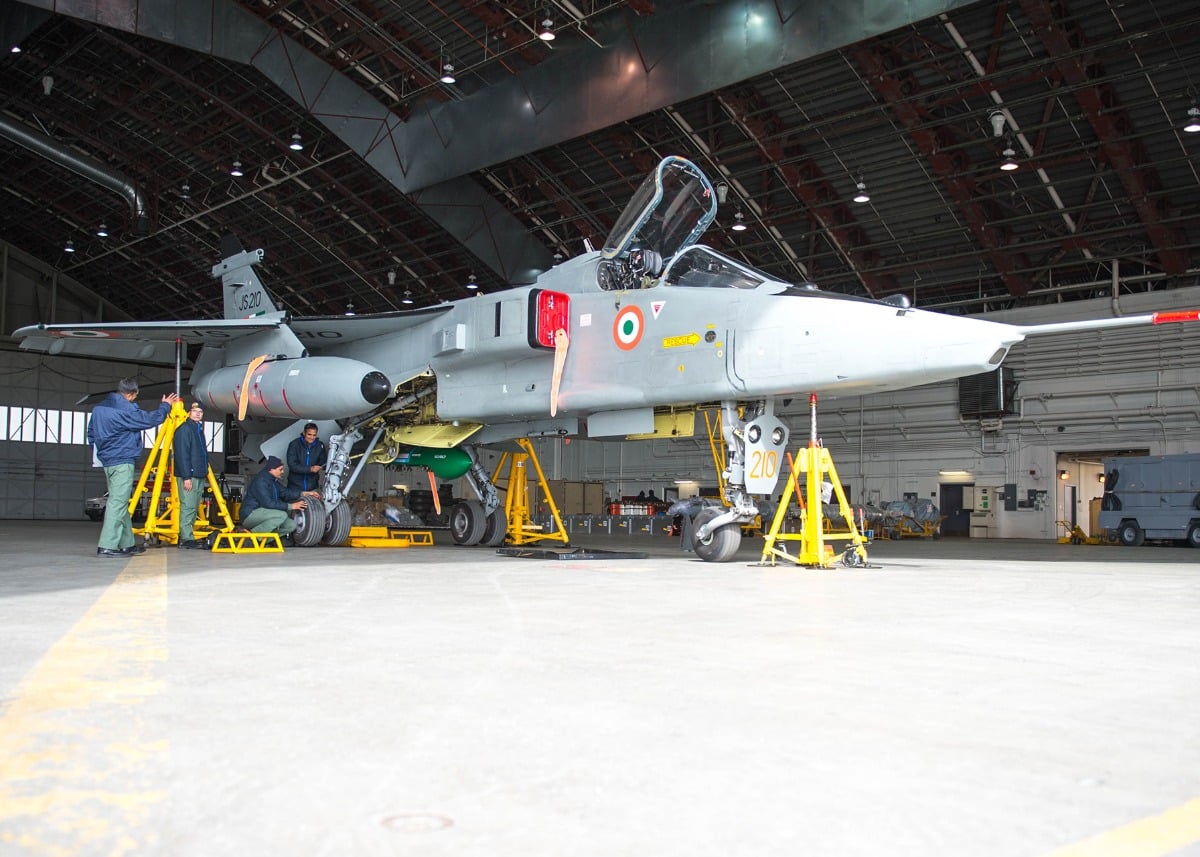
You don't usually see a major military power raiding foreign scrapyards to keep its front-line defense intact. Yet, three former Royal Air Force SEPECAT Jaguar fighter jets, wrapped tight in white protective coverings, recently sat at a British port waiting for a boat ride to India. They are the first wave of a nine-aircraft shipment meant for the Indian Air Force.
Let's be clear about what is happening here. India isn't buying these jets to fly them. The UK retired its last Jaguar back in 2007. These nine airframes are being imported strictly to be stripped down, torn apart, and picked clean for pieces. In military terms, it's called cannibalization. In plain English, India is buying junked British planes for spare parts because its own strike fleet is running on fumes.
This unusual scavenger hunt highlights a deep crisis within India's military planning. The country is currently the absolute last operator of the Anglo-French Jaguar on earth. Everyone else moved on decades ago. France said goodbye in 2005, the UK followed in 2007, and Oman retired theirs in 2014. Now, New Delhi is left holding the bag, trying to keep roughly 120 of these Cold War-era jets flying when the global supply chain for them no longer exists.
The Scavenger Pipeline
Keeping a vintage jet in the air requires a massive amount of hardware. When the original manufacturers stop making gaskets, landing gears, and turbine blades, you have to get creative. This current batch of nine British jets is just the latest stop in India's multinational salvage operation.
Look at what they've done over the last few years to keep these squadrons alive:
- France handed over 31 retired Jaguar airframes along with old engines completely free of charge.
- Oman signed a deal to transfer more than 20 of its retired Jaguars that had lower flight hours.
- The UK previously sent over two twin-seat airframes and 619 lines of rotables for about $400,000.
Technicians from Hindustan Aeronautics Limited have to travel to these countries, dismantle the donated planes, and ship the components back home. It's a grueling, expensive way to run an air force. Internal assessments show the Jaguar fleet's readiness rate hovers somewhere around 50 to 60 percent. Every single hour one of these jets spends in the sky requires about 20 hours of intense maintenance on the ground.
Why Not Just Buy New Jets
You might wonder why India doesn't just scrap the whole fleet and buy modern fighters. It isn't that simple. The Indian Air Force has a government-sanctioned strength of 42 fighter squadrons to handle potential two-front conflicts with Pakistan and China. Right now, they are sitting at just 29 squadrons.
Losing the six remaining Jaguar squadrons would cause the force structure to crater completely. They need these planes to fill space while waiting for indigenous Tejas fighters and new foreign jets to arrive.
IAF Fighter Squadrons: Sanctioned vs. Actual
Sanctioned Strength:  [====================================] 42
Current Strength:     [========================] 29
There was a plan to properly fix the Jaguar's biggest flaw: its underpowered Rolls-Royce Adour engines. The idea was to buy brand-new F-125IN turbofan engines from Honeywell. It made sense on paper. But when the numbers came back, the price tag was staggering. Each new engine was going to cost around $13.26 million. Add in another $2.8 million per jet for airframe modification and testing by HAL, and the project became a money pit. Upgrading just two old Jaguars would cost as much as buying a brand-new, state-of-the-art combat jet. The military pulled the plug.
Instead of new engines, India chose to upgrade the brains of the plane. Half of the fleet received the DARIN-III avionics suite, which adds modern multi-function cockpit displays and an advanced Israeli Elta active electronically scanned array radar. The other half of the fleet didn't get the upgrade and will head straight to retirement starting around 2028. The upgraded ones are expected to drag themselves forward until at least 2032.
The Secret Nuclear Posture
There is another, darker reason India refuses to let the Jaguar die. These planes matter for India's nuclear weapons strategy.
The Jaguar was designed during the Cold War for low-level, high-speed penetration missions. It flies incredibly well right down in the dirt, hiding from enemy radar networks. Western planners originally built it with tactical nuclear strike roles in mind, and those structural design choices remain baked into the airframe.
While the defense ministry keeps exact squadron roles heavily classified, defense analysts know the Jaguar forms a leg of India's airborne nuclear strike capability alongside the Mirage 2000 and the newer French Rafale. It provides a reliable option for low-altitude delivery that newer, high-flying stealth systems can't duplicate in quite the same way.
What Happens Next
Relying on foreign museum pieces to secure your airspace is a temporary patch, not a long-term strategy. The Indian Air Force is burning massive amounts of engineering effort just to keep a 1970s jet operationally relevant.
If you are tracking defense procurement or regional security, watch how quickly India scales up its domestic Tejas Mark 1A and Mark 2 production lines over the next three years. The arrival of these nine British junkers buys the air force a tiny bit of breathing room, but the clock is ticking loudly. Defense planners must accelerate local manufacturing and finalize foreign fighter acquisitions now, or the squadron shortage will become an irreversible crisis by the time these final Jaguars are stripped down to bare metal.