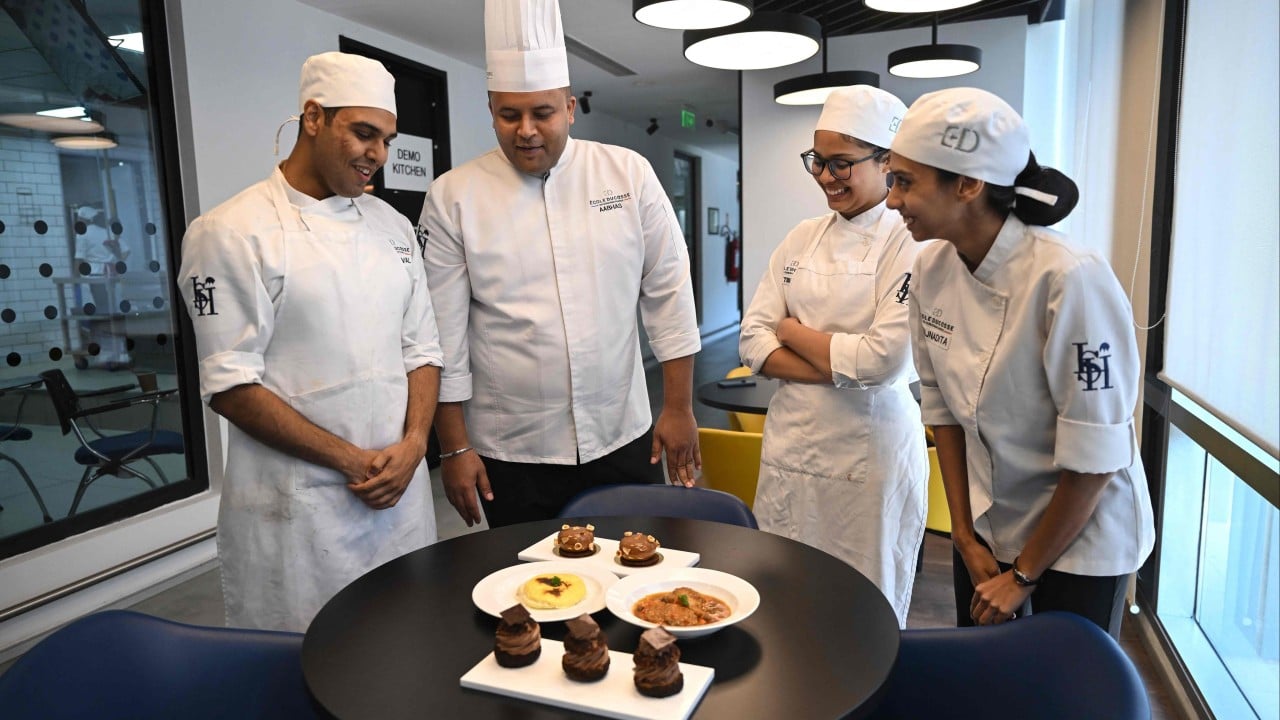
Young Indian chefs are spending tens of thousands of dollars at elite French culinary schools—not to cook French food, but to master the strict technical systems required to re-engineer Indian cuisine for the global fine-dining market. Institutions like Le Cordon Bleu, Institut Lyfe (formerly Institut Paul Bocuse), and Ferrandi Paris have become the ultimate finishing schools for ambitious cooks from Mumbai, New Delhi, and Bengaluru. While the financial burden is immense and the kitchen hierarchy brutal, these graduates are returning home or opening restaurants abroad with a specific competitive edge, using classical European discipline to elevate regional Indian ingredients onto international tasting menus.
For decades, the pipeline for culinary talent in India flowed in one direction. Students enrolled in domestic hotel management programs, graduated into massive luxury hotel chains, and spent years grinding through banquet production. Creativity was rarely on the menu. If you wanted to run a kitchen, you learned to manage inventory for a 300-cover buffet.
That model is breaking down.
Today, a growing cohort of young Indians is bypassing the traditional hotel track entirely. Armed with student loans and family savings, they are heading to Paris and Lyon. They are entering kitchens where the rules were written by Auguste Escoffier over a century ago, and where a broken emulsion or an uneven brunoise is treated like a moral failing.
The Economics of a French Culinary Diploma
Let us look at the numbers, because the financial reality of this trend is staggering. Tuition alone for a comprehensive diploma at a top-tier French culinary institute easily clears $30,000 to $50,000. Factor in the cost of living in Paris—renting a cramped studio apartment, buying professional-grade knife rolls, paying for mandatory uniforms, and surviving on a student budget in one of Europe’s most expensive cities—and the total outlay quickly approaches $70,000 or more.
In the Indian hospitality market, entry-level kitchen salaries are notoriously low. A commis chef returning to Mumbai or Delhi might earn the equivalent of a few hundred dollars a month. On paper, the return on investment makes zero sense. You cannot pay off a $70,000 education on a line cook’s wages in Gurgaon.
Yet applications from India continue to climb. Why? Because these students are not buying a job. They are buying accelerated pedigree and structural literacy.
In a traditional Indian kitchen, knowledge has historically been guarded. Recipes were passed down orally, often incomplete, relying on intuition, sensory memory, and years of repetitive observation. You learned to make a gravy by watching a senior chef for five years until he finally trusted you to stir the pot. French culinary education operates on the exact opposite principle. It breaks cooking down into repeatable, documented systems.
Deconstructing the Brigade System
When an Indian student steps into a French teaching kitchen, they are immediately subjected to the brigade de cuisine. Every station has a defined role. Every sauce has a mother. Every cut has a millimeter measurement.
- Standardization over intuition: Students learn exact ratios—how much gelatin sets a terrine, the precise temperature at which egg yolks coagulate, the exact fat-to-liquid ratio required for a stable velouté.
- Time and motion discipline: French training obsesses over efficiency. How many steps does it take to reach the walk-in cooler? How is your mise en place arranged so your hands never cross?
- Waste elimination: In high-end French kitchens, profit margins are razor-thin. Students are drilled on utilizing every scrap—turning vegetable trimmings into stocks, fish bones into fumets, and meat scraps into consommés.
When a chef masters this framework, they no longer just know how to cook recipes. They understand the underlying physics and chemistry of food. And once you understand the mechanics of a French reduction, you can apply that exact same logic to a South Indian rasam or a Kashmiri yakhni.
The Reverse-Colonization of the Tasting Menu
There is an obvious historical irony here. For centuries, European culinary traditions were positioned as the pinnacle of sophistication, while the cuisines of the Global South were relegated to the category of "ethnic" food—cheap, comforting, and heavily spiced, rarely commanding fine-dining prices.
Modern Indian chefs are flipping that script. They are taking the prestige and structural rigor of French technique and pointing it straight back at their own heritage.
Consider a hypothetical example of how this works on the plate. Take a traditional dish like laal maas, a fiery Rajasthani mutton curry. In a conventional setting, it is served in a heavy bowl with naan, delicious and rustic, priced at fifteen dollars. A chef trained in Lyon looks at that same dish through a completely different lens. They might use sous-vide temperature control to cook the lamb loin to a precise medium-rare, render the fat separately to infuse a clear, intense chili oil, reduce the spiced cooking liquid into a glossy, French-style jus, and plate it with fermented local grains.
The flavors remain unmistakably Indian. The architecture of the dish is pure French fine dining.
This approach has unlocked a massive new market. Diners in London, New York, Dubai, and increasingly in India’s own metro cities are willing to pay $150 to $250 per head for multi-course Indian tasting menus. Restaurants like Indian Accent in New Delhi, Masque in Mumbai, and Gymkhana in London proved that Indian food belongs in the upper echelon of global gastronomy. The young chefs heading to France right now want to build the next wave of those institutions.
The Brutal Reality of the French Kitchen
The glossy brochures from culinary academies show smiling students piping macarons in pristine white jackets. The reality of the mandatory stage—the unpaid or low-paid internship required to graduate—is vastly different.
French fine-dining kitchens are notoriously unforgiving environments. Language barriers hit Indian students hard. Even if a student arrives in Paris with basic conversational French, understanding a chef screaming orders during a Friday night dinner rush in rapid, slang-heavy kitchen French is another matter entirely.
Cultural friction is common. Many young Indians come from middle-class or upper-middle-class families where domestic help is the norm. Suddenly, they are standing on their feet for fourteen hours a day, scrubbing grease traps, peeling fifty kilograms of shallots, and getting berated for a microscopic flaw in a garnish.
The attrition rate is real. Some realize halfway through their program that they romanticized the profession. Television shows and social media have turned chefs into rock stars, sanitizing the physical toll of the job. Burn injuries, chronic back pain, missed holidays, and mental exhaustion are standard features of the industry, not exceptions.
The Visa and Employment Bottleneck
Graduating from a French academy does not guarantee a career in Europe. Immigration laws remain a formidable hurdle. While France offers post-study work visas that allow graduates to stay and look for employment, securing long-term sponsorship requires finding a restaurant willing to navigate bureaucratic red tape and prove they could not hire a local European Union citizen for the role.
Consequently, many graduates face a hard choice after a year or two of gaining experience in Parisian bistros or Michelin-starred dining rooms. Do they fight to stay in Europe, working grueling hours for modest pay just to keep their residency status alive? Or do they return to India, where their French credentials carry immense social currency, even if the local infrastructure is frustrating?
Returning to a Changing Indian Market
Those who return to India today are stepping into a dining landscape that looks radically different from the one they left even five years ago.
India’s urban middle and upper classes are traveling more, eating out more frequently, and demanding higher standards. The monopoly of the five-star hotel restaurant is dead. Independent, chef-driven restaurants are dominating the culinary conversation in cities like Mumbai, Bengaluru, Goa, and Delhi.
Investors are actively looking for young chefs with international pedigrees to front new concepts. A diploma from Paris acts as an immediate stamp of credibility when pitching to venture capitalists or real estate developers. It signals that the chef understands global hygiene standards, kitchen economics, and modern plating aesthetics.
However, returning chefs quickly discover that French techniques cannot be imported wholesale without adaptation.
- Supply chain fragility: In France, a chef makes one phone call and receives butter with an exact 84% butterfat content from Normandy the next morning. In India, dairy fat percentages fluctuate wildly by season and region, requiring constant recipe recalibration.
- Climate and humidity: Techniques perfected in the temperate climate of northern Europe behave differently in the oppressive humidity of a Mumbai monsoon. Sugar work melts, pastry doughs sweat, and fermentation timelines accelerate unpredictably.
- Staff training: A French-trained chef returning home often has to become a teacher, translating classical brigade discipline to a local kitchen staff that may have zero formal training and different cultural attitudes toward hierarchy and time.
The Counter-Argument Against the French Pipeline
Not everyone in the Indian culinary establishment agrees that going to France is necessary—or even beneficial.
A growing faction of veteran chefs and food historians argues that obsessing over French technique creates a homogenization of Indian cuisine. When every ambitious young chef uses the same modernist tricks—foams, gels, reductions, tweezers-placed microgreens—the soul of the food risks getting lost.
Indian cooking already possesses some of the most sophisticated techniques in the world. Mastering the dum method of slow-steaming in a sealed pot, understanding the precise sequence of tempering spices in hot oil (tadka), or managing the live-fire heat of a clay tandoor requires years of dedicated study. None of these skills are taught in Paris.
Critics point out that a young chef who spends $70,000 learning to make a classic béarnaise sauce might return to India completely incapable of rolling a proper roomali roti or balancing the complex fermentation of a traditional dosa batter. By chasing validation through a European lens, young Indian chefs risk treating their own culinary heritage as raw material that needs to be "fixed" by Western methods, rather than a complete, self-sufficient gastronomic system in its own right.
What Actually Separates the Success Stories
Looking closely at the Indian graduates of French schools who have actually built sustainable, acclaimed careers, a clear pattern emerges. The ones who succeed do not treat French culinary school as an end in itself. They treat it as a toolbox.
They survive the grueling internships in Lyon or Paris, absorb the relentless organizational discipline, learn how to run a profitable kitchen without chaos, and then deliberately unlearn the stylistic dogma. They strip away the butter, the cream, and the Eurocentric plating tropes, keeping only the structural rigor.
If you are a young cook in India considering taking on massive debt to attend a French culinary academy, the decision comes down to brutal self-assessment. If you expect the diploma to hand you an executive chef title and an easy life, the industry will chew you up within six months. You can learn to chop an onion and make a stock in a good kitchen in Bengaluru for free, and get paid while doing it.
The only reason to pay the Parisian premium is if you intend to use that systematic, relentless European framework to build something entirely new—taking the hyper-local, uncodified ingredients of your own backyard and presenting them with a precision the global dining table can no longer ignore.