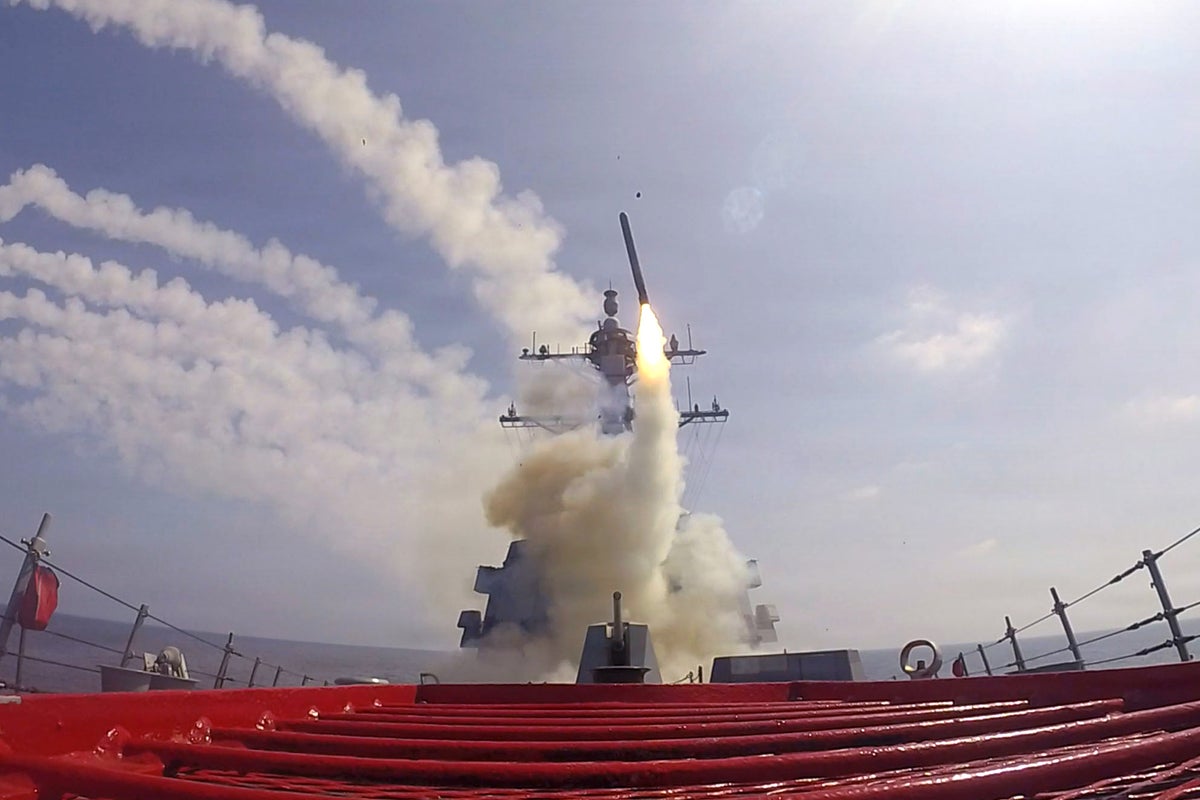
Military procurement directives do not materialize from abstract urgency; they are trailing indicators of inventory depletion curves crossing structural manufacturing thresholds. When a regional conflict transitions from a localized exchange of precision-guided munitions to a protracted campaign of sustained expenditure, the underlying defense-industrial base faces a brutal mathematical reality. Demand outpaces baseline surge capacity. The United States military directive pressing industrial contractors to drastically accelerate weapons manufacturing highlights a fundamental friction between peacetime production optimization and wartime consumption rates.
To understand why mobilization directives encounter severe inertia, one must examine the baseline economic incentives governing defense prime contractors. Unlike consumer goods markets, the defense sector operates under a monopsonistic structure where the Department of Defense is the sole buyer. During extended periods of low-intensity conflict or strategic competition, procurement strategy prioritizes cost control, lean manufacturing, and predictable shareholder returns over excess surge capacity. Maintaining idle assembly lines, unutilized specialized machine tools, or redundant raw material stockpiles imposes a continuous financial penalty under standard Federal Acquisition Regulation pricing rules. Consequently, contractors optimize for efficiency rather than elasticity.
The Three Structural Bottlenecks of Munition Scaling
Accelerating weapons output requires overcoming three distinct operational chokepoints that dictate the outer boundary of manufacturing velocity.
Tiered Supply Chain Fragility
Modern tactical missiles, interceptors, and precision artillery shells are not assembled in a single facility. They rely on multi-tiered supply webs featuring specialized sub-components, rare-earth elements, solid rocket motors, and proprietary energetic materials. A disruption at Tier 3 or Tier 4 halts final assembly at Tier 1. For instance, the production of solid rocket propulsion relies on a dwindling number of domestic suppliers capable of manufacturing specialized ammonium perchlorate and carbon fiber casing composites. When prime contractors receive instructions to accelerate output by orders of magnitude, the constraint is rarely final assembly floor space. The constraint is the lead time required for lower-tier suppliers to permit, finance, and construct expanded chemical processing facilities.
Workforce Specialization and Labor Velocity
Scaling production is fundamentally a function of skilled human capital availability. Precision manufacturing of guidance systems, seeker heads, and warhead fusing mechanisms demands specialized machinist, metallurgical, and electrical engineering talent. Unlike assembly lines with high labor interchangeability, defense manufacturing requires rigorous quality assurance certifications and security clearances. Training an aerospace machinist or a certified welder for rocket motor casting requires months of supervision. Rapidly doubling shift capacity introduces immediate trade-offs in defect rates and quality control, creating a dangerous tension between output volume and operational reliability in the field.
Regulatory and Capital Expenditure Friction
Defense contractors operate under strict return-on-capital expectations. Demanding that a publicly traded corporation fund capital expenditures for expansive manufacturing infrastructure without multi-year, legally binding forward procurement contracts introduces unacceptable shareholder risk. Equipment depreciation schedules, environmental permitting for chemical processing plants, and facility construction timelines mean that capital deployed today does not translate into finished tactical systems for twenty-four to thirty-six months. Without guaranteed long-term demand signals, corporate boards routinely favor share buybacks and dividends over high-risk capacity expansion.
The Cost Function of Burn Rates versus Replacement Latency
The strategic vulnerability facing defense planners is the divergence between consumption velocity and replenishment latency. In high-expenditure conflict scenarios, sophisticated air defense interceptors and precision strike assets are consumed in days or weeks. Conversely, the manufacturing cycle time for these same systems spans from twelve to thirty-six months.
This asymmetry defines the core dilemma of modern attrition warfare. When consumption exceeds production capacity by a factor of five or ten, stockpiles degrade below the minimum threshold required to maintain global deterrence postures. The Department of Defense cannot simply purchase more weapons if the physical manufacturing infrastructure to build them does not exist. Directives demanding acceleration expose the historical underinvestment in industrial surge capacity, forcing a reluctant recognition that national security relies as much on manufacturing depth as it does on technological superiority.
Strategic Capital Allocation and Industrial Base Realignment
Overcoming these structural deficits requires a complete overhaul of procurement mechanisms. Multi-year procurement authorities must replace annual budget cycles, providing contractors with the revenue predictability necessary to justify heavy capital expenditures in secondary and tertiary supply chains. Furthermore, the federal government must directly subsidize the creation of government-owned, contractor-operated facilities dedicated exclusively to maintaining warm, scalable baseline reserves of critical energetic materials and solid rocket motors.
The immediate operational response to supply depletion involves shifting procurement focus away from exquisite, low-volume systems toward standardized, modular designs that leverage commercial manufacturing tolerances where feasible. By decoupling critical military subsystems from hyper-specialized defense-only components, the industrial base can tap into broader commercial supply networks.
Long-term resilience depends on transforming defense procurement from a just-in-time logistics model into a resilient, redundant architecture capable of absorbing severe demand shocks without destabilizing the broader industrial ecosystem.


