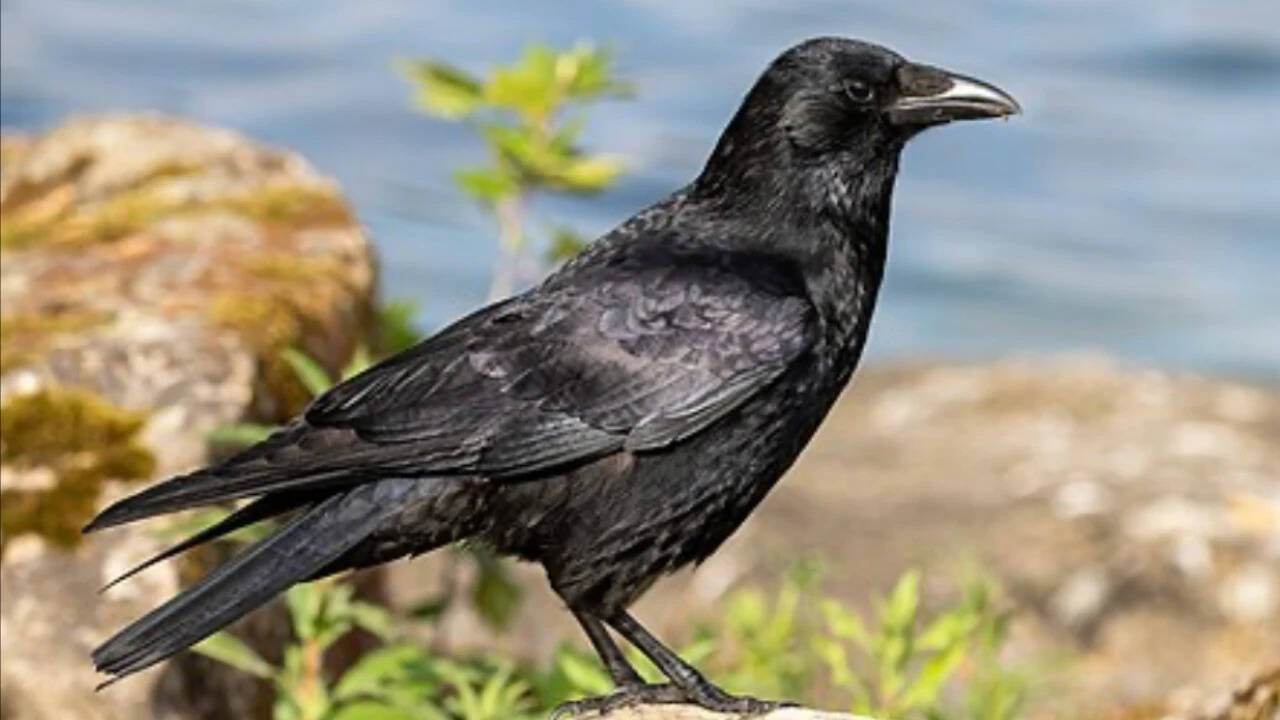
Carrion crows can determine the direction of a chaotic cloud of moving dots in roughly 235 milliseconds. That is faster than a human blink, and it directly challenges decades of neuroscientific dogma regarding how complex visual decisions happen without a primate cerebral cortex.
Most science coverage treats avian intelligence as a charming parlor trick. Journalists love stories about crows bending wires into hooks or dropping nuts into traffic so cars can crack the shells. Those anecdotes make for pleasant reading, yet they obscure the underlying mechanical reality. When a carrion crow stares at a screen of noisy, randomized motion and commits to a directional choice in less than a quarter of a second, we are not looking at a cute behavioral quirk. We are looking at an evolutionary blueprint for high-speed data processing running on radically different hardware than our own. Don't miss our earlier post on this related article.
The Architecture of a Quarter-Second Verdict
To understand why 235 milliseconds matters, you have to look at what the bird is actually doing during those fractions of a second. In laboratory settings, researchers test visual decision-making using a classic psychophysics tool known as the random dot kinematogram. Imagine a computer screen filled with dozens of white dots against a black background. Most of the dots jitter around in completely random directions, creating visual static. Only a small percentage—sometimes as low as ten or twenty percent—move coherently in a single direction, either left or right.
Your brain has to filter out the noise, accumulate evidence from the coherent dots, and cross a threshold of certainty before committing to an answer. Primates, including humans and rhesus macaques, excel at this task. We rely on a specialized cortical pipeline where visual information travels from the primary visual cortex to the middle temporal area (often called MT or V5), and finally up to the lateral intraparietal cortex and prefrontal regions where evidence is integrated over time. To read more about the history here, NPR provides an in-depth summary.
Crows do not have a cerebral cortex. Their brains lack the six-layered neocortical sheet that mammals rely on for abstract reasoning and sensory integration. Instead, birds possess a densely packed nuclear structure called the pallium, specifically a region known as the nidopallium caudolaterale (NCL).
For years, comparative neurobiologists assumed that lacking a layered cortex meant lacking the structural efficiency needed for rapid perceptual accumulation. The 235-millisecond benchmark destroys that assumption. When trained carrion crows track a random dot display and peck a target to indicate motion direction, their reaction times rival—and occasionally beat—those of trained monkeys performing the exact same task under identical conditions.
The speed is not a lucky guess. Accuracy scales cleanly with motion coherence. When eighty percent of the dots move together, the crow locks onto the direction almost instantly with near-perfect precision. When coherence drops to a faint whisper of twenty percent, the bird takes slightly longer, holding off its peck while its neural circuits gather more samples from the screen. This speed-accuracy trade-off is the hallmark of bounded evidence accumulation, a mathematical framework neuroscientists use to describe how brains weigh uncertain information before pulling a trigger.
Why Evolution Built a Faster Visual Processor
Evolution does not spend metabolic energy building a 235-millisecond visual filter so a bird can play video games in a German research lab. It builds that hardware because hesitation in the sky is fatal.
Consider the sensory environment of a foraging corvid. A carrion crow operates in a three-dimensional world packed with high-velocity threats and fleeting opportunities. If a northern goshawk drops out of the canopy through a shifting lattice of wind-blown leaves, the crow's visual system faces a literal real-world random dot kinematogram. The leaves are the visual noise. The sliver of gray feathers moving through the gaps is the coherent signal.
Waiting half a second to be ninety-nine percent sure that the movement in the branches is an accelerating predator means the hawk has already closed the distance. Conversely, flinching at every gust of wind burns precious calories and disrupts foraging. The crow's brain must run a continuous, real-time statistical calculation on messy visual inputs, separating dangerous trajectory from environmental clutter in under a quarter of a second.
The same math applies to scavenging. Carrion crows frequently forage along roadways and shorelines where food sources appear briefly between moving obstacles. Judging the vector of an approaching vehicle or tracking a rolling piece of food amidst swirling debris requires instant motion integration.
Hardware Differences and the Convergence Trap
When journalists cover these findings, they almost always fall into the trap of calling crows "feathered apes." That label is lazy and scientifically misleading. Calling a crow a feathered ape implies that the bird is running a smaller, slightly inferior version of primate software. The reality is far more interesting.
Mammals and birds diverged from a common reptilian ancestor roughly 320 million years ago. That ancestral reptile had a relatively simple brain capable of basic survival routines, not complex perceptual decision-making. Both lineages independently evolved high-level cognition, but they built their processors using completely different wiring diagrams.
| Feature | Primate Visual Decision System | Carrion Crow Visual Decision System |
|---|---|---|
| Primary Brain Structure | Layered Neocortex (6 distinct cellular layers) | Nuclear Pallium (3D clusters of neurons) |
| Key Integration Hub | Lateral Intraparietal Cortex & Prefrontal Cortex | Nidopallium Caudolaterale (NCL) |
| Neuron Density | Moderate (large cell bodies, longer axons) | Extremely High (compact neurons, short connections) |
| Average Reaction Time | ~250–350 milliseconds (task dependent) | ~235 milliseconds |
| Metabolic Cost | High glucose demand per gram of tissue | Remarkably efficient per neuron |
Look closely at the physical layout of those two brains. In a human or monkey brain, neurons are arranged in flat sheets folded into ridges. Signals have to travel across cortical layers and over relatively long white-matter tracts connecting the back of the brain to the front. Distance creates latency. Even at neural conduction speeds, moving data across centimeters of tissue eats up milliseconds.
A crow's brain is tiny, weighing around seven to ten grams, yet it packs roughly 1.5 billion neurons into that compact volume. Because bird neurons are smaller and arranged in dense three-dimensional clusters rather than spread-out sheets, the physical distance between sensory processing units and motor execution hubs is drastically shorter.
Short wires mean lower latency. When visual motion hits the crow's retina, travels through the optic tectum and entopallium, and reaches the NCL, the signal traverses millimeters instead of centimeters. The 235-millisecond reaction time is not magic; it is the direct physical consequence of extreme miniaturization and high-density neural packing.
The Messy Reality of Behavioral Lab Data
Before anyone crowns the carrion crow the undisputed heavyweight champion of visual speed, we need to look closely at how these numbers are generated in a laboratory. Veteran analysts know that reaction time metrics are notoriously sensitive to experimental design.
In standard primate studies, monkeys typically indicate their choice by making a saccade—a rapid eye movement toward a target on the screen. Eye movements are mechanically fast, taking only twenty or thirty milliseconds to execute once the brain sends the motor command.
Crows cannot move their eyes independently in their sockets the way primates do; they move their entire heads and bodies, usually pecking at a touchscreen or a physical key to register a choice. A head movement and a beak strike involve substantially more mechanical inertia than rotating an eyeball.
If a crow completes the entire loop—visual detection, noise filtering, directional decision, and physical beak contact with the screen—in an average of 235 milliseconds, the actual neural computation inside the pallium is happening even faster. Subtracting the motor execution time for a neck thrust suggests the bird's brain is locking onto the directional verdict in well under 200 milliseconds.
However, there is a counter-argument that temperate biologists often raise when comparing bird and monkey data. Laboratory crows are typically food-motivated, working for small mealworm rewards during intense daily sessions. Animals operating under strict foraging pressure tend to optimize for speed over extreme caution, accepting a slightly higher error rate to maximize total rewards per minute. Monkeys in neurophysiology labs, often hydrated via juice rewards over multi-hour sessions, frequently adopt more conservative decision thresholds.
Does the crow truly compute faster, or does it simply set a lower threshold for pulling the trigger?
Single-unit electrophysiological recordings—where microscopic electrodes listen to individual neurons firing inside the crow's NCL while the bird watches the dots—provide the answer. The firing rates of decision-related neurons in the crow's brain ramp up steeply as soon as the coherent dots appear. The slope of that neural ramp directly mirrors the coherence of the visual stimulus. The bird is not guessing early; its neurons are genuinely integrating visual evidence at a blistering pace.
What Neuromorphic Engineers Are Missing
The tech industry spends billions of dollars every year trying to solve the exact problem a carrion crow handles effortlessly before breakfast. Autonomous vehicles, warehouse drones, and missile defense trackers all struggle with low-signal, high-noise visual environments.
Current computer vision relies heavily on deep convolutional neural networks and vision transformers. These models are brutal force engines. They ingest high-resolution frames, multiply massive matrices of floating-point numbers, and burn through hundreds of watts of electrical power on specialized silicon chips. Even with modern hardware, filtering genuine motion from visual clutter—like rain, snow, shifting shadows, or sensor static—introduces latency and hallucination risks.
If an autonomous drone flying through a forest relies on a heavy transformer model to figure out whether a cluster of shifting pixels is a branch or an incoming obstacle, the lag between frame capture and motor adjustment can easily exceed a hundred milliseconds, consuming vast battery reserves in the process.
The avian brain demonstrates that you do not need massive parameter counts or high-wattage hardware to achieve sub-quarter-second perceptual certainty. You need sparse, event-driven processing paired with tight physical coupling between sensory inputs and decision nodes.
Neuromorphic computing researchers have spent the last decade mimicking the human neocortex, building silicon chips arranged in neat, layered grids modeled after mammalian cortical columns. That obsession with primate neuroanatomy might be a strategic blind spot.
A hypothetical neuromorphic processor modeled on the avian pallium would abandon layered hierarchies in favor of dense, three-dimensional local clusters where sensory filtering and evidence accumulation share the same physical neighborhood. By cutting out the long-distance routing bottlenecks typical of cortical architectures, engineers could build low-power vision chips capable of tracking coherent trajectories through severe visual static while drawing milliwatts instead of watts.
The Myth of the Simple Bird Brain
Language shapes how we value biology. For over a century, the phrase "birdbrain" served as shorthand for stupidity, a linguistic artifact left over from early twentieth-century anatomists like Ludwig Edinger. Edinger looked at avian brains under a microscope, saw no neocortex, and concluded that birds were driven entirely by primitive, hardwired instincts housed in an enlarged basal ganglia.
That mistake cost neuroscience nearly eighty years of progress. Because researchers assumed birds lacked the hardware for higher cognition, nobody bothered looking for complex decision-making circuits in the avian pallium until the turn of the twenty-first century.
When researchers finally applied modern electrophysiology and rigorous behavioral psychophysics to corvids, the old anatomical hierarchy collapsed. We now know that carrion crows possess working memory capacity comparable to primates, understand abstract numerical concepts like zero, recognize themselves in mirrors, and evaluate statistical probabilities in real time.
The 235-millisecond dot-motion finding is the latest nail in the coffin of cortical chauvinism. It proves that nature solved the problem of high-speed, noisy perceptual inference at least twice, using two radically different architectural layouts.
The Limits of the Crow's Visual Engine
No biological system is magic, and the crow's rapid decision engine comes with built-in trade-offs. Speed always demands a compromise somewhere in the circuit.
While carrion crows are extraordinarily fast at extracting global motion vectors from noisy backgrounds, their visual system is heavily tuned for survival-relevant kinematics rather than fine spatial detail at rest. Birds possess exceptional temporal resolution—known as a high critical flicker fusion rate—meaning they perceive fast movements as smooth, discrete events where a human sees only a blur. That high temporal sampling rate feeds directly into their rapid reaction times on dot-motion displays.
Yet when tasks shift from rapid motion integration to slow, multi-step visual planning—such as navigating complex visual mazes with delayed consequences or holding multiple static spatial rules in mind simultaneously—primates regain the advantage. The very distance and layering that slow down the mammalian neocortex allow for deeper cross-modal integration, linking visual inputs with long-term episodic memory and abstract rule sets.
A crow's pallium is a tactical sprint weapon. It is built to look at a chaotic burst of sensory data, extract the single vector that matters for immediate survival, and commit the body to action before a mammal has finished processing the second frame.
Watch a pair of carrion crows working a windy coastline or darting across a busy intersection. Every twitch of the head, every sudden hop out of the path of an oncoming tire, is the outward expression of an internal statistical engine running at 235 milliseconds per verdict. We spent centuries looking down at their tiny skulls, completely missing the fact that they were processing the visual world faster than we ever could.