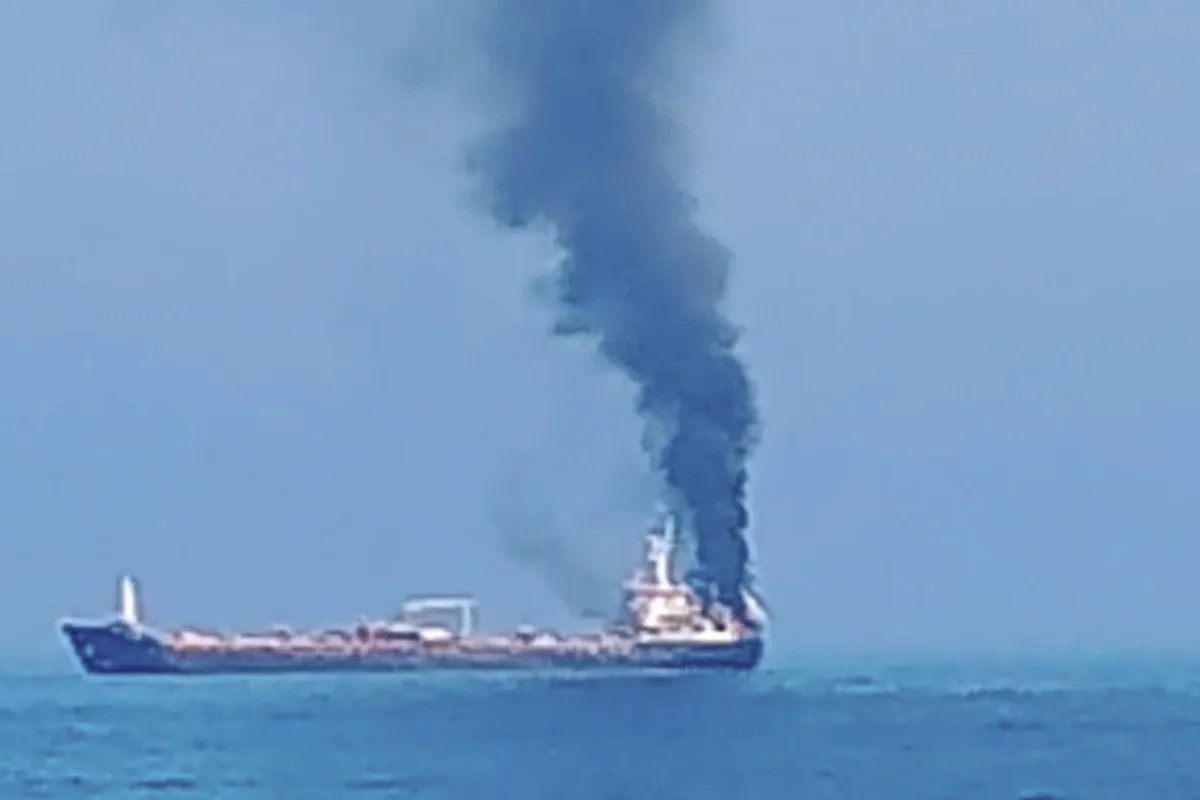
Six lives vanished into the dark waters of the Bab el-Mandeb Strait when ballistic missiles tore through the commercial cargo vessel Tihamah. This escalation marks a terrifying departure from the calculated harassment campaigns that have long defined the geopolitical standoff around Yemen's vital waterways. For months, shipping executives and naval strategists have played a high-stakes game of economic chicken across the Red Sea corridor. Tuesday's strike changed the rules of engagement entirely. Four crew members and two members of the local naval defense forces are dead, transforming a zone of commercial friction into an active graveyard.
The Anatomy of a Choke Point Collapse
To understand why this specific attack matters, look at a map. The Bab el-Mandeb Strait is a narrow aquatic throat measuring barely eighteen miles wide at its skinniest point, connecting the Gulf of Aden to the Red Sea and the Suez Canal beyond. Thousands of vessels squeeze through this passage annually, carrying everything from Asian manufactured goods to Middle Eastern crude oil and essential food commodities.
When the Houthis declared a naval blockade targeting Saudi-linked or compliant assets in the region, commercial insurers responded by rewriting the global trade calculus. Premium rates spiked overnight. Crew members became unwilling conscripts in a proxy war they often understood only through the whine of incoming projectiles.
The Tihamah was not a massive supertanker hauling petrochemicals. It was a local commercial lifeline carrying food supplies meant to sustain populations caught in the crossfire of Yemen's fractured state. Eyewitness accounts and maritime security assessments confirm that the vessel took three direct hits from ballistic systems.
Worse still, a secondary strike targeted rescue coordinators as they attempted to pull survivors from the burning wreckage. That secondary targeting represents an explicit violation of historical maritime norms. Rescue operations have traditionally occupied a gray zone of functional immunity even during active hostilities. By breaking that taboo, the perpetrators signaled that no entity operating within the Red Sea corridor retains civilian protection.
Shifting Alliances and Regional Fallout
The geopolitical shockwaves extend far beyond the immediate coastline of al-Mokha. With the Strait of Hormuz experiencing severe transit disruptions due to parallel confrontations involving Iran, the Red Sea route has carried an unsustainable weight as an alternative arterial highway for energy and commerce.
Regional actors are scrambling. Saudi Arabia, facing an aggressive tightening of economic pressures by Houthi leadership, has spearheaded defensive naval coalitions. Yet multilateral naval patrols cannot easily deter asymmetric missile batteries hidden deep within rugged inland terrain. Coast guard sources report that the casualties included Pakistani and Indonesian nationals among the crew, alongside Yemeni military personnel responding to the distress call. This multi-national toll guarantees diplomatic fallout across South and Southeast Asia, where families now mourn sailors whose voyages ended thousands of miles from home.
The political justifications offered by Houthi leadership center on grievances regarding stalled domestic ceasefires, humanitarian blockades, and economic strangulation engineered by rival coalitions. From Sanaa's perspective, the maritime blockade is an equalizer against an air and sea siege that has crippled civilian infrastructure for years. From the perspective of international maritime law, however, executing lethal strikes on civilian food carriers constitutes a severe escalation that invites direct military retaliation from global superpowers.
The Economic Reality of Extended Risk
Shipping lines do not absorb these shocks quietly. Every time a missile strikes a hull in the Bab el-Mandeb, container index futures climb and logistics boards across London, Singapore, and Dubai recalculate alternative routes around the Cape of Good Hope. Adding thousands of miles to a standard Asia-to-Europe voyage burns millions of extra gallons of bunker fuel and stretches global supply chains thin.
The illusion that localized regional conflicts can remain safely quarantined to desert borders has officially evaporated. When the blood of civilian sailors mixes with the sea salt of a strategic trade corridor, the cost of imported goods spikes in supermarkets from Cairo to Rotterdam. The maritime industry now faces a brutal reality check. Traditional naval escorts can intercept airborne threats, but they cannot guarantee absolute immunity in a narrow strait where the land towers over the sea, and every passing merchant vessel remains a potential target in a war without visible boundaries