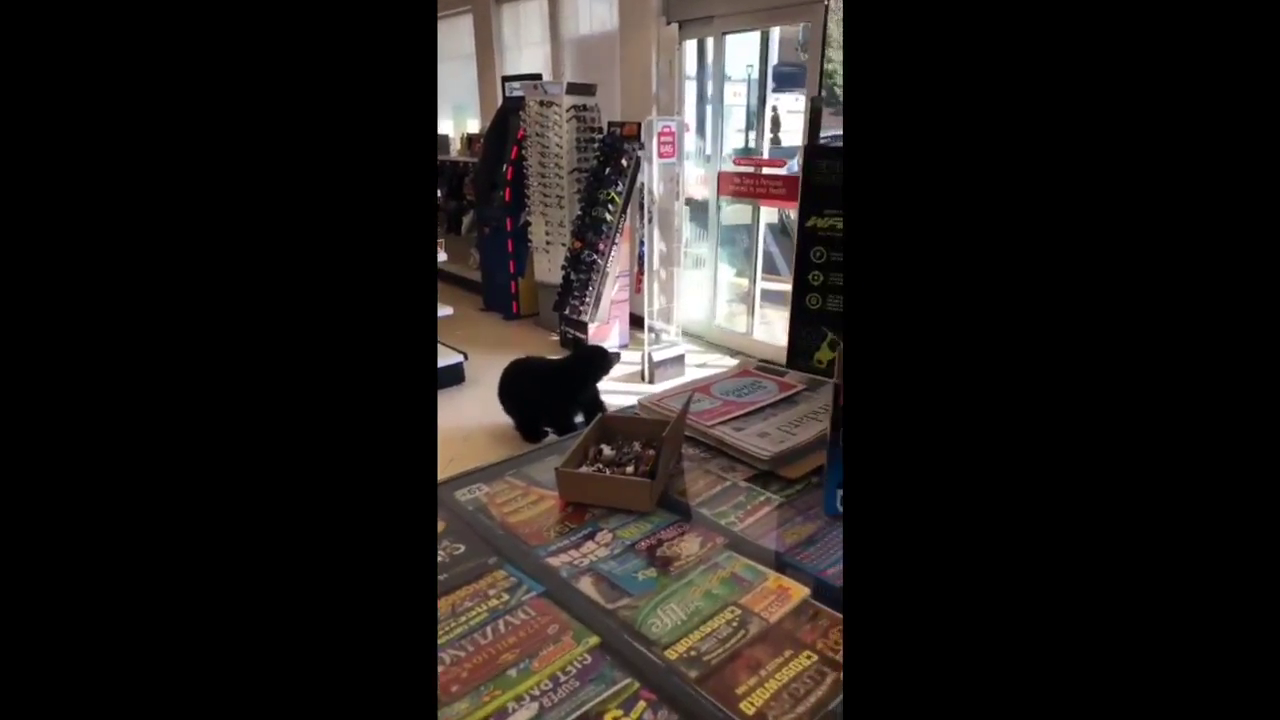
When a mother black bear and her cub trotted through the automatic sliding doors of a Pharmasave on Wallace Street in Hope, British Columbia, the initial reaction across social media was one of lighthearted amusement. Short video clips showed the pair browsing the cosmetic aisles, inspecting perfume displays, and calmly pacing past checkouts as startled employees scrambled to guide customers to safety. To millions of online viewers scrolling through TikTok and X, it looked like a real-life cartoon. A whimsical, almost cinematic moment where urban infrastructure and deep wilderness collided without immediate violence.
That charm evaporated within hours. You might also find this related article useful: Climate Volatility and Institutional Friction The Structural Cost of Delayed Adaptation.
By Monday, the narrative shifted from viral internet curiosity to a grim ecological post-mortem. Conservation officers tracked the bears down outside the store's immediate vicinity. The adult female bear was killed. The cub was captured and sent to a rehabilitation or wilderness transition program. Just like that, a peaceful eight-minute stroll through a suburban storefront concluded with the lethal enforcement of municipal wildlife protocol.
This incident exposes a much deeper, uncomfortable truth about human expansion into wildlife corridors across the Pacific Northwest. We treat animal intrusions as isolated anomalies, bizarre viral blips to be laughed at online before we return to our normal routines. They are not anomalies. They are symptoms of a systemic failure in how expanding towns manage the ecological boundaries where wild habitats abruptly meet commercial strip malls. As discussed in latest coverage by Associated Press, the implications are widespread.
To understand why this tragedy happened, one must look closely at the geography of Hope, British Columbia. Nestled at the confluence of major highway systems and surrounded by dense mountain forests, the municipality is a natural thoroughfare for black bears seeking high-calorie forage. Natural food sources such as berries and salmon fluctuate wildly depending on seasonal weather patterns, climate shifts, and forestry disruptions. When natural calories become scarce in the high country, urban centers offer an irresistible, calorie-dense alternative.
An open commercial door emitting the scent of human food waste, garbage bins, or simply unfamiliar indoor spaces represents a foraging opportunity for an animal driven by pure biological necessity. Bears do not possess malicious intent when they cross asphalt thresholds. They follow their noses. They operate on an evolutionary imperative to consume as many calories as possible before winter dormancy.
Yet, public policy leaves zero room for this ecological reality.
Standard wildlife management frameworks across North America operate under a zero-tolerance philosophy once an animal loses its natural wariness of human spaces. The logic applied by authorities is rooted in public safety. Once a bear learns that commercial buildings or residential backyards contain accessible spaces or food odors, it is categorized as a habituated animal. In the eyes of wildlife agencies, a habituated bear represents an unmanageable risk of a defensive or aggressive encounter with humans.
This creates a cruel paradox for the animal. We build towns directly inside historic migration and foraging routes. We leave garbage unsecured, create rich artificial attractants, and invite urban sprawl deeper into forested valleys. Then, when a wild animal behaves like a wild animal trying to survive in a landscape reshaped by human hands, we label it a public threat and execute it.
The staff at the Hope Pharmasave handled the sudden intrusion remarkably well. They kept calm, cleared shoppers away from the animals, and allowed the bears to wander out on their own volition after a brief, non-confrontational inspection of the store. No one was attacked. No property was destroyed. The bears caused no structural damage and eventually turned around to leave the premises.
For a brief window, it looked like a textbook example of peaceful coexistence. It proved that humans and large carnivores can occasionally share a physical space without immediate catastrophe if cooler heads prevail.
That peaceful exit made the subsequent decision by conservation officers feel all the more jarring to local residents and witnesses. Critics of the lethal outcome argue that if a bear leaves a building under its own power without displaying aggression, killing it later sends a defeatist message about wildlife management. It punishes the animal for human architectural design. It punishes a mother bear for walking through an open door that should have been secured or managed with automated deterrent air-curtains or wildlife-aware storefront protocols.
Conversely, wildlife officers defend these hard choices by pointing to the inevitability of repeat behavior. A bear that successfully enters a brightly lit commercial building and encounters zero physical resistance or negative reinforcement will likely try again. The next time, officials argue, the store might be packed with children, or the mother bear might feel cornered by a panicked crowd, leading to a mauling and a far worse outcome for both humans and wildlife.
Both arguments hold a kernel of uncomfortable truth, which is precisely why these incidents ignite such fierce public debate. One side emphasizes human responsibility and the encroachment of our concrete footprint onto ancient animal paths. The other side emphasizes the absolute unpredictability of wild carnivores once they lose their innate fear of human architecture.
What gets lost in this polarized noise is the fundamental requirement for structural adaptation. Posting viral videos online and expressing temporary shock does nothing to prevent the next encounter. Municipalities that interface directly with wilderness zones need mandatory commercial wildlife defenses. Simple upgrades, such as heavy-duty automatic door locks triggered by remote sensors, better municipal waste bylaws, and strict zoning buffers, could drastically reduce the frequency of urban animal incursions.
Until local governments treat wildlife management as an infrastructure design problem rather than a reactive policing problem, bears will continue to wander into pharmacies, grocery stores, and residential streets.
The mother bear in Hope paid the ultimate price for crossing an invisible line that humans drew across her ancestral home. Her cub survived, destined to grow up in a landscape where every human structure represents a potential death sentence. As long as we treat wildlife intrusions as entertaining viral content rather than urgent warnings about our shrinking natural borders, these tragedies will keep repeating with grim, predictable regularity.