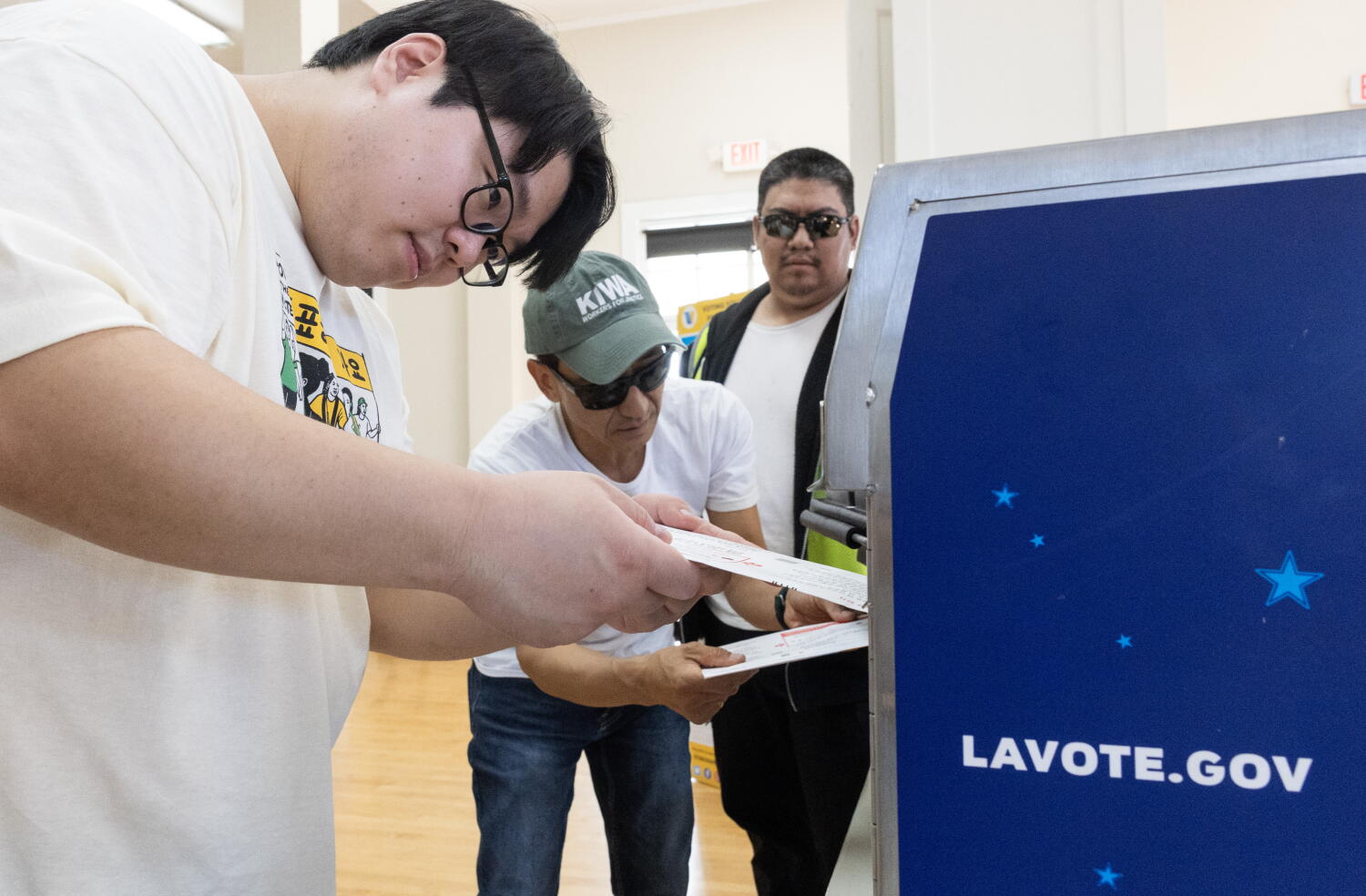
In late October 2026, the Trump Justice Department triggered an extraordinary series of emergency court hearings in a last-ditch effort to freeze and segregate roughly 20,000 mail-in ballots across California. The federal government claimed those ballots belonged to "likely" noncitizens, yet within weeks the entire legal offensive collapsed—rejected twice by the Ninth Circuit, rebuffed by a federal district judge, turned away without dissent by the U.S. Supreme Court, and quietly abandoned by federal prosecutors days after the midterms.
That rapid implosion exposes a profound collision between political theater, algorithmic database matching, and the hard physical realities of American ballot processing. For a more detailed analysis into similar topics, we suggest: this related article.
The Anatomy of a Shrinking Accusation
To understand why the federal blitz failed in court, you have to look at the numbers before the lawyers ever drafted an emergency motion. Months before the November 3, 2026 midterm election, the Justice Department approached California officials with an explosive claim: federal analysts had identified 190,000 individuals on the state's voter rolls whom they suspected were illegally registered.
By the time the DOJ actually filed United States v. California in federal court on October 15, that figure had quietly evaporated by nearly ninety percent. When federal attorneys delivered their target list to the California Secretary of State and the Los Angeles County Registrar on October 13, the roster had shrunk to roughly 20,000 names. For broader context on this development, detailed reporting can also be found on USA Today.
Even that drastically reduced number rested on shaky technical ground. According to court filings, Homeland Security Investigations and its federal partners relied on automated "data-enrichment and verification methods" to cross-reference state voter files against federal immigration records. Anyone who has spent serious time auditing government databases knows the trap here. Cross-matching massive, independently maintained registries—often lacking shared unique identifiers and relying on probabilistic matching of names, birthdates, and addresses—routinely flags naturalized citizens whose immigration records lag behind their oath ceremonies, alongside people who simply share common names.
U.S. District Judge David O. Carter spotted the defect immediately during an October 27 hearing. Confronted with a demand to quarantine 20,000 votes one week before Election Day, Carter noted that the court had zero time to audit the government's opaque "systems" and "algorithms" to see if the list was even accurate. Instead of blindly trusting federal spreadsheets, he appointed a special master to examine how the DOJ built its list. Rather than face that technical scrutiny, the Justice Department ultimately dropped the lawsuit.
Why Secret Ballots Defeat Last-Minute Court Orders
The DOJ's core legal argument sounded deceptively simple on cable news. Federal law under 18 U.S.C. § 611 prohibits noncitizens from voting in federal elections. Therefore, federal lawyers argued, California should simply pull aside the mail-in ballots cast by the 20,000 flagged voters, keep them separated from the main count, and verify citizenship later.
That demand collided head-on with how modern vote-by-mail infrastructure actually works.
California operates an all-mail-ballot system where every active registered voter automatically receives a ballot weeks before Election Day. Early voting begins in early October. In Los Angeles County alone, election workers began opening and processing returned mail-in ballots on October 5—ten days before the Justice Department even filed its lawsuit.
Under California election law and state constitutional secret-ballot protections, ballot processing is a one-way street designed specifically to sever a voter's identity from their choices:
- Signature verification happens first: Election workers inspect the outer return envelope, verify the voter's signature against registration records, and log that the voter has cast a ballot.
- Separation destroys traceability: Once verified, the envelope is sliced open, the paper ballot is removed, and the ballot is flattened and fed into high-speed tabulators.
- Anonymity becomes permanent: After a ballot leaves its outer envelope, it carries no serial number, barcode, or identifying mark linking it back to an individual.
By the time the DOJ went to court in mid-October, hundreds of thousands of Californians had already voted and their ballots had already been separated from their envelopes. Asking county registrars to "segregate" 20,000 specific votes mid-stream was like asking a baker to pull specific grains of flour out of a baked loaf of bread. Even for ballots that had not yet arrived, forcing 58 county election offices to reprogram intake workflows, manually intercept incoming envelopes against an unverified federal list, and halt tabulation risked breaking state chain-of-custody laws and disenfranchising eligible U.S. citizens caught in federal database errors.
A Procedural Meltdown Across Three Levels of Courts
What made the DOJ's October offensive truly unusual was not just its factual weakness, but its procedural impatience. Normally, a plaintiff files a motion for a temporary restraining order in federal district court, waits for a hearing, and appeals only after the judge rules.
Here, the Justice Department broke the rules of appellate procedure. On October 21, the case was reassigned to Judge Carter, who scheduled an expedited hearing for October 27—a full week before Election Day. Unwilling to wait even a few days, DOJ attorneys took an extraordinary step on October 22: they bypassed the district court entirely and demanded an emergency injunction directly from the Ninth Circuit Court of Appeals, arguing that waiting fifteen hours between filings constituted an irreparable emergency.
The Ninth Circuit convened a rare Sunday oral argument via Zoom on October 25. The panel included Judge Gabriel P. Sanchez, a Biden appointee, alongside two Trump appointees, Judge Mark J. Bennett and Judge Patrick J. Bumatay. During arguments, Judge Bennett—appointed by Donald Trump himself—cut straight to the constitutional flaw in the government's case, pointing out that federal lawyers were asking judges to impose an injunction flatly inconsistent with election rules enacted by the California Legislature under the Elections Clause.
On October 26, Bennett and Sanchez dismissed the appeal for lack of jurisdiction, ruling that the DOJ had improperly jumped the line before the district court could even hold its hearing. Two days later, on October 28, Judge Carter formally denied the DOJ's temporary restraining order, warning that seizing and segregating ballots at such a late hour would "wreak havoc" on the midterm elections and risk silencing legitimate citizens.
The Justice Department appealed to the Ninth Circuit a second time and lost again on October 30. On November 2—the eve of Election Day—Solicitor General lawyers filed an emergency application with the U.S. Supreme Court. Later that evening, the Supreme Court summarily denied the request without a single noted dissent and without even asking California to file a formal response.
The Parallel Pressure Campaign on Local Officials
While appellate lawyers fought losing battles over ballot segregation, another arm of the Justice Department ran a far more aggressive campaign aimed directly at the civil servants running California's elections.
In mid-October, federal officials sent warning letters to California election administrators threatening potential criminal prosecution if local workers processed ballots cast by people appearing on the federal government's suspected noncitizen list. By late October, federal prosecutors escalated further, issuing grand jury subpoenas to California election workers and announcing criminal charges against roughly two dozen green card holders over alleged voter registration or voting offenses.
That two-track strategy—combining impossible civil injunctions with criminal intimidation of local registrars—drew a sharp rebuke from another federal bench. In a parallel lawsuit brought by labor unions and voting rights groups, U.S. District Judge Trina Thompson issued a temporary restraining order barring the Justice Department from threatening, intimidating, or coercing local election officials over processing ballots from registered voters on the government's unverified lists.
The contrast between the DOJ's rhetoric and its actual criminal docket told the real story. California is home to more than 22 million registered voters. Across months of aggressive federal sweeps, data-enrichment runs, and subpoena campaigns, prosecutors brought criminal charges against roughly 28 to 30 noncitizens in the state. Every credible academic and government audit over the past two decades has reached the exact same conclusion: noncitizen voting in federal elections is vanishingly rare, largely because immigrants on green cards or visas risk immediate deportation and permanent bars to citizenship if they sign a false attestation on a voter form.
Yet even a tiny number of real violations—often stemming from confusion at motor vehicle agencies during automatic voter registration—provides political fuel for sweeping claims of systemic fraud. By conflating thirty prosecutable mistakes with 20,000 unverified algorithmic matches, the Justice Department created the public impression of a massive crisis while presenting courts with almost zero admissible proof.
What the Quiet Retreat Actually Means
Three days after the polls closed, on Friday, November 6, the Justice Department quietly filed papers to dismiss United States v. California. Prosecutors acknowledged in court filings that the emergency relief they sought was now moot because Election Day had passed.
Even in retreat, DOJ spokespeople insisted that California had chosen to "protect illegal voters"—a talking point designed for headlines rather than judicial scrutiny. Had the department genuinely believed its list of 20,000 names could withstand forensic examination, it could have kept the underlying lawsuit alive to litigate voter-roll maintenance rules ahead of 2028, or submitted its matching methodology to Judge Carter's court-appointed special master.
Instead, federal lawyers walked away the moment a judge demanded to inspect their data. Within two weeks, the prosecutor who spearheaded the failed California ballot suit, Bill Essayli, was reassigned to another politically charged Justice Department inquiry in Florida.
California's voter-roll maintenance is far from flawless. Automatic registration through the Department of Motor Vehicles has historically produced edge cases where eligible noncitizen driver's license applicants were inadvertently added to registration rolls unless they actively opted out, forcing state officials to periodically audit and cancel erroneous entries. Fixing those administrative leaks requires mundane, methodical interagency data hygiene months or years before ballots go to print—not emergency lawsuits filed nineteen days before an election.
The federal courts did not endorse noncitizen voting when they shut down the Justice Department in October 2026. They enforced a far simpler boundary: the federal government cannot weaponize unverified algorithms, bypass statutory notice periods, threaten local election clerks with prison, and demand the quarantine of tens of thousands of ballots on the eve of an election without bringing actual evidence into the courtroom.
Watch Federal court rules against DOJ in suit over California voter rolls for broadcast coverage of how the Ninth Circuit panel dismantled the Justice Department's initial emergency bid to halt California ballot processing.


