The Western Hemisphere is once again being treated as a proprietary security zone under the banner of the Donroe Doctrine. Articulated during the second Trump administration and punctuated by kinetic interventions in South America, this modern adaptation of 19th-century geopolitics aims to forcibly purge extra-regional rivals from the Americas. Yet beneath the theater of gunboat diplomacy and immediate resource extraction lies a structural contradiction. Washington wants absolute strategic obedience from its neighbors without offering the massive capital commitments necessary to replace Chinese and European commercial gravity.
This is not a grand strategy built for long-term competition. It is an exercise in political performance that mistakes tactical disruption for regional dominance.
The Arithmetic Failure of Coercion
For decades, the standard playbook for American hegemony in the Americas relied on a mix of trade agreements, institutional leverage, and selective intervention. The Donroe Doctrine strips away the institutional pretense, substituting economic statecraft with blunt instruments. Tariffs are brandished against allies, maritime interdictions target supply lines, and sudden military operations target uncooperative regimes.
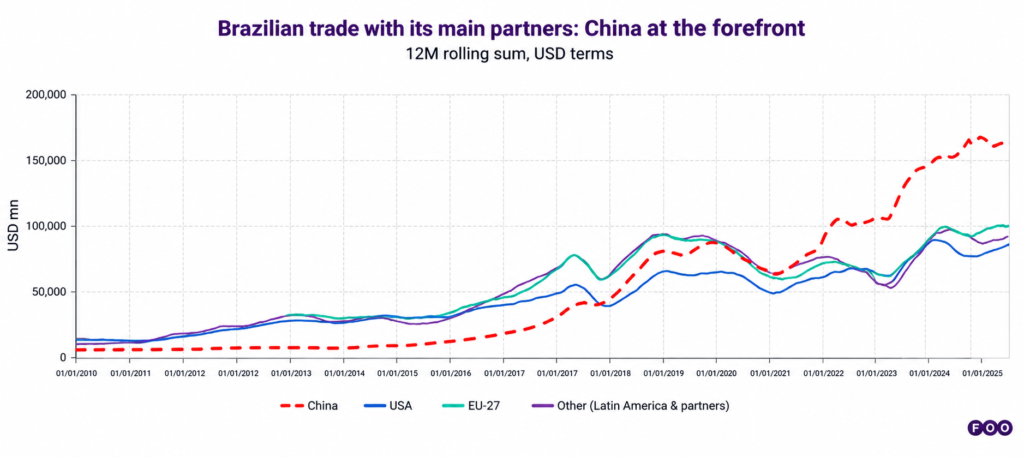
The fatal flaw in this architecture is financial. China did not secure its sprawling footprint in Latin America through military coercion or ideological conversion. Beijing bought its way in through infrastructure financing, state-backed bank loans, telecommunications networks, and ravenous commodity demand.
Consider a hypothetical nation in the southern cone seeking to modernize its electrical grid or expand its deep-water ports. When Washington offers stern warnings against partnering with state-backed overseas firms while providing zero alternative financing, local leaders face an impossible choice. They can accept economic stagnation under American pressure or take Chinese capital to keep their economies functioning.
Threats cannot outcompete credit lines. Until American policymakers match their rhetorical demands with deep capital mobilization through instruments like the Development Finance Corporation, the doctrine will remain an exercise in shouting at the tide.
The Myth of Imminent External Threat
Proponents of the framework argue that drastic measures are required to counter aggressive Chinese and Russian penetration in the Western Hemisphere. Threat inflation has become a core administrative reflex. Commercial investments, port access agreements, and bilateral trade talks are routinely reframed as existential security hazards.
This logic collapses under basic scrutiny. Commercial ports and telecommunications upgrades do not translate into forward-deployed military bases or strategic missile silos. By treating normal globalized commerce as an act of subversion, the United States creates a self-fulfilling prophecy. When Washington treats every Latin American nation as a potential enemy asset unless proven otherwise, it alienates moderate regional leaders who prefer non-alignment and multi-vector diplomacy.
The enforcement mechanism relies on a hierarchical view of sovereignty. Local capitals are treated not as independent actors with legitimate domestic agendas, but as variables to be corrected. When compliance is demanded through intimidation rather than partnership, compliance becomes temporary and superficial.
The Venezuelan Test Case
The operational reality of this posture was laid bare when U.S. forces struck targets in Venezuela and captured its leadership, with top officials explicitly linking the operation to the newly minted doctrine. The public justification leaned heavily on counter-narcotics and anti-terrorism mandates. The subtext was raw resource politics and the outright denial of sovereign autonomy over nationalized assets.
Prominent figures hailed the operation as a definitive return to American preeminence. Yet a deeper look at Venezuela's oil infrastructure reveals the limits of this approach. Decades of underinvestment, corruption, and systemic decay mean that seizing political control does not instantly translate into functional barrels of oil or stabilized cash flows.
Running a fractured state from a distance requires an occupation-grade commitment that the American public and political establishment have no appetite to sustain. Spectacle replaces strategy, leaving behind a vacuum filled by administrative chaos rather than enduring stability.
The Strategic Blind Spot
The architects of this regional strategy assume that other nations in the hemisphere possess no agency of their own. They believe that historical memory can be overridden by sudden displays of kinetic force. That is a dangerous miscalculation. Across Latin America, memories of Cold War interventions run deep. Heavy-handed tactics do not win hearts, nor do they secure long-term alignment; instead, they drive pragmatic regional leaders into defensive nationalism or alternative economic alignments.
True authority is built on the magnetism of markets, the reliability of legal frameworks, and mutual economic benefit. When foreign policy reduces down to a series of punitive episodes and transactional demands, credibility thins out. The applause fades, the headlines cycle away, and the structural vulnerabilities remain entirely unaddressed.
The hemisphere is slipping away not because Washington lacks the capability to break things, but because it refuses to do the hard, unglamorous work of building things that last.