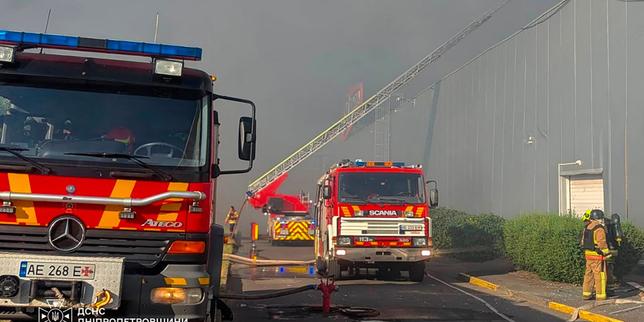
The afternoon air over Kryvyi Rih carried the ordinary hum of late-summer commerce before the low, rasping drone engines tore through it. When the first explosive payload slammed into the Solnechnaya Galereya shopping center, it did not merely rupture a commercial hub in central Ukraine. It triggered a calculated sequence of violence that left at least fourteen dead and over a hundred wounded, cementing a grim tactical evolution in the air war. This was not a stray munition or a miscalculated trajectory. It was a deliberate, two-stage strike executed by jet-powered Shahed drones designed to maximize human casualty by targeting the rescue workers who rushed to save the initial victims.
Decades of reporting on modern conflict zones reveal a chilling truth. Weapons systems adapt not just to defeat enemy armor, but to exploit human empathy. The doctrine of the secondary strike, or double-tap, turns the instinctual rush of first responders, medics, and bystanders into a vulnerability. When the second drone detonated roughly thirty minutes after the first blast, it struck an area already swarming with firefighters and paramedics.
Understanding why cities like Kryvyi Rih remain perpetual targets requires looking beyond frontline maps. Located in central Ukraine and carrying the symbolic weight of being President Volodymyr Zelenskyy’s hometown, the city represents a dense industrial and demographic anchor. Moscow's aerial campaign has increasingly leaned on mixed barrages—pairing low-flying jet propulsion drones with ballistic missiles—to overwhelm regional air defenses that remain stretched desperately thin across a vast geographic expanse.
The Mechanics of Low-Altitude Penetration
Air defense is a game of millimeters and seconds. Traditional radar networks, optimized for high-altitude cruise missiles or fast-moving fighter jets, face immense geometric hurdles when tracking objects skimming rooftops. The modified jet-powered variants of loitering munitions used in strikes like the one in Kryvyi Rih operate at extreme low altitudes. Terrain masking allows these systems to duck beneath radar horizons until they clear the final ridge or urban perimeter.
By the time acoustic sensors or localized spotters flag the incoming threat, flight times are measured in seconds.
[Radar Horizon] ---> (Low-Altitude Flight Path) ---> [Urban Target Masking] ---> Impact
This technological shift has rendered standard siren warnings agonizingly brief. Civilians have mere moments to locate subterranean shelter. In major urban centers like Kyiv, underground metro stations swell with tens of thousands of residents during overnight barrages. In commercial districts like the one in Kryvyi Rih, afternoon shoppers have no such immediate subterranean refuge, turning everyday retail spaces into exposed vulnerabilities.
The Cost of Delayed Interceptors
The human toll of these attacks exposes the widening chasm between strategic rhetoric and operational reality on the ground. Local military administration reports confirmed that among the 121 injured in the shopping center strike, over twenty were children. Twenty-nine individuals were rushed to hospitals in critical condition.
Western allies have steadily supplied air defense platforms, yet the scarcity of high-end interceptors—such as the U.S.-made Patriot systems capable of neutralizing ballistic threats—forces military planners into impossible triage. Protecting critical national infrastructure, power grids, and command nodes frequently drains resources away from regional hubs. Cities like Kryvyi Rih, Kharkiv, and Zaporizhzhia often absorb the brunt of drone attrition warfare precisely because advanced anti-air batteries cannot be everywhere at once.
This dynamic creates a grinding psychological attrition. The objective is not merely territorial capture or the destruction of economic assets. It is the systematic erosion of normalcy. When grocery stores, residential courtyards, and shopping plazas turn into blast zones in broad daylight, the psychological impact ripples outward across the entire nation.
The Logistical Feedback Loop
As the air war deepens into its fourth year, both sides are locked in an escalating retaliatory loop. Ukraine has steadily expanded its own long-range drone campaigns, targeting Russian oil refineries, fuel depots, and logistics hubs hundreds of kilometers behind the border to disrupt the fuel supply feeding the invasion force. In response, Moscow intensifies urban bombardment campaigns, treating civilian population centers as levers of pressure to force political concessions.
The debris from these intercepted and landed strikes settles into the fabric of daily life. Emergency services operate on permanent exhaustion, driving toward secondary explosions knowing that the flight path above them remains contested. International condemnation flows through diplomatic channels, yet on the fractured pavement of central Ukraine, the immediate reality remains defined by the whine of low-flying engines and the frantic search for survivors beneath collapsed concrete.