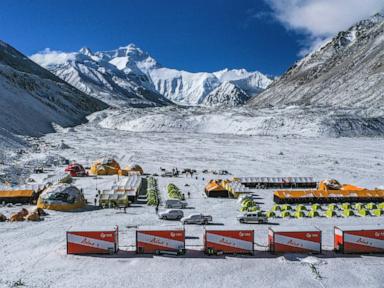
The Indian government wants to pull a ghost off the Northeast Ridge of Mount Everest. In an official tender issued by the Indo-Tibetan Border Police, authorities have called for elite high-altitude recovery teams to ascend into the dead zone, chisel a decades-old corpse out of the ice, and return it to New Delhi by October. The body is the most famous macabre waypoint in mountaineering history, known globally for thirty years simply as Green Boots. DNA testing has finally stripped away the anonymity, confirming the remains belong to Lance Naik Dorje Morup, an Indian soldier who perished in the catastrophic 1996 blizzard.
But this is not a routine recovery. It is a terrifyingly complex logistical nightmare that exposes the brutal underbelly of high-altitude commercialization and the physical limits of human survival. Bringing Morup home means forcing a team of elite Sherpas to work at 8,500 meters for an extended period, moving a heavy, frozen block of human tissue over sheer limestone steps where a single misstep means joining the dead. The official plan demands that a contracted team execute this mission during the unpredictable summer and early autumn months. It is an operation that veteran expedition leaders warn could easily double the body count. If you enjoyed this piece, you might want to look at: this related article.
The Myth of the Lime Green Marker
For nearly three decades, commercial clients ascending the Tibetan side of Everest used Morup as an informal check-in point. They would push past a limestone alcove, spot the bright lime-green Koflach mountaineering boots jutting into the path, and radio base camp to confirm their altitude. The human being inside the clothes was entirely secondary to the utility of the landmark.
This commodification of the dead is unique to Everest. More than 200 bodies remain scattered across the upper slopes, turning the mountain into a vertical open-air cemetery. In 2014, a Chinese expedition quietly dragged Morup's remains slightly out of the direct line of sight to afford him some dignity, but the location remains precarious, frozen fast to the rock beneath the First Step. For another perspective on this development, refer to the latest coverage from The Washington Post.
The primary narrative surrounding Green Boots always focused on identity confusion. For twenty-eight years, the mountaineering community assumed the body belonged to Tsewang Paljor, a 28-year-old constable on the same ill-fated 1996 Indo-Tibetan Border Police expedition. The recent DNA confirmation that the remains are actually those of his 47-year-old teammate, Dorje Morup, solves a clerical mystery but ignores the deeper ethical rot. The world knew exactly where this man was for thirty years. He was left there because leaving him was convenient, cheap, and safe for the commercial industry thriving below.
The True Weight of the Dead
To understand why body recoveries at 8,500 meters are rare, one must understand basic physics under extreme atmospheric pressure. A human body frozen solid over thirty years does not behave like a normal weight. It becomes part of the mountain itself.
The recovery process requires a minimum of six to ten Sherpas working in absolute unison. First, they must use ice axes and crowbars to meticulously chisel the remains out of the permafrost without destroying the body. At an altitude where the human brain is starved of oxygen and a single breath feels like breathing through a straw, this heavy physical labor burns through supplemental oxygen tanks at an exponential rate.
Once freed, the body is wrapped in a heavy canvas sled or plastic shroud. A corpse frozen in a curled, defensive posture is impossible to straighten, meaning it becomes a highly awkward, aerodynamic sail when the wind picks up. A normal human body might weigh 80 kilograms in life. Frozen solid, caked in solid ice, and requiring heavy rigging equipment, the payload easily exceeds 100 kilograms.
- The First Step: The team must lower this dead weight down vertical limestone drops.
- The Ridge Traverses: Sherpas must balance on a knife-edge ridge with the body, fighting crosswinds that top 60 knots.
- The Oxygen Deficit: Every minute spent dragging the sled is a minute the recovery team slides closer to cognitive decline and frostbite.
Veteran mountaineer Guy Cotter, who led legendary operations on the mountain, has warned that body recovery efforts on Everest often cross a very thin line. History proves this out. In 1984, two Nepalese climbers, Yogendra Bahadur Thapa and Ang Dorje Sherpa, died on the South Face while attempting to recover the body of Hannelore Schmatz. The mountain frequently claims the living to protect its custody of the dead.
The Geopolitical Chessboard above the Clouds
The physical mechanics of the recovery are only half the problem. The geopolitical landscape of Everest is as treacherous as its crevasses. Morup lies on the northern slope, which falls under the strict administrative and military jurisdiction of the People's Republic of China.
Currently, China has closed the Tibetan route to most non-Chinese nationals, forcing the global climbing community to focus almost exclusively on the Nepalese side. Yet the Indo-Tibetan Border Police tender expects a private agency to navigate this diplomatic minefield, secure the necessary permits from Beijing, and transport the remains across highly militarized borders to New Delhi.
If the recovery team is forced to ascend from Nepal, cross over the summit, descend the northern face to retrieve Morup, and then haul his 100-kilogram frozen form back over the 8,848-meter summit to descend via the South Col, the mission transitions from high-risk to suicidal. The alternative requires flawless diplomatic coordination between India and China at a time when border tensions between the two nuclear-armed nations remain consistently volatile.
The Myth of the Clean Mountain
The sudden urge to recover Morup highlights a growing crisis regarding the ecological and moral footprint of Everest tourism. For decades, operators treated the upper slopes as an administrative dead zone where normal laws of human decency and environmental waste did not apply.
Bodies like Morup's and Francys Arsentiev's—the American climber known as Sleeping Beauty who died in 1998—became tourist attractions. While Arsentiev's body was eventually moved out of sight in 2007, the underlying culture has not changed. Rainbow Valley, a section of the upper mountain named for the brightly colored down jackets of deceased climbers scattered across the rocks, stands as a monument to institutional apathy.
Skeptics argue that pulling Morup down now is a public relations move designed to sanitize the image of the mountain as international regulatory scrutiny grows. The commercial industry relies on the illusion of safety and prestige. A famous, heavily photographed corpse sitting right next to the standard climbing route shatters that illusion.
The Cost of Closure
For the family of Dorje Morup, the successful repatriation of his remains means everything. For nearly three decades, they have known their loved one was serving as a literal milestone for wealthy tourists. In accordance with traditional religious protocols, his family desires to perform the final rites that have been frozen in time since 1996.
But the mountaineering community must face an uncomfortable reality. Is the reclamation of historical dignity for one fallen soldier worth risking the lives of six to ten living Sherpas? The Indo-Tibetan Border Police's timeline demands completion by October, right in the heart of the monsoon transition when weather windows on the upper ridges open for mere hours before slamming shut with sub-zero blizzards.
If the contracted team pushes too hard to meet the government's deadline, the Northeast Ridge will not be cleaned. It will simply get crowded.