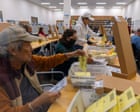
Federal prosecutors have instructed California election officials to identify, isolate, and preserve ballots cast by individuals flagged as potential noncitizens during recent federal audits. The directive stops short of invalidating votes outright, instead triggering an administrative quarantine under the National Voter Registration Act and the Help America Vote Act while state and federal databases are cross-examined. For county registrars across the state's 58 jurisdictions, the mandate creates an immediate operational bottleneck that pits federal oversight against California's automated registration architecture.
Surface-level coverage frames this conflict as a routine partisan skirmish over ballot security. That reading misses the machinery underneath. What is actually unfolding in Sacramento and Washington is a high-stakes collision between two incompatible data ecosystems, driven by decades-old federal statutes that were never built for the era of automatic motor-voter registration.
The Mechanics of the Quarantine Directive
When the Department of Justice issues a preservation and segregation order to state election administrators, it is exercising authority rooted primarily in the Civil Rights Act of 1960 and the Help America Vote Act of 2002. Under Title III of the 1960 law, election officials are legally obligated to retain and preserve all records and papers relating to any application, registration, payment of poll tax, or other act requisite to voting for twenty-two months after a federal election.
Segregating a ballot is not the same thing as throwing it out. It is a forensic hold.
In practice, county election workers must pull specific provisional or mail-in ballot envelopes before the tabulators read them, or flag specific voter records in the statewide VoteCal database so their status remains unresolved during the post-election canvass. Once a ballot is separated from its outer envelope and fed into a high-speed optical scanner, the secret ballot doctrine makes it legally and physically impossible to retrieve. The DoJ directive arrives precisely to beat that clock. By forcing officials to set aside flagged ballots prior to tabulation, federal attorneys preserve standing for potential litigation or administrative enforcement actions before the window of remedy slams shut.
County registrars operate under brutal statutory deadlines. California law gives officials a strict window to certify results, cure mismatched signatures, and adjudicate provisional ballots. Dropping a federal segregation mandate onto local offices in the middle of that sprint forces staff to manually audit registration trails that normally run on automated tracks.
How Motor Voter Databases Create False Positives
To understand why thousands of names routinely land on federal watchlists without a shred of criminal intent, you have to look at the plumbing connecting the California Department of Motor Vehicles to the Secretary of State's office.
California's New Motor Voter program, launched in 2018, automatically registers eligible citizens to vote when they apply for or renew a driver's license, unless they actively opt out. Simultaneously, California issues AB 60 driver's licenses to undocumented residents and standard licenses to lawful permanent residents, visa holders, and temporary workers. The system relies on DMV clerks and applicant touchscreens to accurately route citizen records to VoteCal while filtering out noncitizen applicants.
Software glitches and human fatigue break that filter regularly.
During the initial rollout of the program, state audits revealed tens of thousands of registration errors, including roughly 1,500 noncitizens who were inadvertently added to the voter rolls despite never claiming citizenship. While state engineers patched the primary routing bugs, the underlying friction between state licensing databases and federal immigration records never disappeared.
The core problem is data latency. Federal agencies rely heavily on the Systematic Alien Verification for Entitlements program, known as SAVE, managed by U.S. Citizenship and Immigration Services. SAVE was designed to verify immigration status for public benefits, not to serve as a real-time master list of American citizenship. When an immigrant naturalizes, takes the oath of allegiance, and immediately registers to vote at a courthouse ceremony or a DMV kiosk, their updated status can take weeks or months to propagate across every federal and state database.
If a federal audit cross-references state voter rolls against outdated immigration tables or DMV records showing an older permanent resident card, a newly minted U.S. citizen gets flagged as a "likely" noncitizen. Conversely, a lawful permanent resident who accidentally checks the wrong box on a digital screen at a crowded DMV office generates an active voter registration record that appears entirely valid to local county software until an external audit trips the wire.
The Legal Collision Between State Autonomy and Federal Oversight
The Department of Justice's intervention exposes a deep structural tension in American election law. Under the Elections Clause of the U.S. Constitution, states hold primary authority over the time, place, and manner of holding elections, while Congress retains the power to make or alter those regulations.
California has spent the past decade expanding ballot access through universal vote-by-mail, same-day conditional voter registration, and automated DMV enrollment. State lawmakers built these systems on a trust-first model, relying on felony perjury penalties—up to three years in state prison under California Elections Code Section 18500—to deter noncitizens from registering or casting a ballot.
Federal regulators operate on a verification-first mandate. Under the National Voter Registration Act of 1993, states must conduct general programs that make a reasonable effort to remove the names of ineligible voters from official lists. When the DoJ steps in to demand the segregation of suspected noncitizen ballots, federal attorneys are essentially arguing that California's back-end audit mechanisms are failing to catch ineligible registrations before ballots are cast.
The Double-Edged Sword of HAVA
The Help America Vote Act requires states to maintain a single, uniform, official, centralized, interactive computerized statewide voter registration list. Yet HAVA also mandates that states verify applicant information against driver's license databases or Social Security records, while strictly prohibiting states from systematically removing voters from the rolls within 90 days of a federal election.
This 90-day quiet period creates a legal trap. If state officials discover potential noncitizen registrations two months before an election, federal law bars them from executing a mass purge of the rolls. Setting aside individual ballots for targeted, individualized verification during the canvass is one of the few legally viable maneuvers left on the board once voting begins.
What Actually Happens to a Quarantined Ballot
When a county elections office receives a directive to isolate flagged ballots, the administrative burden falls squarely on local canvass boards. The process looks nothing like the partisan caricatures painted on cable news.
First, technicians query the statewide VoteCal system to match the federal list against active voter identification numbers. That alone is messy. Names are misspelled, hyphenated surnames get truncated, and individuals with common names share birthdates across dense urban counties like Los Angeles, Orange, and San Diego.
Second, once a definitive match is confirmed, staff check whether a mail-in ballot has been returned or a provisional ballot cast at a vote center. If the ballot is still sealed in its return envelope, workers pull it from the general processing stream and place it in a segregated, locked container.
Third, the county must issue a formal notice to the voter. Under due process standards and California's cure procedures, a registered voter whose eligibility is challenged cannot simply have their ballot quietly discarded in a back room. They must be given an opportunity to present documentary proof of citizenship—such as a U.S. passport, birth certificate, or Certificate of Naturalization—before the county certifies its final canvass.
Consider a hypothetical example to see how fragile this timeline becomes in the real world. Imagine a naturalized citizen in Fresno County who took their citizenship oath in September, registered to vote at the DMV in October, and mailed their ballot in November. Because federal SAVE records lag behind their naturalization ceremony, an automated cross-check flags their file as a noncitizen record. County officials quarantine the ballot and mail a cure notice. If that voter is traveling for work, misses the letter, or cannot locate their naturalization certificate within the narrow statutory window before certification, a completely legal vote risks being left uncounted alongside actual ineligible ballots.
The Historical Precedent Nobody Mentions
Current coverage treats federal intervention in California's ballot handling as an unprecedented shock. Veteran election observers know better.
California has been a recurring battleground over federal list-maintenance mandates for nearly three decades. Following the passage of the National Voter Registration Act in 1993, California initially refused to implement the law, triggering protracted federal litigation that forced the state to integrate voter registration into state agencies.
In 2012, the Department of Justice clashed with multiple states—most notably Florida—over the use of the federal SAVE database to purge suspected noncitizens from voter rolls shortly before a presidential election. In that instance, federal officials warned states that using incomplete immigration data inside the 90-day blackout window violated the NVRA and disproportionately ensnared naturalized citizens. The roles were reversed, the political optics were inverted, and the underlying database flaws were identical.
More recently, in 2019, a federal lawsuit brought by conservative watchdog groups forced Los Angeles County and the State of California to begin removing up to 1.5 million inactive registrations from the rolls over a multi-year period under NVRA list-maintenance rules. That settlement proved that federal courts will compel California to audit and clean its voter files when statutory maintenance falls behind, even when state officials insist their rolls are accurate.
The Real Stakes Behind the Numbers
Political operatives on both sides routinely distort the scale of noncitizen voting to serve their respective narratives. One camp claims millions of undocumented immigrants are swinging statewide races; the other insists the number is effectively zero and requires no structural reform.
Both positions collapse under basic scrutiny.
Empirical studies by election scientists, state auditors, and bipartisan commissions consistently show that intentional noncitizen voting in federal elections is vanishingly rare. The risk-to-reward ratio makes no sense for an undocumented immigrant or visa holder: casting an illegal ballot carries federal felony charges, permanent bars to naturalization, and immediate deportation, all to cast a single vote in a state where statewide margins routinely run into the millions.
Yet "vanishingly rare" is not the same thing as "nonexistent," particularly in down-ballot local races. In California, city council seats, school board elections, and municipal water district races are frequently decided by fewer than fifty votes—and occasionally by single digits. When automated registration systems accidentally enroll hundreds or thousands of noncitizens due to clerical errors at the DMV, even a tiny fraction of those individuals casting a ballot because they received one in the mail and assumed they were eligible can alter the outcome of a local race.
Furthermore, public confidence in election administration does not operate on statistical averages. It operates on institutional competence. When state officials admit that their automated registration pipeline occasionally registers noncitizens by mistake, and then resist federal oversight when those records surface during an election cycle, they hand ammunition to critics who claim the entire system is compromised.
Where the System Breaks Next
The immediate fallout of the DoJ directive will play out in courtrooms and county warehouses over the coming weeks, as civil rights organizations challenge the evidentiary threshold used to flag "likely" noncitizens and county registrars scramble to process cure notices before certification deadlines expire.
Quarantining ballots at the eleventh hour is an emergency patch on a broken intake valve. As long as California links automatic voter registration to driver's license transactions for a population that includes millions of noncitizens—and as long as federal immigration databases remain chronically out of sync with state DMV servers—every major election cycle will produce a fresh batch of contested registrations. Until Sacramento and Washington build an encrypted, real-time citizenship verification handshake at the point of registration rather than arguing over sealed envelopes after the polls close, federal investigators and state election chiefs will keep fighting the exact same war over the exact same ballots.



