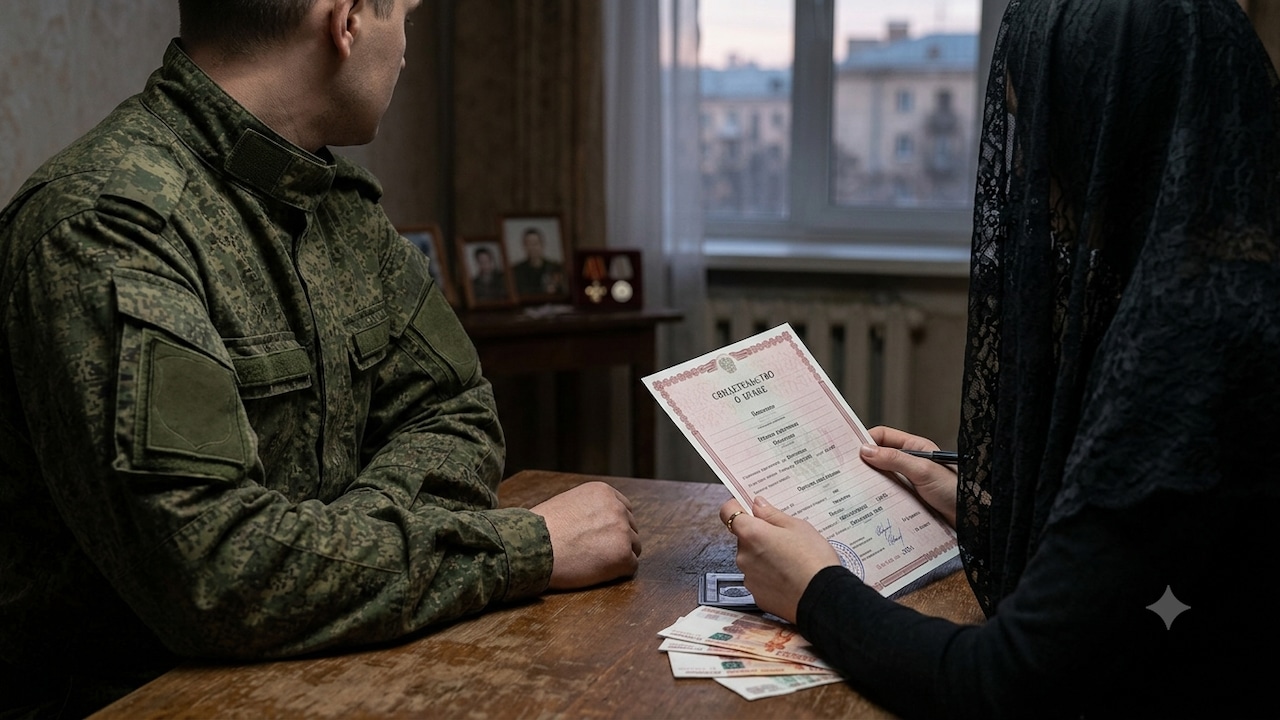
When the Russian state decided to place an astronomical financial price tag on human life, it inadvertently built an entirely new underground market. As cumulative payouts for soldiers killed in action reach millions of rubles—sums representing generations of labor in economically depressed provinces—a macabre subculture has taken root.
Media outlets and independent researchers have increasingly documented the rise of so-called "black widows" and flash marriages. These are opportunistic unions where individuals enter into hasty matrimony with front-line recruits moments before deployment, purely to claim life insurance and state compensation packages if the soldier dies. This phenomenon exposes a profound moral decay, demonstrating how sweeping economic desperation can distort interpersonal relationships into cold-blooded financial transactions.
To understand how a society reaches this juncture, one must look closely at the structural mechanics of Russia's mobilization apparatus.
The Arithmetic of State Compensation
For decades, vast stretches of the Russian interior have suffered from chronic underdevelopment, meager wages, and scarce career prospects. Into this vacuum stepped the Ministry of Defense, offering military contracts featuring signing bonuses and subsequent compensation packages that dwarf local earning potential.
If a contract soldier dies in combat, the combined federal and regional payouts, alongside insurance settlements, can total up to fifteen million rubles or more. In towns where the average annual salary struggles to clear the equivalent of a few thousand dollars, this lump sum represents generational wealth. It buys apartments, clears crippling debt, and purchases luxury vehicles.
Naturally, this monetization of mortality triggered unexpected legal and social behaviors. When a state values a soldier's death at a level equivalent to fifty years of local labor, it creates an aggressive financial incentive structure.
Anatomy of the Marriage Hustle
The mechanics of these fraudulent marriages are as pragmatic as they are cynical. Often orchestrated with the help of corrupt local fixers, notaries, or military personnel, the schemes follow a predictable pattern.
Recruits about to ship out to the front lines are targeted through social media or local acquaintances. In some documented cases, military officials or intermediaries have helped facilitate paperwork for swift registry office marriages. Once the union is legally certified, the newly minted spouse holds formal priority over aging parents, siblings, or biological children when navigating the bureaucratic labyrinth of state payouts.
Consider a hypothetical scenario reflecting these documented court cases: A man from an economically depressed region signs a front-line contract. He marries an acquaintance of convenience shortly before boarding a transport truck. Weeks later, casualty reports are updated. The wife, despite having known the deceased for barely a fortnight, walks away with the entirety of the state insurance fund, locking out the soldier’s surviving family members who must then wage bitter, protracted battles in local courts.
Courts across various regions are now bogged down with civil suits filed by grieving mothers contesting the legitimacy of these lightning-fast marriages. Prosecutors have charged various rings involving brokers, corrupt registrars, and opportunistic partners who split the spoils of war compensation. Yet, judicial intervention remains a lagging indicator in a system moving too fast to police itself effectively.
The Broader Moral Decay
The public reaction within Russia ranges from grim resignation to open outrage. Patriotic bloggers and state-aligned commentators frequently lambost these schemes, pointing to them as evidence of civic rot. Real estate agents and influencers have occasionally sparked severe backlashes by openly joking about using front-line casualty payouts to acquire property.
Yet, the outrage misses the forest for the trees. These scams do not exist in a vacuum. They are the direct symptom of a political economy that treats human lives as expendable commodities, offset by cash transfers designed to keep public dissent at bay. When survival is commodified, human connection inevitably becomes a target for exploitation.
The state relies on these financial incentives to maintain troop levels without resorting to an immensely unpopular general mobilization. In doing so, it has fostered an environment where the ultimate tragedy of war is viewed by predatory actors not as a human catastrophe, but as an opportunity for upward mobility.
As long as the state maintains this fiscal structure, the underground economy surrounding combat casualties will persist. Courts will continue to sort through fraudulent marriage certificates, families will tear themselves apart over death certificates, and the grim ledger of the war will keep expanding to account for the predators operating safely behind the front lines.
The true cost of the conflict cannot be measured solely by territorial gains or battlefield losses, but by the fundamental erosion of social trust, where every wedding certificate carries the shadow of a calculation, and death itself has been successfully integrated into the national marketplace.
A Vile Scam? Russian Women Dubbed 'Black Widows' Marry For War Death Payouts
This video examines the emergence of fraudulent marriages targeting front-line soldiers for state compensation packages.