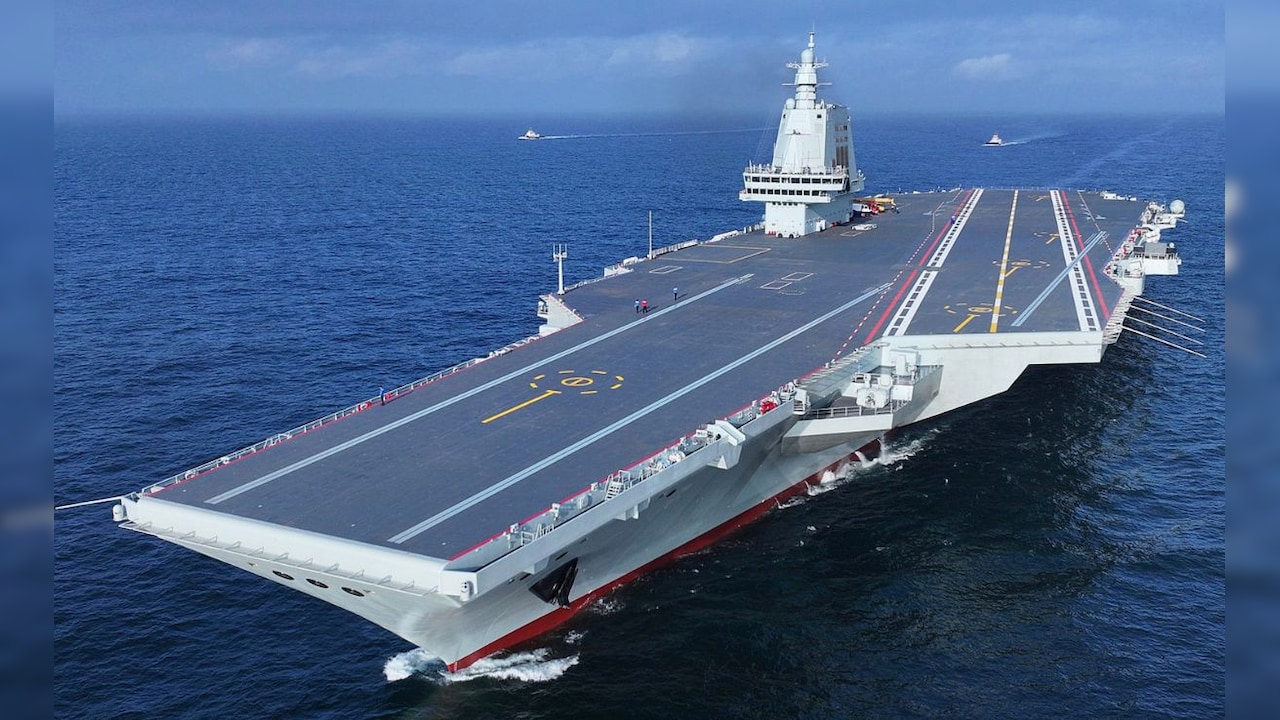
China has finalized the tactical framework for its carrier-based naval aviation, presenting New Delhi with an unprecedented maritime challenge in the Indian Ocean. In May 2026, China’s Ministry of National Defense formally acknowledged the deployment of what military planners call the carrier five-piece set. This is not a vague modernization goal; it is a fully realized operational doctrine centered around the newly commissioned supercarrier, the Fujian. The air wing integrates fifth-generation stealth fighters, heavy multirole strike aircraft, dedicated electronic warfare platforms, fixed-wing airborne early warning assets, and anti-submarine helicopters into a cohesive combat system.
For India, the strategic calculus in the Bay of Bengal and the Arabian Sea has changed permanently. The traditional view that the People’s Liberation Army Navy (PLAN) is constrained by geography no longer holds weight. By mastering the complex orchestration of specialized carrier aircraft, Beijing is building the capacity to project sustained, high-intensity airpower directly into India's maritime backyard.
Anatomy of the Five Piece Fleet
The core of Beijing's naval expansion lies in abandoning the outdated practice of using aircraft carriers merely as mobile runways for defensive fighters. The PLAN now replicates, and in some areas seeks to outpace, the comprehensive air wing architecture perfected by the United States Navy.
The system relies on five distinct components engineered to operate as a unified network:
- The Stealth Spearhead (J-35): This fifth-generation carrier-borne fighter has moved rapidly into serial production. Satellite imagery confirmed dozens of airframes leaving the Shenyang Aircraft Corporation facility, which recently underwent a massive $1.2 billion expansion. The J-35 provides the fleet with low-observable penetration capabilities, designed to counter modern air defense networks and challenge adversary air superiority.
- The Heavy Multirole Workhorse (J-15T): Optimized for catapult assistance, the J-15T handles the heavy lifting. Unlike older variants restricted by ski-jump ramps, this heavy fighter can take off with full fuel tanks and a maximum weapons payload, enabling long-range maritime strike and saturation attack missions.
- The Airborne Command Center (KJ-600): A twin-propeller early warning aircraft featuring a large active electronically scanned array (AESA) radar. The KJ-600 multiplies the strike group’s radar horizon by hundreds of miles, detecting low-flying cruise missiles and coordinating complex intercept missions far beyond the line of sight of surface ships.
- The Airborne Jammer (J-15D): A twin-seat electronic warfare platform similar to the American EA-18G Growler. Equipped with heavy wingtip pods and conformal antennas, it blinds enemy radars, disrupts communications, and fires anti-radiation missiles to suppress hostile air defenses.
- The Submarine Hunter: Dedicated carrier-based anti-submarine warfare (ASW) helicopters that form the final defensive layer, protecting the capital ship from the quiet diesel-electric and nuclear submarines that patrol the Indo-Pacific.
The Catapult Advantage
The linchpin of this entire apparatus is the Fujian, China's Type 003 aircraft carrier. Unlike its predecessors, the Liaoning and Shandong, which utilize restrictive short take-off but arrested recovery (STOBAR) ski-jumps, the Fujian employs an electromagnetic aircraft launch system (EMALS).
The physics of naval aviation dictate that a plane taking off via a ski-jump must be light. To get airborne without mechanical assistance, it must sacrifice fuel, ammunition, or both. This operational limitation has historically crippled Chinese carrier operations, reducing their jets to short-range defensive interceptors.
The transition to a catapult-assisted take-off but arrested recovery (CATOBAR) system changes everything. EMALS uses linear induction motors to accelerate heavy aircraft down the deck smoothly. This allows the heavy J-15T to carry anti-ship cruise missiles at maximum operational weight. More importantly, it allows the heavy, slow-moving KJ-600 early warning plane to take off from a ship for the first time in Chinese naval history. A carrier without a fixed-wing early warning aircraft is effectively blind to low-altitude threats; a carrier with one can dictate the terms of engagement across thousands of square miles of ocean.
The Asymmetric Challenge to New Delhi
India’s naval strategy has long relied on the assumption that the Indian Ocean remains a sanctuary protected by geography. The Indian Navy possesses significant institutional experience in operating aircraft carriers, spanning decades. However, its current operational fleet relies entirely on STOBAR platforms, specifically the INS Vikramaditya and the INS Vikrant.
While India's pilots are exceptionally well-trained, their Mig-29K fighters are constrained by the physical realities of the ski-jump. They cannot match the range, payload, or electronic sophistication of a Chinese CATOBAR strike group. Furthermore, India lacks a fixed-wing carrier-borne early warning aircraft, relying instead on rotary-wing assets like the Kamov-31, which offer significantly less altitude, endurance, and radar range.
The threat is not limited to the physical presence of Chinese carrier strike groups sailing through the Malacca Strait. The broader issue is industrial scale and technology transfer.
"With such a complex and massive new warplane production capability in place, Beijing gets to experiment with what its officials are now referring to as the new frontier of sea-based naval power".
This industrial capacity means China can produce these airframes at a volume that allows for rapid export variants. The looming crisis for India is the high probability that simplified, land-based or carrier-capable variants of these platforms—specifically the J-35—will be exported to Pakistan. This would effectively create a dual-front naval aviation challenge, squeezing India's western and eastern seaboards simultaneously.
Strategic Countermeasures
India cannot match China hull-for-hull or factory-for-factory. The economic disparity makes an industrial race unfeasible. To counter the arrival of the five-piece carrier set, New Delhi must pivot toward a mixed strategy of technological upgrades and asymmetric denial.
Accelerating the Twin Engine Deck Based Fighter
The indigenous Twin Engine Deck Based Fighter (TEDBF) program must be treated with absolute fiscal urgency. Relying on foreign acquisitions is a stopgap measure that leaves India vulnerable to supply chain disruptions. The TEDBF needs to incorporate advanced sensor fusion and network-centric warfare capabilities to match the integrated system-of-systems approach demonstrated by the PLAN.
Leveraging Land-Based Maritime Strike
India enjoys a massive unsinkable aircraft carrier: the Andaman and Nicobar Islands. By heavily fortifying these islands with long-range anti-ship missile batteries, advanced drone squadrons, and land-based maritime strike aircraft like the Jaguar IM and Su-30MKI, India can seal the choke points leading into the Indian Ocean. A Chinese carrier strike group cannot easily operate in waters constantly monitored and targeted by land-based assets.
Expanding the Submarine Fleet
The ultimate counter to a massive surface fleet is a quiet, lethal undersea force. India must overcome the bureaucratic inertia plaguing its submarine acquisition programs. Project 75Alpha, aimed at building indigenous nuclear-powered attack submarines (SSNs), must be accelerated. A single nuclear submarine shadowing a carrier strike group imposes a massive operational tax on the adversary, forcing them to dedicate immense resources to self-defense rather than offensive operations.
The operationalization of the five-piece carrier set proves that China has completed its experimental phase of naval aviation. They are now producing a standardized, highly lethal maritime air wing designed for power projection. If India fails to modernize its naval architecture and capitalize on its geographical advantages immediately, the Indian Ocean will cease to be an Indian sanctuary.