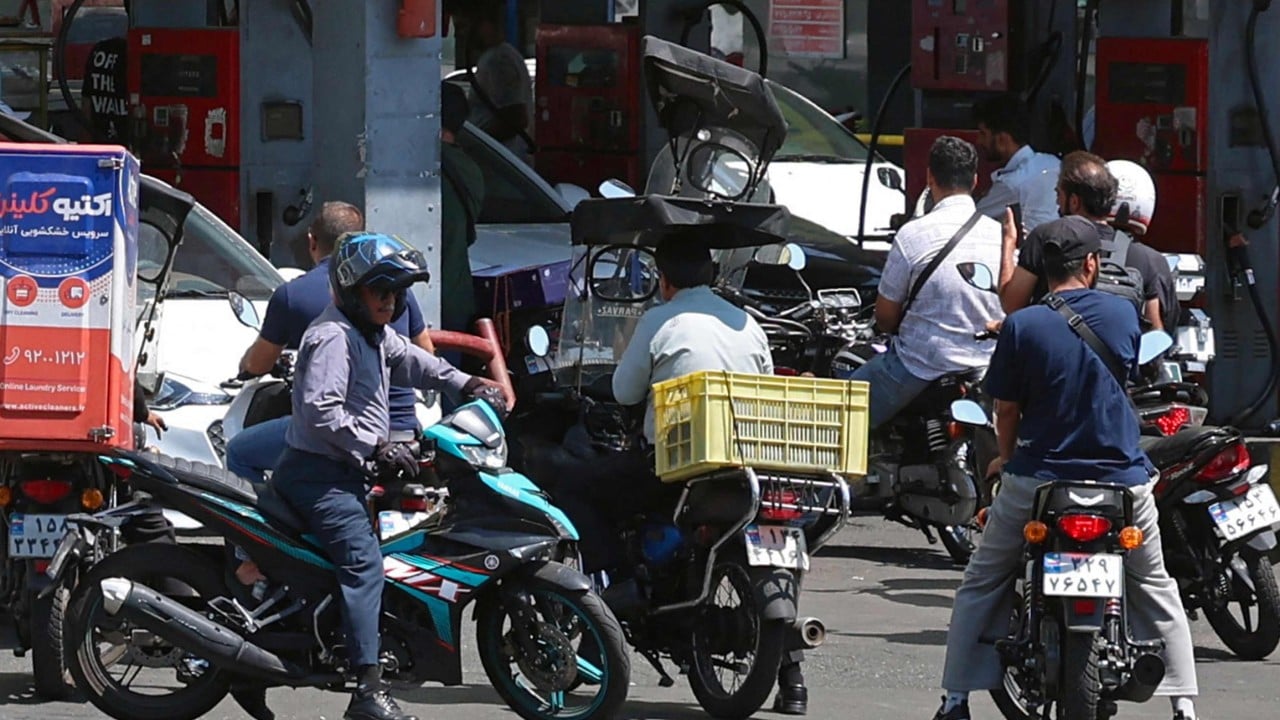
Long queues wrapping around city blocks in Tehran are not merely the byproduct of logistical gridlock; they are the physical manifestation of an economy being systematically squeezed from the outside while fracturing from within. When the United States Treasury announced an aggressive expansion of secondary sanctions and an enforcement of naval blockades, the immediate casualty was not military command infrastructure, but the civilian fuel pump. Motorists across the Iranian capital now spend hours idling in the summer heat, caught in a compounding panic-buying loop born of currency collapse, impending subsidy cuts, and a crippling domestic refining deficit.
Understanding why Tehran is choking on its own crude requires looking past the superficial irony of a major oil-producing nation running short on petrol. Iran's domestic energy dilemma is a structural trap decades in the making, worsened by targeted military strikes on refining capacity and a strict naval embargo that prevents adequate fuel imports. The state-backed Energy Optimisation Organisation estimates a daily deficit running in the tens of millions of liters against a backdrop of surging consumption. Yet, the lines at the stations are driven as much by psychology as they are by physics.
The Arithmetic of Exhaustion
The rial has plunged to historic lows against the dollar, trading past the two-million mark. Year-on-year inflation hovers near catastrophic levels, turning basic survival into a daily calculation of scarcity.
For the average citizen, a full tank of gas is a perishable asset. Drivers know that whatever is subsidized today may be re-priced or rationed tomorrow.
Consider a hypothetical scenario reflecting daily reality in districts like southern Tehran: a rideshare driver earning a depreciating local wage watches half their daily income vanish into a two-hour wait at a petrol station, only to be capped at a twenty-liter limit. That driver is not reacting to abstract geopolitical theories. They are reacting to the raw math of replacement costs. When a government hints at structural pricing reforms to manage its fiscal hemorrhage, the public hears an impending price shock. Panic ensues, filling stations run dry, and the state is forced to distribute record volumes of fuel that still fail to quench the artificial thirst created by uncertainty.
The Subsidy Paradox
Iranian leadership faces a cruel policy labyrinth. For years, the state maintained social stability by offering some of the cheapest heavily subsidized fuel on Earth.
It drained national resources. President Masoud Pezeshkian's administration has openly questioned the logic of purchasing refined products at high market rates only to dispense them domestically for pennies.
Yet, untying this Gordian knot carries immense political peril. Past attempts to alter fuel pricing overnight triggered explosive, widespread unrest. The state remembers 2019 vividly. Consequently, authorities find themselves paralyzed between two dangerous alternatives. Raising prices risks igniting popular fury among a populace already battered by inflation. Maintaining the status quo drains the treasury, accelerates black-market smuggling across porous borders, and guarantees chronic supply shortages.
Washington's strategy relies on weaponizing this exact structural vulnerability. By tightening financial isolation and targeting trade lifelines, external architects of the embargo hope to induce enough domestic pressure to force political capitulation.
Resilience and Its Breaking Point
Sanctions proponents often model target economies as machines with clean on-off switches. Reality is far messier.
Economic coercion rarely triggers immediate regime collapse; instead, it erodes the middle class, vaporizes savings, and forces ordinary people into informal survival economies. Shelves in grocery stores may remain stocked, but the purchasing power required to clear those shelves has evaporated for millions.
The resilience of the Iranian public has absorbed wave after wave of external shock, but resilience is finite. When the cost of basic transit, food, and energy outpaces the capacity of wage earners to adapt, the margin for error disappears entirely. The queues at the petrol stations of Tehran are a warning indicator of an ecosystem operating dangerously past its design limits, ticking quietly toward an unpredictable threshold