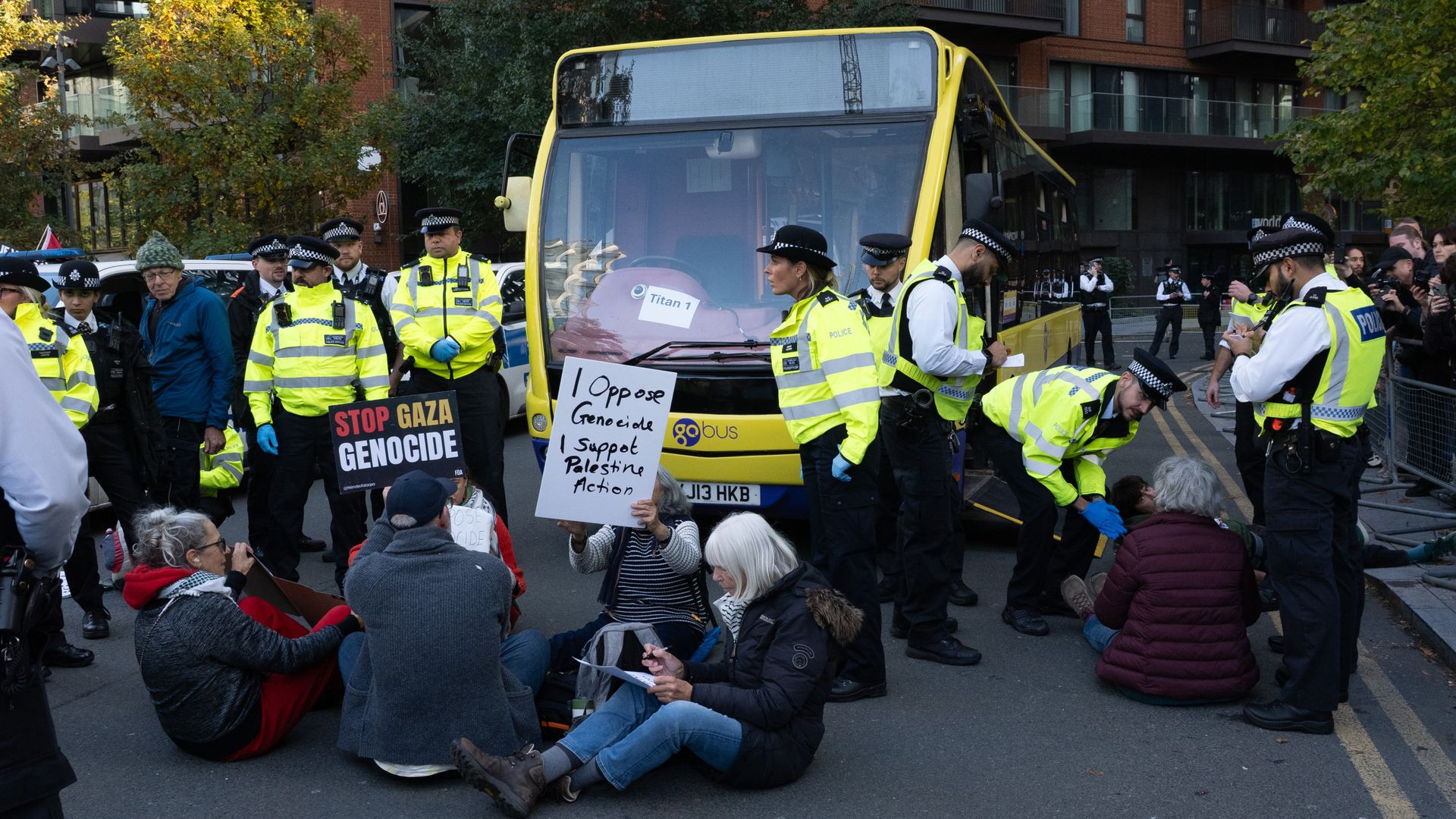
When police arrested 139 people during a single Palestine Action demonstration in central London, the headlines treated it like just another weekend clash on the streets. They missed the real story. Those 139 arrests were not a spontaneous breakdown in public order, nor were they merely a routine policing operation—they were the predictable collision of a decentralized direct-action network with some of the strictest public order legislation Britain has enacted in decades.
To understand how a protest ends with well over a hundred people in handcuffs, you have to look beyond the placards and the police kettles. You have to examine the legal machinery quietly assembled in Westminster over the past few years, the specific tactical playbook Palestine Action uses to force economic and political disruption, and the mounting strain on a Metropolitan Police force caught between political pressure and operational reality.
The Anatomy of a Mass Arrest Operation
Standard protests follow a script. Organizers negotiate a route with police liaisons, stewards keep marchers moving along designated avenues, and the day concludes with speeches at a predetermined rally point. Palestine Action does not play by that script.
Founded in 2020 with the explicit goal of shutting down the UK operations of Elbit Systems—an Israel-based defense contractor—the group rejects traditional lobbying and symbolic marches. Their model is direct action: occupations, blockades, red paint, and targeted disruption aimed at supply chains, financial backers, and public institutions linked to arms manufacturing.
When a network built around unannounced disruption converges on a major capital, traditional policing strategies fall apart. You cannot negotiate a route with a decentralized group whose core tactic relies on surprise. Police commanders respond by shifting from facilitation to containment.
In operations resulting in mass arrests like the 139 detentions, officers rely heavily on pre-emptive and containment tactics. Rather than waiting for property damage to occur, commanders deploy specialist public order units—often dressed in protective gear rather than standard patrol uniforms—to isolate crowds early. Once a perimeter is established, arrests escalate rapidly under broad statutory powers covering obstruction of the highway, breach of the peace, and conspiracy to cause criminal damage.
The sheer number of arrests tells its own story. Processing 139 detainees requires dozens of police vans, coordinated custody suites across multiple boroughs, and hundreds of officer hours spent on paperwork rather than street patrol. Police do not commit that level of logistical bandwidth lightly. It signals a deliberate command decision to clear the streets completely rather than manage a prolonged standoff.
The Legal Architecture Behind the Handcuffs
Five years ago, a protest of similar size and intensity would likely have resulted in a fraction of those arrests. The difference is not necessarily the behavior of the protesters—it is the law beneath their feet.
Two major pieces of legislation have fundamentally altered the boundaries of legal dissent in the United Kingdom: the Police, Crime, Sentencing and Courts Act 2022 and the Public Order Act 2023. Together, they handed law enforcement sweeping discretionary powers that would have been unthinkable a generation ago.
Consider the practical effect of these laws on the ground during a Palestine Action demonstration:
- Lowering the threshold for serious disruption: Police no longer need to prove that a protest is causing severe, prolonged chaos. Under the updated framework, even minor delays to traffic or routine business operations can trigger legal intervention.
- Locking-on offenses: The Public Order Act 2023 criminalized "locking on"—attaching oneself to another person, an object, or land—along with simply carrying equipment that could be used for that purpose. A bike lock or a tube of superglue in a backpack is now enough to justify an arrest before any disruption even happens.
- Serious Disruption Prevention Orders (SDPOs): Courts can now impose preventative restrictions on individuals with a history of protest-related offenses, effectively banning them from attending demonstrations, associating with certain activists, or even using the internet to organize.
When you combine these statutes, the legal margin for error shrinks to almost zero. A protester sitting in a roadway or blocking an entrance is no longer committing a minor civil infraction that police might tolerate for a few hours to let tensions cool. They are committing an arrestable offense the moment they sit down.
Why Conspiracy Charges Are Changing the Game
Beyond street-level public order offenses, prosecutors have increasingly reached for heavier tools. In recent years, activists affiliated with Palestine Action have faced charges of conspiracy to commit criminal damage and aggravated trespass, alongside attempts by prosecutors to invoke counter-terrorism powers during investigations.
Conspiracy charges carry far stiffer sentences than simple trespass or obstruction. More importantly for law enforcement, they allow police to cast a wider net. Under conspiracy law, a person does not need to swing a hammer or spray paint a wall to be arrested; providing logistical support, driving a vehicle, or participating in planning chats can be enough to bring charges.
For civil liberties lawyers, this represents a dangerous blurring of lines. Direct action, even when it involves property damage, has a long and complicated history in British political life—from the suffragettes smashing shop windows to anti-war activists disarming fighter jets at airbases. Treating coordinated civil disobedience through the lens of serious organized crime changes the stakes for everyone who steps onto the street.
Inside the Palestine Action Playbook
To dismiss Palestine Action as a disorganized fringe group is a mistake. Their operational model is disciplined, repeatable, and specifically designed to exploit vulnerabilities in corporate and state infrastructure.
Unlike broad coalition groups that organize massive Saturday marches through central London, Palestine Action operates through small, autonomous cells alongside larger solidarity mobilizations. When they call for a major action in the capital, the objective is rarely just to wave flags. It is to create a focal point that forces a response from authorities, media, and the targets of their campaign.
Their strategy rests on three core pillars:
- Targeting the supply chain, not just the factory: Early campaigns focused directly on Elbit Systems manufacturing sites in places like Oldham, Shenstone, and Bristol. Over time, the group expanded its target list to include landlords, insurance providers, logistics firms, and financial institutions—such as Barclays—that hold investments in or provide services to defense contractors.
- High-visibility symbolism: The use of blood-red paint is not random vandalism; it is visual shorthand engineered for social media feeds and front-page photographs. Even when police quickly arrest participants, the images achieve the group's primary communication goal.
- Absorbing the legal cost: Traditional protest groups try to avoid arrests to protect their members. Palestine Action builds arrest into its operational assumptions. Activists are trained in arrestee support, legal observers are embedded from the start, and court cases themselves are used as platforms to argue the morality and legality of UK arms exports.
This approach creates an asymmetric dilemma for authorities. If police stand back, protesters shut down buildings, disrupt commercial operations, and dominate the news cycle. If police move in aggressively and arrest 139 people, they risk handing the movement headlines about state repression and overwhelming their own custody and court systems.
The Policing Tightrope in London
Spare a thought for the senior officers running the command room during these operations. The Metropolitan Police is operating under intense, contradictory pressures from every direction.
On one side sits the UK government and vocal political commentators demanding "zero tolerance" for disruptive protests. Ministers have repeatedly urged police chiefs to use the full weight of their new statutory powers, framing direct-action groups not as political protesters, but as extremists undermining public order and economic security.
On the other side sits the reality of British policing by consent, the Human Rights Act, and a court system already buckling under historic backlogs.
Every mass arrest carries a hidden price tag. When 139 people are arrested in a single afternoon, the immediate crisis on the street ends, but a slow-motion crisis inside the justice system begins.
The Custody and Court Bottleneck
London does not have 139 empty cells waiting in a single building. Detainees from a mass arrest have to be transported across the city—sometimes as far out as outer-ring boroughs in Kent, Essex, or Surrey—splitting up police units and pulling officers off regular duties for entire shifts.
Once booked, each case requires evidence gathering: body-worn video footage must be reviewed, arresting officers must write detailed statements, and Crown Prosecution Service (CPS) lawyers must assess whether there is a realistic prospect of conviction.
Historically, a massive percentage of mass-arrest cases never result in convictions. Charges are dropped months later due to insufficient evidence, procedural errors during chaotic street arrests, or prosecutors deciding that pursuing minor obstruction charges is not in the public interest. In some cases, activists who do go to trial are acquitted by juries persuaded by arguments of necessity or proportionality—a trend that has frustrated prosecutors and prompted calls from some politicians to restrict jury defenses in protest trials.
The Gray Areas Nobody Wants to Admit
Public debate around protests like the one that saw 139 arrests tends to split into two rigid camps. One side sees dangerous lawbreakers holding the public hostage; the other sees heroic peace activists crushed by an authoritarian police state. Neither caricature holds up under scrutiny.
The truth sits in an uncomfortable middle ground that both sides prefer to ignore.
First, direct action is designed to be coercive. When activists blockade a building, occupy a roof, or disrupt transport links, they are not merely expressing an opinion—they are attempting to impose a cost on a target until it changes behavior. In a democratic society governed by the rule of law, the state has a legitimate obligation to protect public safety, prevent criminal damage, and ensure that ordinary citizens can move freely. Expecting police to ignore deliberate property damage or sustained blockades is unrealistic.
Second, the state's response has become wildly disproportionate. Sweeping up 139 people in a single operation inevitably sweeps up bystanders, legal observers, journalists, and peaceful demonstrators standing near the wrong cordon at the wrong time. Using broad conspiracy laws and preventative orders to neutralize political movements sets a precedent that will not stay confined to one cause. Powers created to stop Palestine Action or environmental groups like Just Stop Oil today can just as easily be turned against striking nurses, farmers, or anti-tax protesters tomorrow.
The Jury Nullification Factor
One of the most revealing undercurrents in recent UK protest trials has been the behavior of ordinary citizens sitting on juries. Despite strict judicial directions narrowing the legal defenses available to activists charged with criminal damage, British juries have repeatedly acquitted protesters—including members of Palestine Action—when presented with evidence of what the weapons manufactured at targeted sites are used for.
These acquittals highlight a widening gap between statutory law written in Westminster and public notions of justice. When the state tightens the screws through mass arrests and harsher charges, it often runs straight into the unpredictable wall of twelve ordinary citizens who refuse to convict.
What the Numbers Actually Signal
Look closely at the figure 139. It is large enough to dominate a news cycle, yet small enough to demonstrate that this was not a riot involving thousands of violent participants. It was a targeted confrontation between a committed network of activists and a state determined to draw a hard line.
The arrests also expose a deeper strategic stalemate. Years of arrests, injunctions, and factory closures have not stopped Palestine Action from organizing, nor have they fundamentally altered UK defense export policies. Meanwhile, the government's reliance on ever-more-restrictive public order laws has steadily eroded traditional protections for assembly and expression without actually delivering the quiet streets ministers promised.
If you want to know where British protest policing is heading, do not watch the speeches in Parliament. Watch the custody vans lined up outside central London stations after a demonstration, and check the court dockets twelve months later to see how many of those 139 arrests ever hold up before a judge.