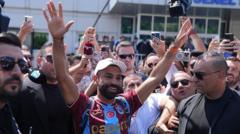
The scenes at the terminal were absolute pandemonium. Hundreds of supporters packed the transit halls, flares stained the air crimson, and the security perimeter collapsed within seconds as Mohamed Salah touched down to finalize a stunning transfer to Trabzonspor.
Let us clear the air immediately. This was not the Egyptian superstar Mohamed Salah of Liverpool fame. This was a completely different player sharing the exact same name, a lower-profile professional whose arrival in the Turkish Süper Lig triggered a viral social media storm built entirely on mistaken identity and algorithmic hunger.
For roughly two hours, digital platforms hummed with frantic speculation that one of the Premier League's most lethal goalscorers had orchestrated a shock exit from Anfield. Verified accounts jumped the gun. Aggregator pages farmed the engagement. By the time the dust settled and the actual identity of the winger became clear, the incident had morphed into a masterclass in modern sports media illiteracy.
We need to talk about how easily collective delusion takes root when a famous name collides with a desperate need for viral content.
The Anatomy of a Digital Mirage
Modern football reporting operates on a knife-edge between verified journalism and speed-driven speculation. When a video surfaces showing airport chaos, packed arrival gates, and a scarf-wielding athlete thrusting his fists into the air, context is the first casualty.
Algorithms reward velocity over accuracy. If a post contains keywords like Mohamed Salah, airport mob, and transfer move, the recommendation engines amplify it before human editorial oversight can intervene. The Turkish club Trabzonspor did not hide the signing; they announced a player named Mohamed Salah, a modest acquisition designed to bolster their squad depth rather than shatter global transfer records.
Yet, the digital ecosystem craved the bigger narrative. Fans scrolling through their feeds saw only the flashing lights, heard the roar of the crowd, and mapped their own expectations onto grainy mobile phone footage.
- The Trigger: A routine club reinforcement arrival filmed from a low angle to maximize dramatic effect.
- The Catalyst: Automated news bots and click-hungry fan channels stripping away the player's middle or first names to maximize search impressions.
- The Amplification: Millions of users sharing the clip without clicking the source link, treating a local sports event as a global blockbuster.
This is not a harmless misunderstanding. It is a symptom of an information economy that values the sensation of breaking news far more than the reality of it.
Why Trabzonspor Fits the Chaos
To understand why this specific airport frenzy felt believable to the casual observer, you have to look at the unique pressure cooker of Turkish football culture. Fan bases in Istanbul, Trabzon, and Ankara treat club arrivals with the ceremonial gravity usually reserved for heads of state.
When a foreign player lands at Atatürk or Trabzon Airport, the supporters do not just show up. They mobilize. They bring pyrotechnics, drum corps, and banners. They turn baggage claim zones into amphitheaters.
If you drop an unfamiliar athlete into that hyper-charged environment while sporting a famous moniker, the local energy naturally scales up. The supporters gathered at the terminal were genuinely excited for their new signing. They were chanting for their team, waving club flags, and welcoming a professional to their ranks.
The disconnect occurred entirely online. International followers watching compressed video snippets on social media projected the Liverpool context onto a Süper Lig reality. They assumed the smoke bombs and shoulder-carried celebrations meant only one thing. They forgot that in Turkish football, this level of theatrical reception happens multiple times every transfer window for players who have never kicked a ball in the Champions League.
The Cost of Speed Over Substance
We have built a media landscape that punishes caution. If a journalist or an outlet waits twenty minutes to verify passport numbers, club registration documents, and birth dates, they lose the traffic race.
Consequently, reputable outlets increasingly find themselves chasing accounts run by teenagers sitting in their bedrooms who care nothing about journalistic ethics. When those accounts post a misleading video, mainstream feeds feel compelled to address it, inadvertently spreading the oxygen of attention to a falsehood.
Consider the aftermath. Once the truth emerged—that this was a completely different Mohamed Salah plying his trade away from the European elite—the internet simply shrugged and moved on to the next shiny distraction. No retractions carried the weight of the initial panic. No algorithms adjusted to penalize the accounts that manufactured the frenzy.
The player himself, meanwhile, arrived at his new employer under an absurd shadow. Instead of focusing on his tactical fit, his fitness levels, or his personal ambitions for the upcoming season, his first week as a Trabzonspor player was defined by him not being someone else.
Breaking the Cycle of Algorithmic Panic
Fixing this requires a conscious rejection of instantaneous reaction culture. It demands that consumers of sports media pause before mashing the repost button.
Ask yourself three basic questions the next time a breaking video crosses your screen:
- Which specific tier-one journalist or official club channel has verified this?
- Does the visual evidence match the extraordinary claims being made in the caption?
- What does the publisher stand to gain by framing this event in the most sensational way possible?
If those questions yield vague answers, the story is likely a ghost.
The Trabzonspor airport mob was real enough. The flares burned hot, the chants echoed off the concrete pillars, and the new signing experienced the fierce, beautiful intensity of Turkish football fandom firsthand. But the narrative attached to him was a phantom, conjured out of thin air by a public that consumes names rather than sports.
Until we learn to look past the marquee letters and examine the fine print, we will continue to mob airports for ghosts.