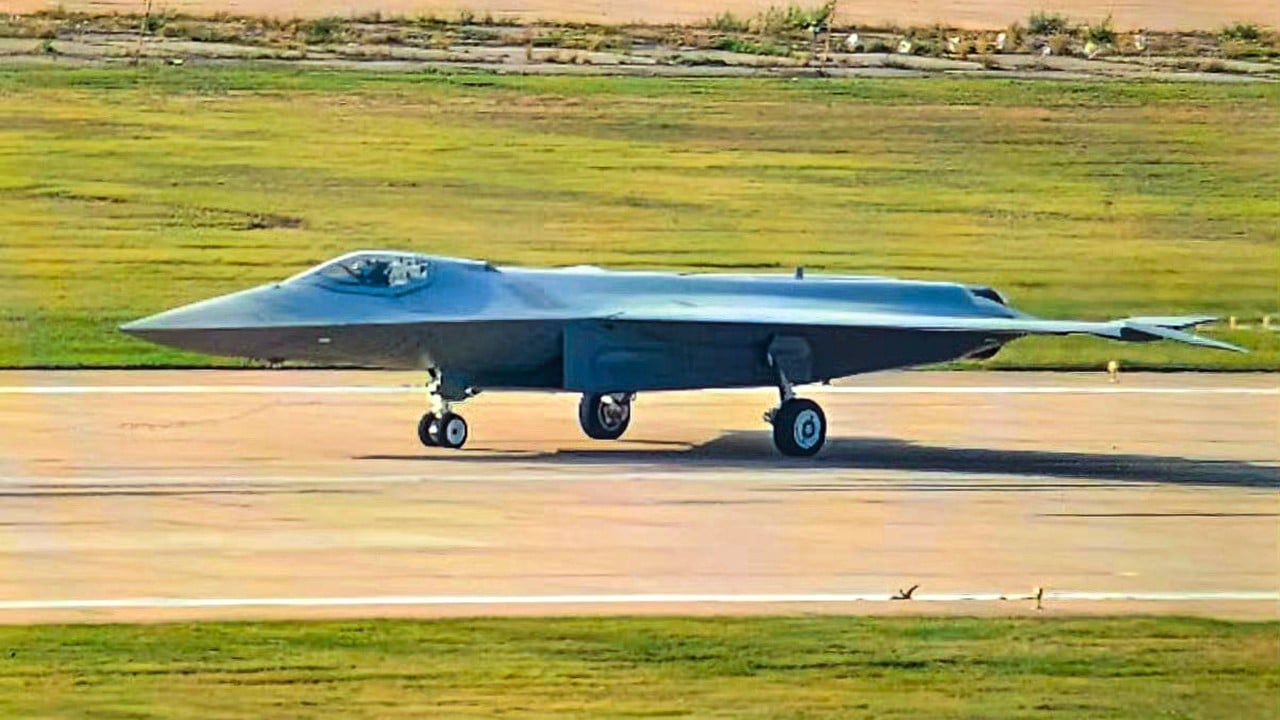
Military aviation reporting often operates on a diet of glossy press releases and state-sanctioned leaks. When whispers emerge about fifth-generation or sixth-generation platforms like China's J-50 design concepts, defense journalists frequently rush to parrot claims of radical propulsion breakthroughs and impossible thermal management metrics. That approach misses the entire point of modern aerospace competition. The real story does not reside in the marketing bullet points of thrust-to-weight ratios or speculative radar cross-section reductions. It lies in the grueling, unglamorous physics of thermal bleed, computational power scaling, and the manufacturing tolerances required to build an airframe that can survive modern integrated air defense systems.
Understanding the trajectory of China's next-generation military aviation requires peeling back layers of official rhetoric to examine the actual constraints of materials science. Aerospace engineering is an exercise in brutal compromise. Every design choice is a war against weight, heat, and drag. When engineers push for sensor fusion architectures that process petabytes of data per second, they generate an enormous internal thermal load. Managing that heat without opening infrared windows to enemy sensors remains the defining engineering bottleneck of this decade.
The Thermal Signature Dilemma
Stealth was once primarily about shaping airframes to scatter X-band radar waves. Those days are gone. Modern multi-spectral sensors detect aircraft through infrared search and track systems, ultraviolet missile warning receivers, and low-frequency VHF radar arrays that ignore traditional radar-absorbent materials.
The J-50 conceptual architecture, much like contemporary Western programs, attempts to solve this via embedded cooling loops and advanced composite skins that bleed heat into fuel or structural members. Yet, thermodynamics remains unforgiving.
- Internal Bay Heat Sinks: Pushing avionics heat into internal fuel tanks works until the fuel itself reaches flashpoint limits during supersonic dash phases.
- Conformal Antennas: Embedding radar arrays across curved fuselage surfaces creates massive computational cooling demands that standard heat exchangers cannot handle.
- Infrared Suppression Exhausts: Chevron nozzles and serpent-shaped ducts reduce rear-aspect thermal signatures, but they extract a heavy toll on engine thrust efficiency.
These friction points are rarely discussed in basic defense commentary. A fighter jet is not just a flying wing with a clever paint job. It is a flying thermodynamic crisis. If the cooling architecture fails, the avionics throttle back to prevent meltdowns, turning a multi-million-dollar apex predator into a blind target.
Manufacturing Realities Behind the Renderings
Computer-aided design files are frictionless. Real titanium and ceramic matrix composites are stubbornly difficult to machine. Reports suggesting rapid prototyping and deployment of leapfrog combat aircraft often ignore the brutal reality of tooling and metallurgy.
Building a low-observable airframe demands sub-millimeter tolerances across vast surface areas. If a maintenance crew patches a skin panel and leaves a micro-step edge of half a millimeter, that seam lights up on a modern high-frequency radar like a neon sign.
China has invested heavily in large-scale laser powder bed fusion and automated fiber placement machines to build complex structural components in single pieces, reducing fastener counts and radar reflection points. Even so, yield rates for large structural titanium castings remain notoriously volatile.
A brilliant design concept on a server in Chengdu or Beijing means nothing if the foundry can only produce three defect-free fuselage bulkheads out of twenty attempts.
The bottleneck has shifted from design capability to industrial execution. Western analysts often assume that infinite state funding translates to infinite manufacturing perfection. History demonstrates otherwise. The Soviet Union possessed brilliant aerodynamicists yet struggled perpetually with turbine blade metallurgy and avionics reliability. Modern Chinese defense industries have largely closed that historical gap, but mastering high-temperature single-crystal turbine blades and ceramic matrix composites remains a punishing trial-and-error discipline.
The Software Integration Trap
Hardware gets the attention, but software dictates survival. A next-generation fighter is essentially a flying data center governed by millions of lines of proprietary code.
Integrating radar data, electronic warfare inputs, optical targeting, and datalinks into a single coherent picture for the pilot requires an operating system with zero latency and absolute fault tolerance. When a pilot pushes the throttle forward in a high-threat environment, they cannot afford a blue screen of death or a lagging sensor fusion loop.
- Distributed Processing: Shifting away from central mission computers toward edge-computing nodes embedded directly inside sensor modules.
- Autonomous Wingman Control: Managing unmanned loyal wingman drones via encrypted directional data links without exposing the lead aircraft's position through RF emissions.
- Cognitive Electronic Warfare: Systems that dynamically rewrite jamming waveforms in real-time based on enemy radar adaptation.
Developing this code base requires massive simulation farms and thousands of flight-test hours. More importantly, it requires a feedback loop between operational pilots and software engineers that can translate tactical reality into clean, executable algorithms. The race for air superiority is now a software compilation race disguised as an aviation contest.
Geopolitical Implications of Industrial Scaling
The debate over whether a specific design concept represents a generational leap obscures a wider strategic reality. Air superiority in a protracted conflict is an attrition game.
An exquisite aircraft that requires six months of depot-level maintenance for every ten hours of flight time is a strategic liability, regardless of how invisible it is to radar. True combat power relies on maintainability, parts commonality, and the ability to surge production when attrition bites.
As research laboratories refine these advanced concepts, the defining metric of success will not be the sleekness of the initial wind-tunnel model. It will be the boring, unsexy ability to mass-produce reliable powerplants, maintain complex cooling systems in austere forward operating bases, and keep software updated against rapidly evolving electronic attack vectors.
The next generation of aerial combat will not be decided by a single technological breakthrough. It will be won in the machine shops, the metallurgical labs, and the quiet server rooms where engineers solve the unglamorous physics of flight.