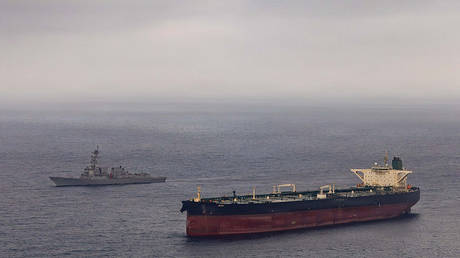
The United States military posture in the Middle East has hardened into a permanent state of latent confrontation, driven by overlapping naval deployments, persistent maritime blockades in the Strait of Hormuz, and tit-for-tat drone strikes involving Iranian forces and regional proxy groups. Beneath the surface calculations of carrier strike groups and early-warning radar arrays lies a much more dangerous reality: Washington and Tehran are trapped in an escalation cycle where deterrence fails because neither side can afford to show weakness, yet neither possesses a viable diplomatic off-ramp.
For months, the official line from the Pentagon has treated these force posture adjustments as defensive necessities. Yet, intelligence assessments and open-source tracking paint a picture of an operational theater primed for miscalculation. Task Force Iron Gate and the constant rotation of naval assets near the Persian Gulf are designed to squeeze Iran economically while keeping regional commerce moving. Instead, this rigid posture has incentivized asymmetric responses, from maritime harassment to long-range drone barrages targeting coalition facilities in Bahrain. You might also find this connected story insightful: The Broken Machinery of Peace Why the United Nations Still Survives Despite Itself.
To understand why this friction persists, one must look past the immediate tactical flashes and examine the structural deadlock.
The Mechanics of Perpetual Deterrence
Conventional military theory assumes that overwhelming force deters aggression. When the United States maintains multiple carrier strike groups within striking distance of the Iranian coastline, traditional deterrence logic dictates that Tehran should back down. That theory broke down years ago. As highlighted in detailed reports by Al Jazeera, the effects are notable.
Iran has adapted to maximum pressure by adopting a doctrine of decentralized attrition. Rather than engaging in symmetric naval battles it is guaranteed to lose, Tehran relies on fast-attack craft, sea mines, and localized aerial drones. These assets impose chronic economic anxiety on global energy markets without crossing the invisible threshold that would automatically trigger a full-scale conventional war.
Consider a hypothetical scenario to illustrate this friction: If a commercial tanker is struck near the Bab el-Mandeb Strait or the Strait of Hormuz, insurance rates spike globally within hours. The economic damage radiates outward to European and Asian markets instantly. Meanwhile, the military cost to Tehran for launching a low-cost drone is negligible compared to the multi-million-dollar interceptors expended by American warships to knock it out of the sky.
This asymmetry breaks the financial calculus of modern defense. Washington is spending vast resources to maintain a dominant footprint, while Tehran sustains a low-overhead campaign of disruption that keeps the entire region on edge.
The Diplomatic Vacuum
Diplomacy has ceased to function as a pressure relief valve. Direct channels have repeatedly stalled, replaced by public ultimatums and social media declarations. When political leadership discards formal mediation in favor of unyielding stances, military commanders on the ground inherit an impossible mandate. They must project absolute strength while managing the daily risk of an accidental escalation that could spiral out of control.
Regional partners add another layer of friction. Governments in the Persian Gulf find themselves caught between the physical reality of hosting foreign military infrastructure and the devastating consequences of becoming ground zero for retaliatory strikes. While some capitals quietly lobby for aggressive containment, others actively scramble to insulate themselves through bilateral security pacts and alternative diplomatic channels.
This divergence prevents a unified front. Washington tries to enforce an airtight blockade while regional capitals attempt to manage local de-escalation quietly behind the scenes. The resulting friction gives Tehran ample room to exploit the seams in the coalition's diplomatic architecture.
The Cost of Staying Put
The strategic reality is stark. Maintaining a massive force posture near Iran does not solve the underlying geopolitical crisis; it merely manages the symptoms at an unsustainable financial and operational cost. Ships wear out, crews face relentless operational tempos, and the margin for error narrows with every intercepted projectile.
As long as the political cost of a genuine compromise remains politically toxic in both capitals, the military instrument will remain the default tool of statecraft. But force without a political strategy is just spinning wheels in the sand, waiting for the inevitable spark.
The buildup continues, the patrols never stop, and the margin for error shrinks with every passing watch.


