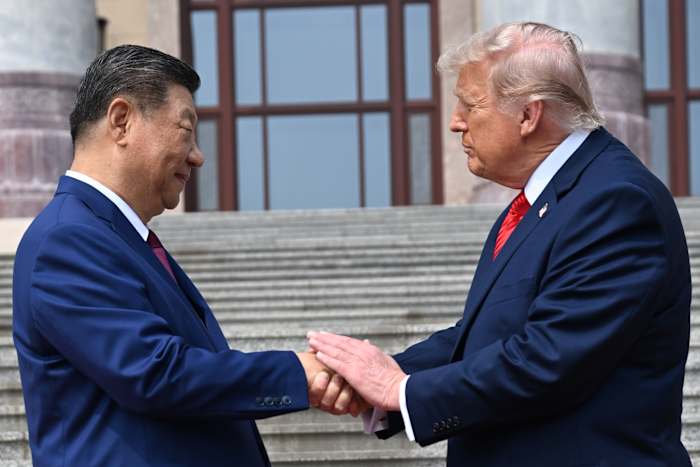
Donald Trump built a political empire by treating Beijing as an existential adversary, yet his posture toward Xi Jinping has shifted toward personal diplomacy and public accommodation. The core reason is straightforward. Raw confrontation without leverage produces domestic pain, while bilateral deals offer immediate political trophies that blunt criticism from export-heavy constituencies.
Washington observers love a clean story of ideological conversion. They want to believe either that Trump woke up to the costs of endless friction or that Xi finally cracked the code of flattery. Neither explanation survives contact with how power actually moves between the White House and Zhongnanhai. When a leader who spent years branding China as a serial cheater starts talking about chemistry, personal rapport, and grand bargains, the shift is rarely about affection. It is about arithmetic, timing, and the limits of unilateral pressure. Recently making news in this space: The Fracture Inside NATO How Fico is Weaponizing Article 5 Fears.
The Myth of Permanent Hostility
Politics rewards consistency until consistency stops paying dividends. During his first term, Trump treated tariffs as a multipurpose weapon—part punishment, part negotiating club, part theater for rallies in industrial towns. That approach worked remarkably well as a signal. It forced American corporations to talk seriously about supply chains and made Beijing nervous about unfiltered market access.
Yet tariffs also carry a stubborn mechanical flaw. They act like a tax collected at the border, and someone has to absorb the bill. Even when exporters shave margins or currencies wobble, importers, retailers, and consumers feel the friction. Over time, a permanent state of hostility turns into a recurring headache for any administration trying to keep prices calm and capital markets steady. Additional insights regarding the matter are covered by Associated Press.
Xi Jinping read that vulnerability early. Beijing has never viewed Washington’s mood swings as permanent law. Chinese statecraft treats American presidents as temporary custodians of a system that oscillates between hawkishness and dealmaking. When Trump signaled openness to direct leader-to-leader contact, Beijing did not waste time lecturing him about past rhetoric. Officials in Beijing focused on what Trump actually values in a counterpart: visible deference, tangible purchases, and the optics of a strongman negotiating directly with another strongman.
How Personal Diplomacy Replaces Institutional Friction
Traditional foreign policy relies on working groups, interagency reviews, and incremental communiqués. Diplomats love process because process lowers the odds of embarrassment. Trump treats process as a trap designed to slow him down and hand credit to career officials.
Rolling out a welcoming mat for Xi bypasses the slow machinery of state. A summit, a warm photo opportunity, or a carefully staged phone call compresses months of bureaucratic grinding into a single news cycle. For an executive accustomed to closing property deals or striking television arrangements, personal contact feels like cutting straight to the principal.
Xi’s system is built for exactly this kind of choreography. Unlike a U.S. president who has to manage Congress, courts, governors, and a fractious media ecosystem, Xi controls the agenda at home with near-total precision. When he decides to offer a concession—whether buying agricultural commodities, easing a specific regulatory bottleneck, or toning down state media commentary—he does not have to horse-trade with fifty senators first. That asymmetry makes bilateral negotiation look deceptively fast.
A summit looks like a breakthrough when both sides need a pause, even if neither side has resolved the underlying dispute.
Consider a hypothetical example to see how the mechanics work in practice. Suppose a U.S. administration faces pushback from farm states over stalled grain shipments while simultaneously worrying about industrial input costs. A working-level negotiation might drag on for a year over verification rules and enforcement mechanisms. A leader-level understanding, by contrast, can produce a headline pledge in days. The fine print stays ambiguous, yet the immediate political pressure eases.
Supply Chains Don't Care About Speeches
Talk of a red carpet alarms hawks who assume warmth equals surrender. That assumption misunderstands how deeply entangled the two economies remain despite years of decoupling rhetoric.
You can announce reshoring incentives in Washington and launch self-reliance campaigns in Beijing, and still wake up to find that critical components, active pharmaceutical ingredients, or specialized tooling move across Pacific shipping lanes. Decoupling is not flipping a light switch. It is rewiring a house while the power is still on.
American manufacturers have spent years diversifying—shifting assembly to Vietnam, Mexico, India, or Southeast Asia. Look closer at many of those alternate routes and you find Chinese sub-suppliers, Chinese machinery, or Chinese-owned factories operating under new flags. Beijing adapted to pressure by re-routing trade rather than surrendering its industrial base.
From the White House perspective, pretending that supply chains are already severed creates a dangerous blind spot. If an abrupt escalation triggers shortages in autos, electronics, or consumer goods, voters blame the incumbent sitting in the Oval Office, not a think tank report from five years ago. Managing friction with Xi is a way to keep the plumbing working while deeper structural adjustments grind along.
What Xi Actually Wants From the Thaw
Beijing’s willingness to play along with a softer tone is not charity. Xi faces his own set of domestic constraints: sluggish household confidence, local government debt overhangs, property sector drag, and intense scrutiny from foreign investors who want predictable rules.
A warmer atmosphere with Washington gives Xi three concrete advantages:
- Breathing room for the economy. Reducing the threat of sudden tariff spikes or broad financial restrictions helps Chinese exporters plan and reassures nervous domestic entrepreneurs.
- Status parity. Being treated as an equal co-architect of global stability elevates Xi’s standing at home, reinforcing the narrative that China sits at the top table regardless of Western lectures.
- Leverage over U.S. allies. When Washington signals a willingness to deal directly with Beijing, European and Asian capitals hesitate to run ahead with tough restrictions of their own.
Notice what is missing from Beijing’s playbook. Xi has shown little inclination to dismantle state subsidies, abandon industrial policy, or alter core security positions in exchange for goodwill. Accommodation on tone does not mean capitulation on structure.
The Trap Inside the Warm Welcome
Every rapprochement carries its own hazard. When Trump praises Xi or stages an unusually cordial reception, critics accuse him of going soft on an authoritarian rival. Supporters counter that tough talk was always meant to bring Beijing to the table, and now the table is set.
Both sides miss the sharper reality. Personal warmth between two leaders does not erase competing interests. It simply changes the venue where those interests collide.
In Washington, skepticism remains baked into Congress and the national security apparatus. Export controls on advanced semiconductors, scrutiny of outbound investment, and worries over intellectual property rarely disappear just because two leaders exchange pleasantries. A warm summit can easily be followed within weeks by a fresh regulatory salvo from an agency operating on a separate track.
In Beijing, officials treat cordiality as tactical cover. If Washington eases pressure, Beijing pockets the relief and keeps building domestic capacity in artificial intelligence, clean energy, and advanced manufacturing. If Washington pivots back to confrontation, Beijing reaches for retaliatory levers—rare earths, regulatory probes, or diplomatic freezes—calibrated to hurt specific American sectors.
Why the Pendulum Keeps Swinging
Anyone looking for a permanent truce between Trump and Xi is reading the wrong history. The relationship is defined by a push-pull cycle driven by domestic politics on both sides.
Trump’s instinct is transactional. When confrontation stops delivering clean wins, he looks for a deal. When a deal stalls or looks lopsided, he reaches back for tariffs and blunt rhetoric. Xi’s instinct is strategic patience. He welcomes relief when offered, resists demands that threaten Party control, and waits out shifts in American politics.
The red carpet rolled out for Xi is neither a betrayal of past principles nor a final settlement of a historic rivalry. It is a calculated pause by a president who knows that permanent warfare at the border carries a steep domestic price, meeting a ruler who knows how to turn a handshake into breathing room.


